Zero-Waste Kimono Construction: T-Shaped Tailoring Techniques in 2026
The Philosophy of the Tanmono: Zero-Waste Before It Was a Trend
In 2026, the global fashion industry is deeply entrenched in the zero-waste movement, with designers scrambling to eliminate textile offcuts. Yet, long before modern eco-conscious tailoring became a mainstream mandate, traditional Japanese artisans perfected the art of zero-waste pattern cutting through kimono construction. The kimono is a masterclass in geometric tailoring, utilizing every single thread of its foundational fabric bolt. For textile enthusiasts, historians, and modern patternmakers, understanding these garment construction techniques offers profound insights into structural engineering, drape manipulation, and sustainable design.
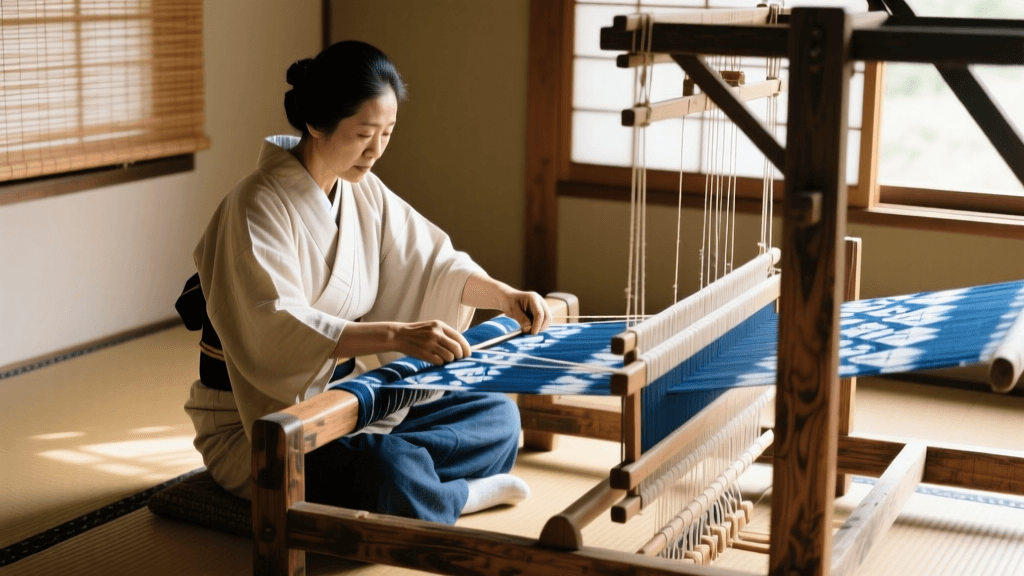
The foundation of this construction is the tanmono, a narrow, standardized bolt of fabric. Unlike Western textile manufacturing, which produces wide yardage meant to be cut into curved, irregular shapes (resulting in 15% to 20% fabric waste), the tanmono is woven specifically for a single garment. In 2026, a standard silk tanmono measures approximately 36 to 40 centimeters (14 to 16 inches) in width and 11.5 to 12 meters (about 38 to 39 feet) in length. This precise dimension dictates the entire architecture of the garment.
According to the Victoria and Albert Museum, the kimono's structure is inherently tied to the loom's width, meaning the garment is an extension of the weaving process itself. There is no negative space, no discarded scraps, and no curved armholes. The fabric is folded, layered, and sewn using entirely straight lines.
Deconstructing the T-Shape: Straight Seams and Structural Integrity
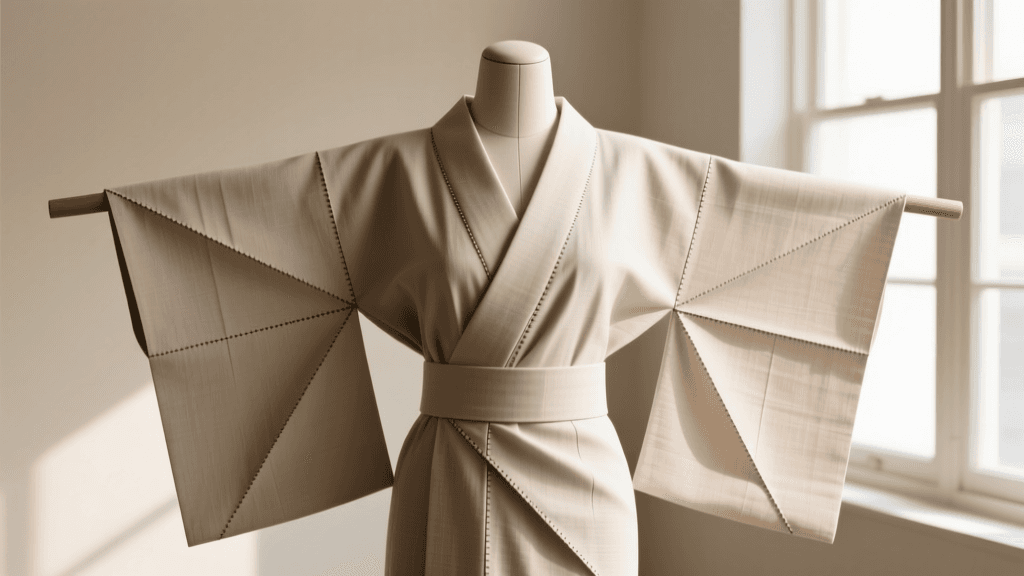
When laid flat on a table, an unlined kimono (hitoe) or lined kimono (awase) forms a perfect, symmetrical "T" shape. This T-shaped construction is achieved without the use of curved darts, princess seams, or set-in sleeves. Instead, the garment relies on the natural drape of the fabric and the strategic placement of straight seams to accommodate the human form.
The migoro (main body panels) and sode (sleeves) are cut in strict rectangular blocks. The shoulder line is not a seam but a fold (katayama), allowing the fabric to drape gracefully over the shoulders and down the back and front. This lack of a shoulder seam not only preserves the continuity of the fabric's surface design but also distributes the weight of heavy silk brocades evenly across the wearer's upper back.
The Metropolitan Museum of Art notes that this T-shape allows for infinite surface design, as the unbroken rectangular panels serve as a continuous canvas for dyeing and weaving techniques like yuzen and nishijin-ori. In 2026, contemporary sustainable fashion houses are heavily referencing this T-shaped geometry, adapting the straight-seam philosophy to create modular, zero-waste outerwear that mirrors the kimono's structural elegance.
The Core Components of Kimono Construction
To understand the engineering of the garment, one must look at its individual rectangular components. Below is a breakdown of the primary structural elements:
| Japanese Term | English Translation | Dimensions & Structural Function |
|---|---|---|
| Migoro | Main Body Panels | Two long rectangular panels forming the front and back. Cut to the wearer's height plus hem allowance. |
| Sode | Sleeves | Rectangular panels attached to the migoro. The bottom and outer edges are folded and sewn, creating the signature pouch (tamoto). |
| Okumi | Front Overlap Panels | Narrower vertical panels attached to the front migoro, providing the necessary width for the garment to wrap securely across the body. |
| Eri | Main Collar | A long, narrow strip folded in half lengthwise, running from the front hem, up the neck, and down to the back hem. |
| Tomoeri | Collar Cover | A protective, replaceable piece of fabric sewn over the back of the neck on the main collar to prevent soil and wear. |
The Eri (Collar) and Okumi (Front Panels): Engineering the Drape
While the T-shape provides the base, the true engineering marvel of the kimono lies in the eri (collar) and the okumi (front overlap). The okumi panels are cut from the same straight-grain fabric but are attached at a slight angle or manipulated via the wrapping process to create a secure, diagonal closure across the chest. This overlap is crucial; it provides the necessary circumference for the wearer to move comfortably while maintaining the strict, columnar silhouette prized in traditional Japanese aesthetics.
The eri is equally complex in its execution. It is not a rigid, interfaced collar like those found in Western shirting. Instead, it is a soft, bias-folded or straight-grain strip that is meticulously eased around the neckline. The tension of the collar is adjusted during the dressing process (kitsuke), allowing the wearer to control the depth of the neckline and the angle of the back drape (eri-nuki). Research from the Textile Research Centre highlights that this adjustable, non-rigid collar construction is a prime example of how traditional Asian garments prioritize wearer interaction and dynamic fit over static, pre-determined tailoring.
The Art of Arai-Hari: Deconstruction as a Construction Technique
One of the most remarkable aspects of kimono construction is that it is designed to be temporary. Traditional silk kimonos are rarely dry-cleaned in the modern Western sense. Instead, they undergo arai-hari, a process where the entire garment is completely deconstructed into its original rectangular tanmono panels.
These panels are then washed, stretched on bamboo frames (shinshi) to remove wrinkles and restore the fabric's tension, and finally resewn. This cyclical construction technique ensures that the garment can be cleaned thoroughly, resized for a new wearer, or repurposed entirely without ever cutting the fabric. In 2026, as the circular fashion economy demands garments that can be easily disassembled and recycled, the arai-hari philosophy is being studied by textile engineers as a blueprint for future modular clothing.
Adapting T-Shaped Construction for 2026 Sustainable Fashion
For modern sewists and designers looking to incorporate these techniques in 2026, the transition from Western curved patterns to Eastern geometric tailoring requires a shift in both mindset and tooling. Handling traditional silk chirimen (crepe) or heavy brocades demands precision.
Sourcing Authentic Materials and Tools in 2026
- Fabric Sourcing: As of early 2026, a high-quality, newly woven Nishijin-ori silk tanmono bolt costs between $600 and $1,500 on specialized Kyoto textile export platforms. However, vintage deadstock bolts from the mid-20th century remain highly accessible, often priced between $120 and $350, offering an eco-friendly entry point for zero-waste experimentation.
- Needle Selection: Modern sewists in 2026 utilize specialized microtex needles (size 60/8 or 70/10) to pierce tightly woven silk taffeta and crepe without causing micro-tears or snagging the delicate threads.
- Pressing Equipment: Traditional construction relies heavily on the kote (a specialized Japanese iron). Today, practitioners use digital temperature-controlled gravity-feed irons paired with silk organza press cloths to set the straight seams without flattening the three-dimensional texture of the crepe.
- Thread: While traditional silk thread (shozan-ito) is still used for basting, 2026 construction often incorporates ultra-fine, high-tenacity polyester threads for the main seams, providing the necessary tensile strength to support the weight of lined garments while remaining virtually invisible.
Conclusion
The construction of the traditional kimono is far more than a historical artifact; it is a living, breathing blueprint for sustainable, zero-waste design. By utilizing the strict geometry of the tanmono bolt and relying on the structural integrity of straight seams, T-shaped tailoring eliminates textile waste while offering a dynamic, adjustable fit. As the fashion industry in 2026 continues to seek solutions to its environmental impact, the ancient engineering of the kimono stands as a testament to the fact that true innovation often lies in looking back to the meticulous, waste-free traditions of the past.