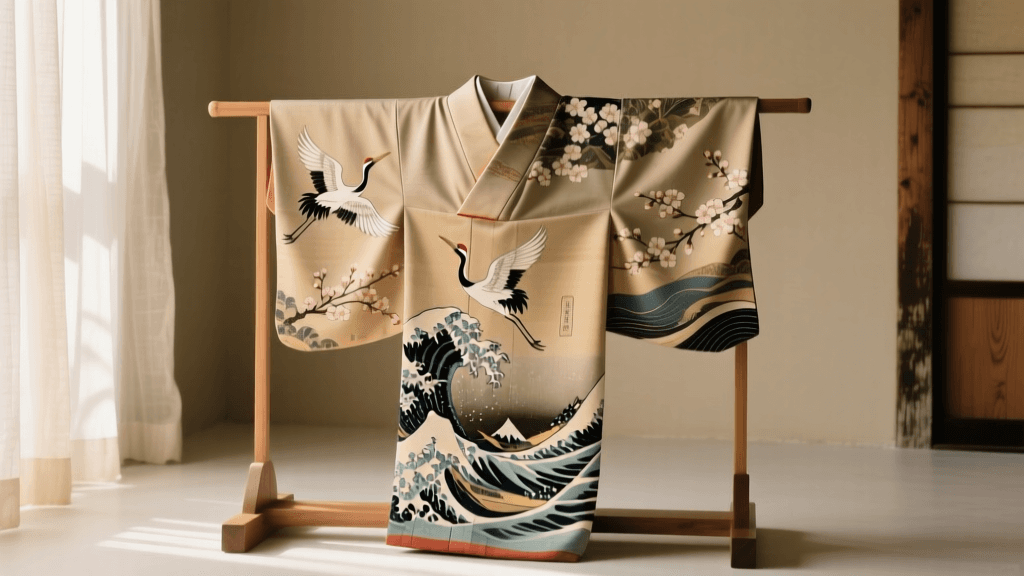
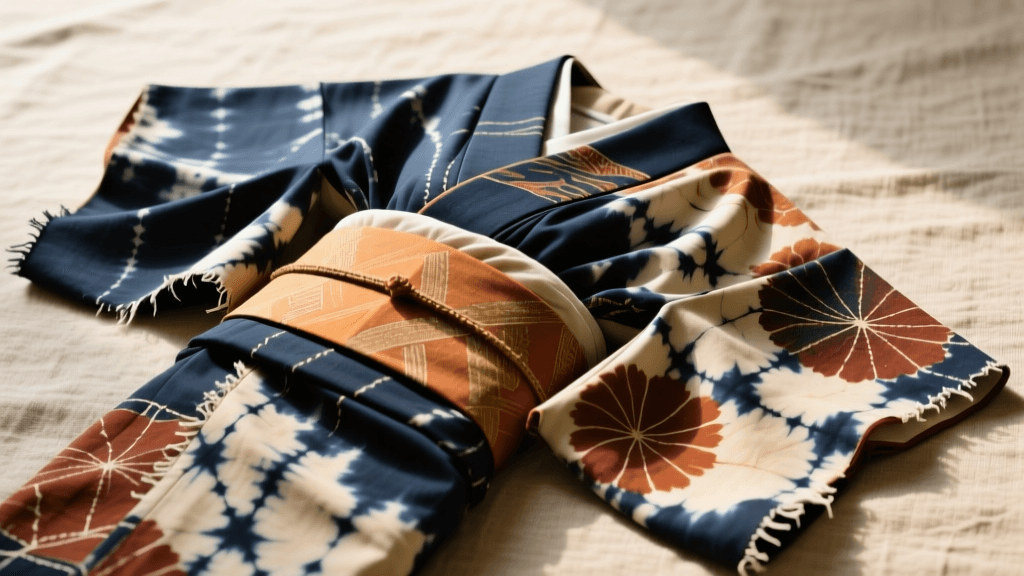
Kimono Tanmono Construction: Zero-Waste Sewing Techniques 2026
The Renaissance of Zero-Waste: Kimono Construction in 2026
As the global fashion industry grapples with the stringent sustainability mandates of the 2026 EU Strategy for Sustainable and Circular Textiles, designers and artisans are increasingly looking toward historical Asian dress traditions for solutions. At the forefront of this movement is the traditional Japanese kimono, a masterclass in zero-waste pattern drafting and modular garment construction. Unlike Western tailoring, which relies on curved seams and discards up to 20% of fabric as offcuts, kimono construction utilizes a standardized fabric bolt known as the Tanmono. This ancient system ensures that every single thread of the woven textile is incorporated into the final garment, making it a highly relevant blueprint for 2026 eco-conscious makers.
Understanding the structural geometry of the kimono requires a shift in perspective from three-dimensional draping to two-dimensional modular assembly. According to the Metropolitan Museum of Art, the fundamental T-shape structure of the kimono has remained largely unchanged for centuries, yet its underlying construction techniques offer profound lessons in longevity, modularity, and circular fashion.
The Geometry of the Tanmono Bolt
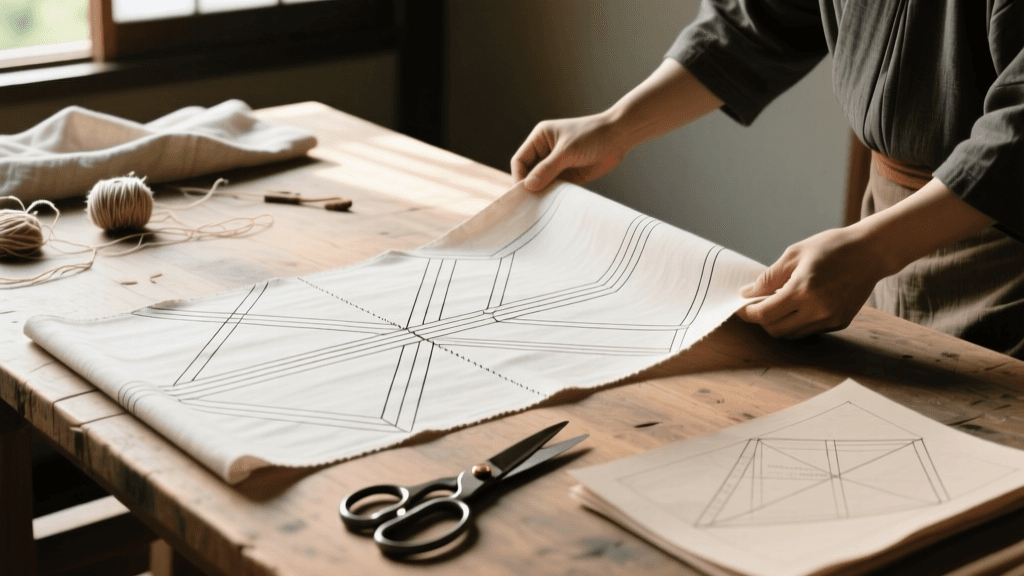
The foundation of all traditional kimono construction is the Tanmono, a narrow, continuous bolt of fabric. To successfully draft and sew a kimono today, one must understand the strict mathematical parameters of this textile format.
- Standard Width: Women’s Tanmono are traditionally woven to a width of 36 cm (14.2 inches), while men’s bolts are slightly wider at 40 cm (15.7 inches). This width dictates the maximum panel size and, consequently, the sizing of the garment.
- Standard Length: A complete bolt contains approximately 11.5 to 12.5 meters (12.5 to 13.6 yards) of fabric. This exact length is mathematically calculated to yield the eight primary rectangular panels required for a standard women’s kimono: two body panels, two sleeve panels, two overlap panels (okumi), and a collar.
- The Zero-Waste Guarantee: Because the garment is constructed entirely from straight, rectangular cuts parallel to the selvedge, there are absolutely no offcuts. The selvedge edges are often left intact and hidden within the seams, preventing fraying and eliminating the need for overlocking or serging.
Core Construction Techniques for the Modern Artisan
Sewing a kimono relies on Chokusen-Dachi (straight-line cutting) and Wa-Sai (Japanese sewing methods). For artisans adapting these techniques in 2026, mastering the following hand-sewing and structural methods is essential.
1. The Straight-Line Seam and Allowances
Unlike Western garments where seam allowances are trimmed and finished, kimono seam allowances are generous and folded inward. The standard side seam allowance is 1.5 cm to 2 cm. The seam is sewn using a running stitch (gushi-nui), and the raw edges are folded toward the center back and secured with a blind stitch. This creates a clean, unlined interior on unlined garments (hitoe) and provides structural integrity that allows the seams to bear tension without tearing.
2. Basting and Tacking (Shitsuke)
Before any permanent stitching occurs, panels are basted using shitsuke-ito, a loosely twisted cotton thread. In 2026, modern makers often use contrasting, biodegradable bamboo basting threads to ensure visibility against complex digital prints or traditional Yuzen dyed silks. Basting is mandatory; the slippery nature of silk and modern Tencel blends makes machine sewing without prior hand-basting nearly impossible if one wishes to maintain the precise geometric alignment of the motifs.
3. The Art of Kuke (Blind Stitching)
Hems and collars are finished using kuke, an invisible blind stitch. The needle picks up only one or two threads of the face fabric, ensuring the stitch is completely invisible on the exterior. For heavy 2026 winter-weight hemp or wool-blend Tanmono, a stitch length of 4-5 mm is recommended, whereas delicate summer silks require a tighter 2-3 mm stitch to prevent puckering.
2026 Material Sourcing: Traditional vs. Sustainable Alternatives
While traditional mulberry silk remains the gold standard, the 2026 market has seen a surge in sustainably produced Tanmono bolts woven from alternative fibers. Below is a comparison of materials currently available to artisans, balancing heritage aesthetics with modern ecological standards.
| Material Type | Traditional Equivalent | 2026 Cost per Bolt (11.5m) | Sustainability & Performance Profile |
|---|---|---|---|
| Mulberry Silk (Rinzu) | Standard Formal Silk | $450 - $800 USD | High environmental footprint; unmatched drape and dye absorption for formal wear. |
| Ahimsa (Peace) Silk | Wild Tussah Silk | $380 - $550 USD | Cruelty-free (moth emerges before boiling); slightly slubby texture, excellent for semi-formal garments. |
| Tencel-Linen Blend | Summer Ramie (Jofu) | $220 - $350 USD | Closed-loop lyocell process; high breathability, crisp hand-feel, ideal for summer hitoe kimono. |
| Recycled PET Crepe | Silk Chirimen (Crepe) | $180 - $280 USD | Upcycled ocean plastics; mimics the pebbled texture of silk crepe, highly durable for daily wear. |
Structural Spotlight: Drafting the Miyatsukuchi
One of the most ingenious structural elements in women’s kimono construction is the Miyatsukuchi, the underarm opening. While men’s kimono and children’s garments have closed underarms, women’s garments feature a 20 to 23 cm slit positioned approximately 10 cm below the armpit line on both the body and the sleeve.
Why is this necessary? The wide, tubular sleeves of a kimono restrict arm movement if sewn completely shut. Furthermore, when a woman ties her Obi (sash) tightly around her torso, the fabric of the bodice needs room to shift and adjust. The Miyatsukuchi allows the wearer to reach through the slit and pull the front and back bodice panels into a smooth, comfortable alignment over the Obi without distorting the collar or the sleeve.
Construction Tip: When finishing the edges of the Miyatsukuchi, the seam allowance must be folded back and secured with a reinforced bar tack (kangi-nui) at the top and bottom apexes of the slit. In 2026, artisans working with high-stress recycled poly-blends often insert a tiny square of silk organza behind the apex to prevent the tension from tearing the main fabric over time.
Essential Tools for the 2026 Workshop
To execute these techniques properly, specific tools are required. While some traditional implements remain unchanged, modern iterations have improved safety and precision.
- Hera (Marking Spatula): Traditionally made of bamboo or deer horn, the hera is used to crease fabric rather than mark it with chalk or pens, which can stain delicate dyes. Modern makers utilize polished acrylic or Teflon-coated hera to prevent snagging on textured crepes.
- Kote (Iron): Seam pressing is critical in Wa-Sai. While traditional charcoal irons are still used by purists, the 2026 standard is the temperature-controlled electric Kote. Its narrow, pointed tip allows artisans to press open seam allowances in tight areas like the collar attachment without flattening the surrounding fabric weave.
- Kukedai (Hemming Board): A specialized wooden board with adjustable pins used to stretch and hold the hem taut while executing the invisible blind stitch, ensuring perfectly straight hemlines without measuring tape.
Circularity in Practice: The Art of Arai-Hari
Perhaps the most compelling argument for kimono construction in the context of 2026 circular fashion is the practice of Arai-Hari (wash and stretch). Because the kimono is assembled entirely from straight, uncut rectangular panels using running stitches, it is designed to be completely deconstructed.
When a kimono becomes soiled or needs to be resized for a new generation, the artisan simply snips the basting and running stitches, returning the garment to its original eight flat panels. These panels are then washed, stretched on wooden frames (itabari), and dried. Once dry, the fabric looks brand new, free of creases and body-oil degradation, and can be re-sewn into a fresh garment. The Victoria and Albert Museum highlights that this inherent modularity allowed historical garments to be passed down, resized, and repurposed for centuries, a stark contrast to the planned obsolescence of modern Western fast fashion.
'The kimono is not merely a garment; it is a temporary arrangement of a continuous textile. The fabric outlives the cut, and the cut outlives the wearer.' — Traditional Wa-Sai Proverb, frequently cited in 2026 sustainable design symposiums.
Conclusion
Mastering the garment construction techniques of the Japanese kimono requires patience, precision, and a deep respect for the textile. By embracing the Tanmono bolt, the straight-line cut, and the modular assembly of the Miyatsukuchi and Arai-Hari systems, modern artisans and fashion designers can create garments that are not only breathtakingly beautiful but inherently sustainable. As we navigate the ecological demands of 2026 and beyond, the ancient wisdom of Asian dress traditions offers a flawless blueprint for the future of zero-waste fashion.