Authenticating Vintage Shibori, Yuzen & Kasuri Kimono
The Collector's Guide to Authenticating Japanese Dyeing Techniques
For textile collectors and enthusiasts of traditional Japanese garments, the secondary market is a treasure trove of history, artistry, and craftsmanship. However, the proliferation of modern digital printing and mass-produced replicas has made authenticating vintage kimono a necessary skill. To truly appreciate and accurately value a garment, one must understand the foundational dyeing techniques that define Japanese textile heritage. According to the Metropolitan Museum of Art's Heilbrunn Timeline of Art History, Japanese textile arts evolved through centuries of complex resist-dyeing, paste-painting, and thread-binding methods that transformed simple silk and cotton into wearable canvases.
This guide provides actionable, tactile, and visual methodologies for authenticating three of the most prized and frequently counterfeited dyeing techniques: Shibori, Yuzen, and Kasuri. Furthermore, it outlines strict preservation protocols to ensure these delicate textiles survive for future generations.
Shibori: The Sculptural Art of Shaped Resist
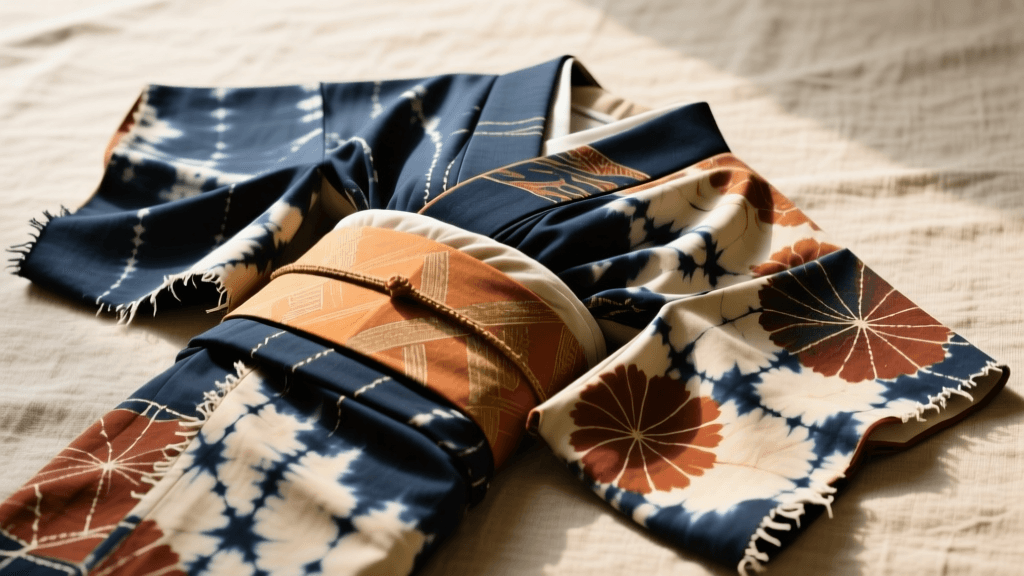
Shibori is often reductively translated as 'Japanese tie-dye,' but it is far more complex. It involves shaping, folding, stitching, binding, or clamping fabric before immersing it in indigo or synthetic dyes. The physical manipulation of the cloth creates a three-dimensional texture that is the hallmark of true, hand-crafted shibori.
Visual and Tactile Authentication
The most definitive test for authentic hand-tied shibori (such as Kanoko Shibori or fawn-spot shibori) is tactile. Run your fingertips lightly over the dyed motifs. Authentic shibori will feel puckered, raised, or textured. The tiny dots of Kanoko shibori are created by binding individual pinches of silk with thread before dyeing. When the bindings are removed, the fabric retains a distinct 3D topography. If the fabric is perfectly smooth and flat, you are likely looking at a modern digital print or a stamped imitation.
Another key indicator is the 'bleed' or gradient of the dye. Hand-dipped shibori features organic, slightly irregular gradients where the dye penetrated the bound resist areas. Machine-printed imitations often have harsh, pixelated, or perfectly uniform edges that lack the organic bleed of liquid dye.
Yuzen: Paste-Resist Painting and the White Halo
Yuzen dyeing, developed in the late 17th century by Miyazaki Yuzensai, revolutionized Japanese fashion by allowing artisans to paint intricate, multi-colored pictorial designs directly onto silk. The process uses a thick rice-paste resist (itome-nori) applied through a metal-tipped cone to outline designs, preventing adjacent colors from bleeding into one another.
Identifying the 'Ito-me' (White Halo)
To authenticate hand-painted Yuzen (particularly Kyo-Yuzen from Kyoto or Kaga-Yuzen from Kanazawa), you need a 10x jeweler's loupe. Examine the borders where two different colors meet, or where a colored motif meets the white background. Authentic Yuzen will reveal a microscopic, uneven white line or 'halo' known as ito-me. This is the physical remnant of the rice paste that was washed out after dyeing. Digital prints attempting to mimic Yuzen will either lack this white line entirely or feature a perfectly uniform, printed white border that looks artificial under magnification.
Additionally, examine the application of gold leaf (surihaku) or metallic embroidery. In genuine vintage Yuzen, gold leaf is applied using specialized adhesives and will show micro-cracking or slight wear over decades, whereas modern metallic heat-transfers will peel uniformly or appear plasticky.
Kasuri: The Blurred Geometry of Pre-Dyed Threads
Kasuri is the Japanese equivalent of Ikat. Unlike Shibori and Yuzen, which dye the woven fabric, Kasuri involves pre-dyeing the warp and/or weft threads in specific, measured patterns before they are placed on the loom. When woven, the slightly misaligned dyed threads create a characteristic blurred or fuzzy edge, which is the literal translation of the word 'kasuri'.
The Reverse-Side Penetration Test
The most foolproof way to authenticate true Kasuri (such as the highly prized cotton Kurume Kasuri, recognized by UNESCO's Intangible Cultural Heritage frameworks for traditional Japanese weaving and dyeing) is to examine the reverse side of the garment. Because the threads themselves are dyed before weaving, the color penetrates deeply. The pattern on the back of the fabric should be nearly as vibrant as the front, albeit slightly softer. If the reverse side is predominantly white or shows only a faint, shadowy outline of the pattern, the fabric has been surface-printed after weaving, indicating a modern, mass-produced fake.
Authentication Comparison Chart
Use this quick-reference table when evaluating garments at antique markets, estate sales, or online auctions.
| Technique | Primary Visual Cue | Tactile / Loupe Test | Reverse Side Check | Vintage Market Value (USD) |
|---|---|---|---|---|
| Shibori | Organic gradients, geometric or fawn-spot patterns. | Distinct 3D puckering and raised texture on the silk. | Dye penetrates fully; pattern is visible but mirrored. | $150 - $800+ |
| Yuzen | Pictorial, multi-colored motifs with metallic accents. | Microscopic white 'ito-me' halo between color fields. | Colors bleed through slightly; paste-resist areas remain white. | $300 - $2,500+ |
| Kasuri | Geometric, blurred, or fuzzy-edged repeating patterns. | Smooth weave; blurred edges visible to the naked eye. | High color penetration; pattern is vibrant on both sides. | $100 - $600 |
Actionable Care: Cleaning, Storage, and Mushi-Boshi
Acquiring an authentic vintage garment is only the first step; preserving it requires strict adherence to archival textile care. The Victoria and Albert Museum's Asian Collections conservation guidelines emphasize that light, moisture, and pests are the primary enemies of historical silk and cotton.
Professional Cleaning vs. Spot Treatment
Never machine wash or aggressively hand-wash a vintage silk kimono. Water can cause the dyes to run and the silk fibers to lose their structural integrity. For authentic Yuzen and Shibori silk garments, seek out a professional Arai-hari (wash and stretch) service, either domestically through specialized Japanese textile restorers or via proxy services in Japan. This traditional process involves unstitching the kimono into flat panels, washing them with specialized mild agents, stretching them on wooden frames to dry, and restitching them. Expect to pay between $120 and $250 USD per garment for this meticulous service.
For minor, localized stains on cotton Kasuri, you may use a no-rinse wool wash like Eucalan. Apply a single drop to a damp cotton swab, gently dab (never rub) the stain, and allow it to air dry flat. Always test on an inner seam first.
Archival Storage Specifications
Improper storage leads to permanent creasing, acid burns, and mildew. Follow these exact specifications for your archive:
- Wrapping: Wrap each garment in acid-free, pH-neutral tissue paper (pH 7.0 to 8.5). Never use standard colored tissue paper, as the dyes can transfer. Traditional Japanese Tatoushi paper is ideal if sourced from reputable dealers.
- Containers: Use archival-quality, corrugated polypropylene storage boxes. A standard folded kimono measures roughly 60 cm wide by 80 cm long. Purchase boxes measuring at least 85 cm x 45 cm x 15 cm to prevent tight folding, which causes silk fibers to snap over time.
- Environment: Store in a climate-controlled interior closet. Maintain a relative humidity (RH) of 45-55% and a stable temperature of 65-70°F (18-21°C). Avoid attics and basements entirely.
The Mushi-Boshi (Airing Out) Protocol
In Japan, the practice of Mushi-boshi (literally 'bug drying' or airing out) is essential for preventing mold and pest infestations. Twice a year—ideally in late autumn and early spring on dry, low-humidity days—remove your garments from storage.
- Unwrap the kimono and hang them on specialized, wide-shouldered kimono hangers (standard Western hangers will distort the shoulder seams).
- Hang them in a well-ventilated, shaded room for 2 to 3 hours. Never expose vintage silk to direct sunlight, as UV radiation will rapidly degrade the fibers and fade the natural dyes.
- While airing, gently brush the fabric with a soft-bristled garment brush to remove microscopic dust and potential pest eggs.
- Place natural camphor blocks or untreated cedar wood blocks in the storage boxes to deter silverfish and moths. Replace these pest deterrents every 6 to 8 months.
'To collect vintage Japanese textiles is to become a custodian of history. The imperfections in a hand-tied Shibori knot or the slight misalignment of a Kasuri thread are not flaws; they are the fingerprints of the artisan.' — Textile Conservation Proverb
Conclusion
Authenticating and caring for vintage Shibori, Yuzen, and Kasuri garments requires a blend of historical knowledge, sensory observation, and meticulous environmental control. By mastering the tactile tests for shibori, utilizing a loupe to find the yuzen white halo, and checking the reverse penetration of kasuri threads, collectors can confidently navigate the vintage market. Coupled with rigorous archival storage and the biannual mushi-boshi protocol, these extraordinary examples of Asian textile traditions can be preserved in pristine condition for decades to come.