Kimono Tanmono Zero-Waste Cutting & Shitate Sewing 2026
The global fashion industry in 2026 is heavily focused on circularity, sustainable practices, and zero-waste design. Yet, one of the most sophisticated and elegant zero-waste systems in human history has existed for centuries within traditional Japanese dress. The construction of the kimono is a masterclass in geometric precision, textile preservation, and modular engineering. Unlike Western tailoring, which relies on curved cuts that inevitably leave behind scrap fabric, traditional kimono construction utilizes a system that preserves the integrity of the textile from the moment it is woven to the final stitch. For modern makers, historians, and sustainable fashion designers in 2026, understanding these techniques offers profound insights into garment longevity and eco-conscious design.
The Philosophy of Tanmono: Zero-Waste Pattern Cutting
The foundation of kimono construction begins long before the sewing process; it starts with the weaving of the tanmono (反物), a traditional bolt of fabric. According to historical textile archives and modern exhibitions highlighted by the Victoria and Albert Museum, the tanmono is woven to a highly specific, standardized width—traditionally about 36 centimeters (roughly 14 inches) and approximately 12 meters (13 yards) in length. This exact dimension is not arbitrary; it is mathematically calculated to yield a single adult-sized kimono with virtually zero waste.
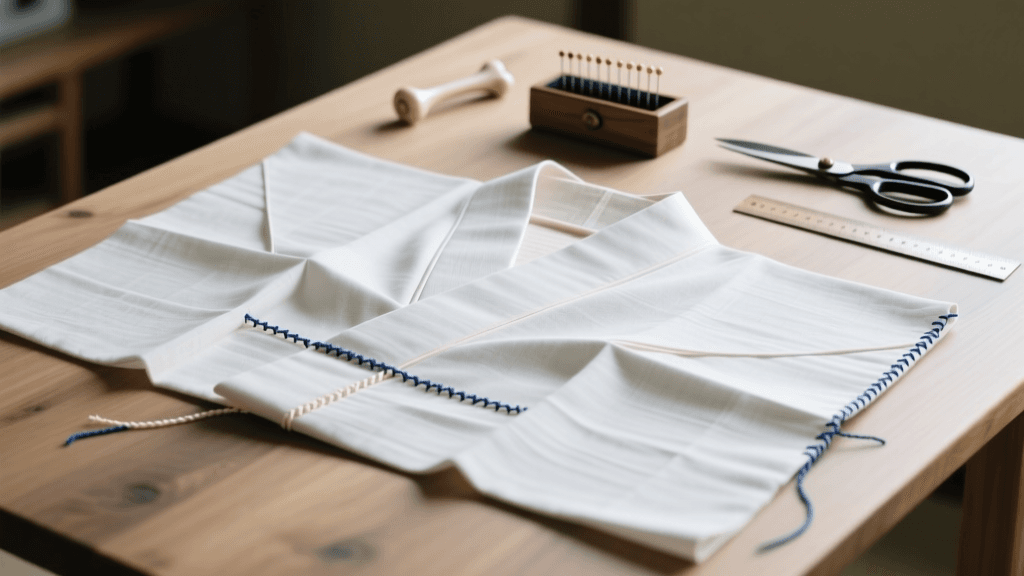
The cutting technique, known as chokudan-giri (straight-line cutting), involves slicing the fabric only along the straight grain. A standard kimono requires eight primary rectangular panels: two main body panels (migoro), two sleeve panels (sode), two front overlap panels (okumi), and two collar pieces (eri). Because the fabric is never cut on the bias or curved around the armhole or neckline, the structural integrity of the woven threads remains entirely intact. This straight-grain cutting ensures that the garment drapes beautifully and that the fabric can be entirely disassembled and re-woven or re-sewn decades later, a crucial feature for the circular fashion models gaining traction in 2026.
Essential Tools for Traditional Shitate (Sewing) in 2026
The art of kimono sewing, or shitate (仕立て), requires a specialized toolkit that has remained largely unchanged for generations, though modern artisans in 2026 have access to refined, ergonomically improved versions of these classics. To begin traditional construction, a maker must acquire the following:
- Hari (Needles): Traditional kimono needles are longer and finer than standard Western sewing needles. In 2026, hand-forged steel needles from artisanal workshops in Hiroshima are highly prized, typically costing between $45 and $65 USD for a premium set. They are designed to glide through tightly woven silk without snagging the delicate fibers.
- Yubinuki (Thimble): Unlike the cap-style thimbles used in Western sewing, the yubinuki is a ring or band worn around the middle finger. Often crafted from leather or stiff paper covered in silk, it features a textured surface that allows the sewer to push the long needle with the side of their finger, providing superior leverage for thick layers of silk.
- Hera (Spatula): A bamboo or bone spatula used to crease fabric and turn edges. It replaces the use of a hot iron for preliminary folds, preventing heat damage to delicate vintage or newly woven silks.
- Kakehari (Tension Frame): While not used during the actual stitching, this wooden frame is essential for stretching the fabric taut during the measuring and marking phases, ensuring the geometric precision required for the straight-line cuts.
Core Sewing Techniques and Stitches
The sewing techniques employed in shitate prioritize flexibility, drape, and the ability to disassemble the garment. As noted by textile historians at Encyclopædia Britannica, the kimono is fundamentally a modular garment. The seams are not meant to be permanent; they are designed to be unpicked so the flat panels can be washed, re-dyed, or rearranged to hide wear and tear.
Honsan-gake (Main Seam) and Kise (Folding)
The primary seam used to join the body panels is the honsan-gake. This is a variation of a running stitch, but the true magic lies in the kise technique. After sewing the seam, the seam allowance is not pressed flat. Instead, it is folded over the stitch line by a few millimeters and tacked down. This kise fold hides the actual stitching thread beneath the fabric, protecting the silk thread from abrasion against the wearer's body and giving the kimono its characteristic soft, rolling drape at the seams.
Mitsuba-guchi (Three-Leaf Hem)
The hem of the kimono, known as the suso, requires a specialized finishing technique called mitsuba-guchi. Because the hem experiences the most friction, the fabric is folded in a precise three-layer configuration that encloses the raw edge entirely without the use of modern sergers or synthetic binding tapes. This creates a weighted, clean edge that helps the kimono hang straight and sway elegantly when the wearer walks.
Kaeshi-nui (Backstitch)
While the running stitch is used for 90% of the garment, high-stress areas such as the base of the sleeve attachment and the collar junction require kaeshi-nui, a dense backstitch. In 2026, modern makers often reinforce these specific junctions with hidden silk organza stays to accommodate the heavier digital devices and modern accessories carried by contemporary wearers, blending ancient technique with modern utility.
Hitoe vs. Awase: Unlined and Lined Construction
A critical decision in kimono construction is whether the garment will be hitoe (unlined, for summer) or awase (lined, for cooler months). The construction techniques vary significantly between the two.
For an awase kimono, the outer silk shell and the inner lining (often a lightweight silk habotai or modern cupro blend) are sewn as separate entities and then joined together at the collar, sleeves, and hem. The lining is intentionally cut slightly smaller than the outer shell. This technique, known as okumi-kise, ensures that the inner lining never pulls or distorts the outer silk, allowing the exterior fabric to maintain its flawless, uninterrupted drape. Mastering the tension differential between the shell and the lining is considered the ultimate test of a shitate artisan.
Comparison Chart: Hand Shitate vs. Machine Construction
While traditional hand-sewing remains the gold standard for formal and heirloom garments, machine sewing has become prevalent for everyday and casual kimono in 2026. Below is a comparison of the two methods based on current industry standards.
| Feature | Traditional Hand Shitate | Modern Machine Construction |
|---|---|---|
| Seam Flexibility | High (allows natural fabric stretch) | Low (rigid thread tension) |
| Disassembly | Easy (designed for unpicking) | Difficult (requires seam ripping) |
| Drape Quality | Superior (kise folding softens seams) | Stiffer (pressed flat seams) |
| Construction Time | 20 to 40 hours | 3 to 6 hours |
| 2026 Average Cost | $800 - $1,500 USD (labor only) | $150 - $300 USD (labor only) |
Sourcing Materials and Modern Adaptations in 2026
For contemporary makers looking to practice shitate in 2026, sourcing authentic tanmono has become more accessible than ever. Digital platforms and direct-to-consumer initiatives from weaving cooperatives in Nishijin (Kyoto) and Yuki (Ibaraki) now allow international artisans to purchase newly woven silk bolts directly. A standard high-grade silk crepe (chirimen) tanmono currently retails between $600 and $1,200 USD, depending on the complexity of the woven pattern and the use of natural dyes.
Furthermore, the 2026 sustainability movement has sparked a revival in upcycling vintage kimono. Many modern makers purchase second-hand, unwearable kimono, carefully unpick the original shitate stitches, wash the flat panels using modern eco-friendly textile detergents, and re-sew them into new garments or adapt the zero-waste rectangular panels into contemporary modular streetwear. This practice not only preserves the ancient sewing techniques but also actively diverts high-quality textiles from landfills, proving that the traditional Japanese approach to garment construction is as relevant and revolutionary today as it was centuries ago.
By mastering the straight-line cuts of the tanmono and the meticulous, hidden stitches of shitate, modern sewists do more than create a beautiful garment; they participate in a sustainable, circular philosophy that honors the life cycle of the textile itself.