Kimono Tanmono Construction: Zero-Waste Tailoring in 2026
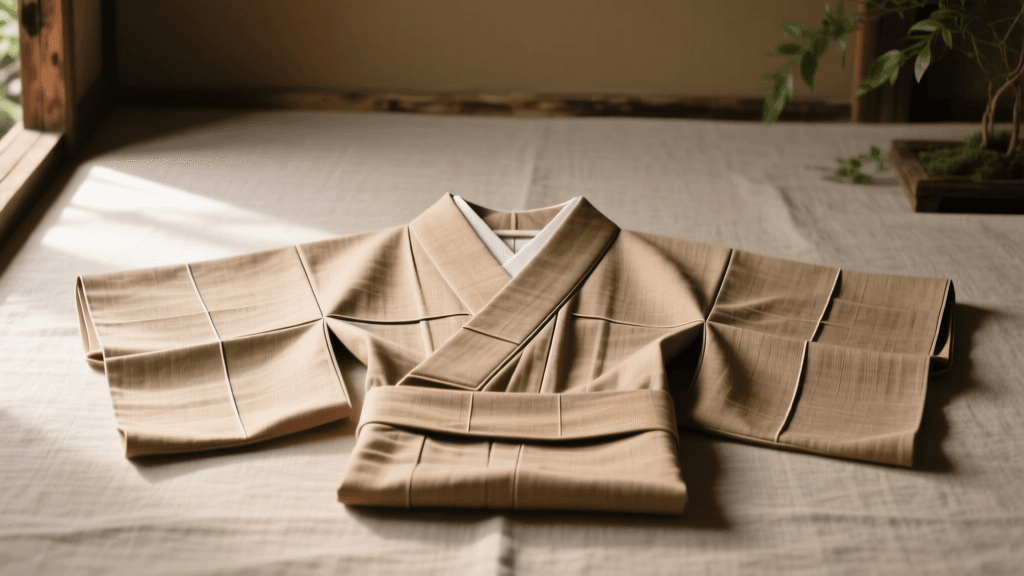
The Enduring Genius of Tanmono Construction
In the global fashion landscape of 2026, sustainability is no longer a niche trend but a fundamental requirement. As modern designers scramble to develop zero-waste pattern drafting techniques to reduce textile landfill contributions, the traditional Japanese kimono stands as a centuries-old masterclass in sustainable garment construction. At the heart of this sartiful engineering is the tanmono, a standardized bolt of fabric that dictates a completely zero-waste, flat-pattern tailoring system. Unlike Western garment construction, which relies on curved cutting, darts, and significant fabric waste, the kimono is constructed entirely from straight lines, utilizing every single inch of the textile. According to The Metropolitan Museum of Art, the structural elegance of the kimono lies not in its complex cutting, but in its sophisticated assembly, draping, and surface design, making it one of the most efficient garment structures ever conceived.
The Anatomy of a Tanmono Bolt
To understand kimono construction, one must first understand the canvas upon which it is built. A standard tanmono bolt is woven to highly specific dimensions: typically 36 to 38 centimeters (about 14 to 15 inches) in width and approximately 12 meters (about 13 yards) in length. This specific width is not arbitrary; it is a direct descendant of the physical constraints of traditional backstrap and floor looms, which were operated by a single weaver whose arm span and body mechanics naturally limited the textile width.
In 2026, while modern industrial looms can easily produce fabrics of any width, the 38-centimeter standard remains fiercely protected by traditional weaving cooperatives in regions like Kyoto, Ishikawa, and Okinawa. This standardized width ensures that a single bolt contains exactly the right amount of fabric to create one adult-sized kimono with zero leftover scraps. The entire 12-meter length is cut into specific rectangular panels, which are then sewn together using a system of running stitches that allow the garment to be completely disassembled, cleaned, and re-sewn, vastly extending the lifecycle of the textile.
Straight-Line Cutting and Flat-Pattern Tailoring
Western tailoring is inherently subtractive. To achieve a three-dimensional shape that contours to the human body, Western pattern makers cut curves into flat fabric, creating armholes, necklines, and waist darts. The offcuts from these curves are almost always discarded as waste. The kimono, however, embraces a two-dimensional, flat-pattern approach. The garment is designed to drape over the body rather than cling to it, utilizing the natural fall of the silk, linen, or hemp to create shape.
The Victoria and Albert Museum highlights that the kimono's T-shape structure is a triumph of geometric efficiency. Because the fabric is never cut on a curve, the structural integrity of the woven threads remains intact. This straight-line cutting method means that the fabric's grain is always perfectly aligned, preventing the twisting and warping that often plagues Western-cut garments after repeated washing and wearing. Furthermore, because the panels are rectangular, the kimono can be easily folded flat for storage, a practical necessity in traditional Japanese architecture where closet space was historically limited.
Deconstructing the Eight Essential Panels
A standard kimono is constructed from eight primary rectangular panels cut directly from the tanmono bolt. Understanding these panels is crucial for any garment maker studying Asian dress traditions:
- Mi-goro (Main Body): Two long panels that form the front and back of the torso. They are cut to the full length of the wearer's height plus an allowance for the ohashori (the waist fold).
- Sode (Sleeves): Two panels that are attached to the mi-goro. Unlike Western set-in sleeves, kimono sleeves are extensions of the body panel, creating a deep, pouch-like structure at the underarm that aids in ventilation and movement.
- Okumi (Front Overlap): Two narrower panels attached to the front edges of the mi-goro. These provide the necessary overlap to ensure the garment wraps securely across the chest and hips.
- Eri (Collar): A long, narrow strip that is folded and attached to the neckline, extending down the front overlap to frame the face and neck.
Any remaining fabric from the 12-meter bolt is utilized for the kake-eri (outer collar) and age (underarm gussets), ensuring that absolutely nothing is thrown away.
Hidden Seam Allowances: The Art of Kise and Kuke
Perhaps the most brilliant aspect of tanmono construction is how the raw edges are finished without cutting the fabric. In Western sewing, raw edges are often serged, zig-zagged, or bound with bias tape. In kimono construction, the raw edges are protected through a technique called kise. When two panels are sewn together with a running stitch, the seam allowance is not pressed flat. Instead, it is folded over the stitching line, enclosing the raw edge completely within the fold of the fabric itself. This creates a soft, padded seam that is gentle against the skin and adds structural weight to the garment's drape.
To secure these folded seam allowances, artisans use kuke, a meticulous blind-stitching technique. Using incredibly fine silk thread, the maker catches only a single thread of the fabric's weave, rendering the stitching virtually invisible from the outside. In 2026, master artisans in Kyoto still teach this technique, noting that a single kimono can require over 20,000 individual blind stitches. This level of hand-finishing is what gives the kimono its fluid, unbroken silhouette.
Comparison: Tanmono vs. Western Pattern Drafting
To fully appreciate the engineering of the kimono, it is helpful to compare its construction methodology directly with modern Western tailoring standards.
| Feature | Tanmono (Kimono) Construction | Western Tailoring (2026 Standard) |
|---|---|---|
| Fabric Waste | 0% (Zero-waste geometry) | 15% - 25% (Curved offcuts) |
| Cutting Method | Straight lines only | Curves, darts, and bias cuts |
| Seam Finish | Kise (folded and blind-stitched) | Serged, bound, or French seams |
| Resizing Capability | High (seams can be unpicked and moved) | Low (limited by seam allowance and curves) |
| Garment Lifespan | Generational (can be fully disassembled) | Seasonal to Decadal |
Sourcing and Sewing Tanmono in 2026
For contemporary makers, textile artists, and sustainable fashion students looking to practice tanmono construction in 2026, sourcing authentic materials requires specific knowledge. A brand-new, hand-woven silk tanmono from a certified traditional craftsperson in Japan can range from $800 to over $3,000 USD, depending on the complexity of the weave, such as Oshima Tsumugi or Nishijin-ori. However, the thriving vintage market offers an accessible entry point. Vintage, unworn tanmono bolts (often referred to as 'new old stock') can be sourced from specialized online kimono recyclers and Japanese auction proxies for between $150 and $400 USD.
When constructing a kimono, specialized tools are required to maintain the integrity of the flat-pattern system. The hera, a smooth bamboo or bone spatula, is used to mark the fabric by temporarily displacing the threads rather than using chalk or ink, which could permanently stain delicate silks. Furthermore, the thread used for the primary running stitches must be loosely spun silk, which provides the necessary elasticity to move with the fabric, whereas standard polyester or cotton threads will cut through the silk fibers over time due to friction.
The Future of Zero-Waste Asian Dress
As the environmental impact of the global fashion industry faces intense scrutiny, the principles of tanmono construction are being heavily studied by modern design institutions. The Ellen MacArthur Foundation continuously advocates for circular fashion systems where waste is designed out of the production process. The kimono is the ultimate historical proof that circularity and zero-waste design do not require sacrificing aesthetic beauty or cultural significance.
In 2026, we are seeing a fascinating hybridization where contemporary Asian designers are applying the 38-centimeter straight-line cutting rules of the tanmono to modern, everyday garments like wide-leg trousers, wrap coats, and modular workwear. By adopting the kise seam finish and the eight-panel geometry, these designers are creating garments that can be easily altered, repaired, and eventually passed down, proving that the ancient construction techniques of Asian dress traditions hold the key to the future of sustainable global fashion.