Kimono Tanmono Cutting: Zero-Waste Construction 2026
The Geometry of Tanmono: Understanding the Fabric Bolt
In 2026, as the global fashion industry grapples with stringent new environmental mandates and a consumer demand for circular design, modern patternmakers are looking backward to move forward. At the forefront of this sustainable renaissance is the traditional Japanese kimono and its foundational construction method: the tanmono (fabric bolt) system. Unlike Western tailoring, which relies on curved armholes, tapered seams, and inevitably generates 15% to 20% textile waste on the cutting room floor, the kimono is a masterclass in zero-waste geometry.
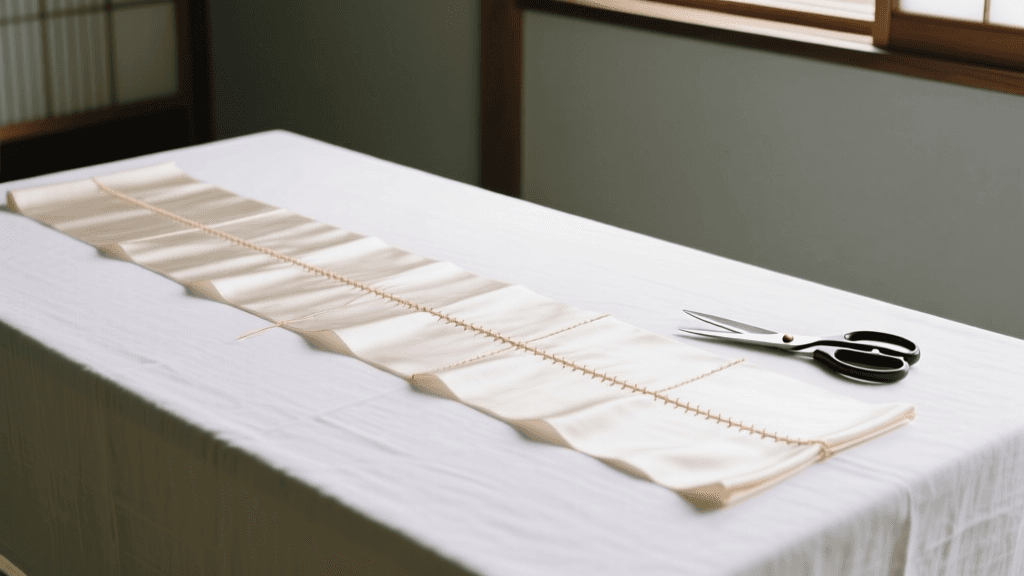
A standard tanmono bolt is woven to specific, unvarying dimensions: approximately 36 centimeters (14 inches) in width and 11 to 12 meters (12 to 13 yards) in length. This narrow width is not an arbitrary choice but a direct result of the traditional backstrap and floor looms historically used in Japan. According to the Metropolitan Museum of Art's Heilbrunn Timeline on Japanese textiles, the constraints of the loom birthed a revolutionary approach to garment construction where the fabric's dimensions dictate the pattern, rather than the pattern dictating the cut. Every single centimeter of the tanmono is utilized in the final garment, with the selvedge edges (mimi) intentionally preserved and incorporated into the seams to prevent fraying without the need for overlocking or serging.
Essential Tools for the 2026 Zero-Waste Atelier
Constructing a kimono requires a specialized toolkit that honors traditional craftsmanship while integrating modern precision. For artisans and sustainable fashion students in 2026, blending heritage tools with contemporary technology yields the best results.
- Takejaku (Bamboo Ruler) & Laser-Guided Mats: While the traditional takejaku is used for measuring and folding fabric along the warp grain, modern 2026 ateliers often pair this with laser-guided cutting mats to ensure absolute straight-line accuracy across the 12-meter bolt.
- Hera (Marking Spatula): A smooth, oblong spatula traditionally made from bamboo, bone, or agate. The hera is used to mark the silk by gently bruising the fibers or leaving a temporary crease, eliminating the need for chemical chalks or disappearing inks that can degrade delicate natural dyes over time.
- Bunchin (Silk Weights): Heavy, often lead-filled or modern tungsten-filled fabric weights wrapped in silk. These are essential for holding the slippery tanmono in place during the marking phase without piercing the fabric with pins.
- Shitsuke Thread (Basting Thread): A loosely spun, easily breakable cotton thread used for temporary basting. Its low tensile strength is a deliberate feature, ensuring it snaps cleanly when removed without damaging the primary silk fibers.
The Straight-Line Cutting Method (Chokudan-giri)
The brilliance of the kimono lies in its modular, rectangular construction. The garment is composed of eight primary panels, all cut in straight lines parallel or perpendicular to the warp and weft threads. This technique, known as chokudan-giri, ensures that the fabric's natural drape and structural integrity remain uncompromised. Because the fabric is never cut on the bias (except occasionally for the collar), the garment resists stretching and warping over decades of wear.
The cutting process begins by folding the tanmono in half lengthwise, aligning the selvedges. The artisan then measures and marks the panels using the hera. The main body panels (mi-goro) form the front and back of the kimono. The sleeves (sode) are cut as perfect rectangles, which are then folded in half and partially sewn to the body, leaving the characteristic underarm openings (miyatsukuchi) that allow for ventilation and the graceful draping of the obi sash. The overlapping front panels (okumi) provide the necessary width for the garment to wrap securely around the body, while the collar (eri) is cut as a long, narrow strip that is folded and attached to the neckline.
Standard Kimono Panel Dimensions and Allowances
Understanding the precise allocation of the tanmono is crucial for zero-waste construction. Below is a structural breakdown of the panels and their standard seam allowances (kise).
| Panel Name | Japanese Term | Quantity | Standard Width (Cut) | Function & Seam Allowance |
|---|---|---|---|---|
| Main Body | Mi-goro | 2 | ~36 cm (Full Bolt Width) | Forms front and back. Selvedge used at center back and side seams. |
| Front Overlap | Okumi | 2 | ~15 cm (Cut from body panel) | Provides wrap width. Features a deep inner fold for future resizing. |
| Sleeves | Sode | 2 | ~34 cm (Slight taper) | Rectangular pouch sleeves. Excess folded inside to create depth. |
| Collar | Eri | 1 | ~8 cm (Folded strip) | Wraps the neckline. Contains the eri-shin (collar stiffener). |
The Art of Kise and Shitsuke: Engineering for Longevity
What truly separates the kimono from modern zero-waste garments is the sewing technique, specifically the use of kise and shitsuke. In Western garment construction, seams are typically sewn, finished, and trimmed. In kimono construction, seam allowances are never trimmed. Instead, the artisan employs kise—a technique where the seam allowance is folded over the stitching line and lightly basted down. This hides the structural thread from the outside, protects the silk from friction, and most importantly, preserves the excess fabric inside the garment.
This hidden fabric is the secret to the kimono's immortality. Because the panels are sewn using a simple running stitch (hon-gushi) and the excess fabric is merely folded away, a kimono can be completely disassembled back into its original rectangular tanmono state. As highlighted by the Victoria and Albert Museum's comprehensive guide to kimono construction, this modularity allows the garment to be washed flat (arai-hari), re-stretched, and resewn. Furthermore, if the wearer's body changes, or if the garment is passed down to a shorter or taller descendant, the hidden seam allowances can be let out, and the panels repositioned. It is a garment engineered not for a single season, but for generations.
Before any permanent running stitches are laid, the artisan uses shitsuke (baste-stitching) to assemble the garment. This allows the wearer to test the drape, the alignment of the okumi overlaps, and the sleeve drop. Adjustments are made by simply moving the basting threads, ensuring that the final silk is never pierced unnecessarily.
Zero-Waste Sustainability: Why Tanmono Matters in 2026
The principles of the tanmono system are highly relevant to the 2026 fashion landscape. According to the Ellen MacArthur Foundation's principles of circular fashion, the industry must transition from a linear 'take-make-dispose' model to one that designs out waste and pollution. The kimono achieves this inherently. By restricting the designer to a 36-centimeter width, the loom forces a discipline that eliminates offcuts. The straight-line cut ensures that when the garment eventually reaches the end of its multi-generational life, the pristine, un-biased rectangular panels can be easily repurposed into other textiles, such as futon covers, zabuton cushions, or modern upcycled streetwear, without the need to navigate complex curved seams.
Contemporary sustainable fashion programs in Tokyo, London, and New York are now incorporating tanmono geometry into their 2026 curricula. Designers are experimenting with narrow-loom weaving techniques to create modern, modular wrap coats and trousers that mimic the kise seam allowance system. By adopting the straight-line cutting method, modern brands can drastically reduce their pre-consumer textile waste while offering consumers garments that can be resized and repaired indefinitely.
Conclusion: The Future is Rectangular
The Japanese kimono is far more than a beautiful cultural artifact; it is a highly engineered, sustainable technology. The tanmono bolt and its accompanying straight-line cutting and baste-stitching techniques represent a perfect closed-loop system. As we navigate the ecological imperatives of 2026, the ancient wisdom of the kimono artisan offers a profound lesson: true sustainability does not require inventing new synthetic recycling methods, but rather returning to a geometry where nothing is wasted, everything is preserved, and every stitch is designed to be undone and begun anew.