Kimono Tanmono Construction: Zero-Waste Tailoring in 2026
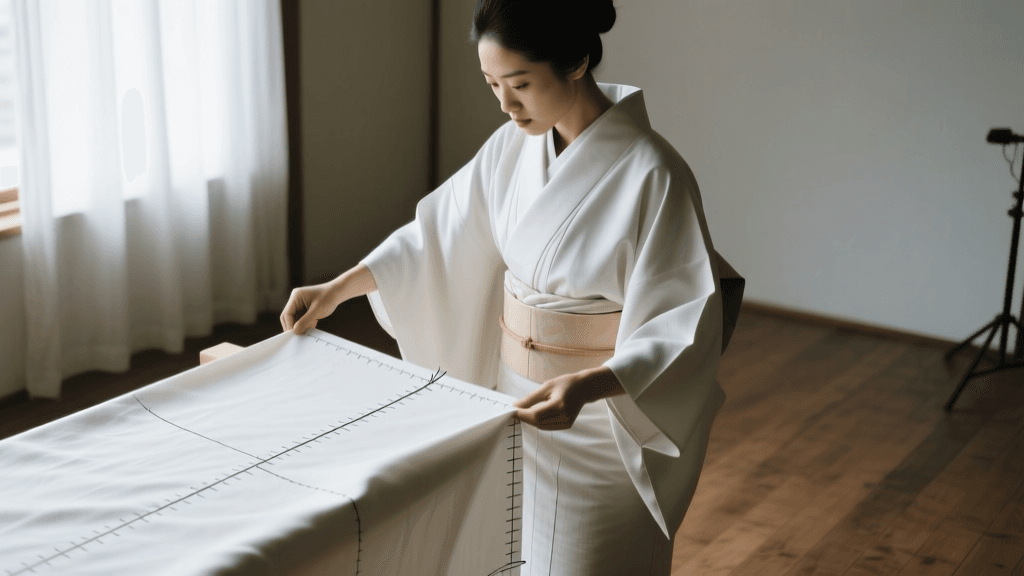
The Philosophy of Tanmono: Zero-Waste Before It Was a Trend
As we navigate the 2026 fashion landscape, where circular design and zero-waste pattern drafting are no longer niche concepts but industry mandates, Western designers are increasingly looking East for structural inspiration. At the pinnacle of sustainable garment engineering is the traditional Japanese kimono, constructed entirely from a single, standardized bolt of fabric known as a Tanmono. Unlike Western tailoring, which relies on curved armholes, dart manipulation, and aggressive fabric cutting that leaves up to 20% of the textile on the cutting room floor, kimono construction is an exercise in geometric restraint and absolute material reverence.
The Tanmono system dictates that every single thread of the woven fabric is incorporated into the final garment. There are no offcuts, no serged edges, and no permanent alterations. In 2026, as global textile waste continues to be a focal point for environmental regulators, understanding the exact construction techniques of the Tanmono offers master tailors, sustainable fashion students, and cultural preservationists a masterclass in zero-waste engineering.
Anatomy of the Tanmono Bolt and Panel Breakdown
A standard Tanmono bolt measures approximately 36 centimeters (14.2 inches) in width and 12 meters (13.1 yards) in length. This specific width is not arbitrary; it is a direct descendant of the physical limitations of the traditional handloom, designed to be woven by a single artisan. Today, even with advanced 2026 jacquard looms, this dimension is strictly maintained to preserve the integrity of the traditional cutting system.
The entire bolt is cut into exactly eight primary rectangular panels. Because the fabric is never cut on a curve, the structural integrity of the warp and weft threads remains completely unbroken, resulting in a garment that drapes fluidly and can be easily deconstructed.
| Panel Name | Quantity | Approx. Dimensions | Garment Function |
|---|---|---|---|
| Migoro (Body) | 2 | 36cm x 120cm | Forms the front and back main body of the kimono. |
| Sode (Sleeves) | 2 | 36cm x 110cm | Creates the iconic flowing sleeves; folded in half to form a pouch. |
| Okumi (Front Overlap) | 2 | 15cm x 120cm | Added to the front Migoro to create the overlapping V-neck closure. |
| Eri (Collar) | 1 | 15cm x 110cm | Folded and attached to the neckline to frame the face. |
| Kake-eri (Collar Cover) | 1 | 15cm x 60cm | A protective, often contrasting layer placed over the back of the neck. |
Straight-Line Cutting and the Art of the Seam Allowance
The most critical distinction between Western and kimono construction lies in the seam allowance. In a 2026 bespoke Western suit, seam allowances are typically 1.5 cm and are immediately finished with an overlock stitch to prevent fraying. In kimono tailoring, seam allowances are massive—often measuring up to 4 cm (1.5 inches) or more—and are never cut away or serged.
Instead, these deep allowances are folded inward and secured using a blind stitch. This serves two vital purposes. First, it adds weight to the seams, allowing the silk to drape beautifully and hang straight without the need for heavy interfacings. Second, it acts as a built-in reservoir of fabric. If the wearer gains weight, or if the garment is passed down to a taller family member, the deep seams can be let out, effectively resizing the garment without requiring new fabric.
Core Hand-Stitching Techniques (Nui) for 2026 Artisans
While machine sewing is occasionally used for the inner linings of modern, casual kimono, formal and bespoke garments are still constructed entirely by hand. The stitches used are designed to be flexible, allowing the silk to stretch and breathe, and most importantly, they are designed to be removed.
- Kuke-nui (Blind Stitching): Used extensively for hemming and securing the folded seam allowances. The needle catches only one or two threads of the face fabric, rendering the stitch completely invisible from the outside. In 2026, master tailors use ultra-fine, 0.4mm silk threads dyed to perfectly match the garment's base color.
- Chikara-nui (Reinforcement Stitching): Applied at high-stress points, such as the base of the sleeve attachment and the side vents. This involves a dense, cross-hatched bar tack that distributes tension across a wider area of the delicate silk.
- Jujin-nui (Shirring/Gathering): Used when attaching the wide Sode (sleeve) to the narrower armhole slit. Rather than clipping the fabric to force a curve, the sleeve is hand-gathered using a running stitch, creating a soft, controlled ease that maintains the straight grain of the textile.
"A kimono is not merely sewn; it is temporarily assembled. The stitches hold the garment together for a lifetime, but they must always yield to the needle of the future washer." — Traditional Kyoto Tailoring Maxim
The Araihari Method: Construction for Infinite Reversibility
The ultimate triumph of Tanmono construction is the Araihari method. Because the garment is constructed using straight lines and deep, unfinished seam allowances, it can be entirely taken apart at the end of its wearing cycle. Once deconstructed, the eight panels return to their original flat, rectangular state.
These panels are then washed, stretched on wooden boards (a process called yuzen-hari), and allowed to dry. The washing process removes all dirt, oils, and creases, effectively returning the silk to a brand-new, unwoven state. The panels are then re-cut (if necessary to remove stains) and sewn back together into a brand-new kimono. According to the Ministry of Economy, Trade and Industry (METI), the preservation of these reversible construction and weaving techniques is vital to Japan's cultural heritage and sustainable future.
Modern Tools for Traditional Construction in 2026
While the techniques remain centuries old, the tools utilized by 2026 artisans have seen subtle, high-precision upgrades to accommodate the increasingly delicate nature of heritage silks.
- Clover Gold Eye Quilting Needles (Micro-Weight): The 2026 iteration of these needles features a proprietary titanium-ceramic coating that glides through tightly woven Oshima Tsumugi silk without snagging or splitting the micro-filaments.
- Water-Soluble Basting Threads: Traditional cotton basting thread has largely been replaced in high-end 2026 ateliers by advanced polyvinyl alcohol (PVA) threads. These threads dissolve completely upon contact with warm water, eliminating the need to painstakingly pull basting stitches out of fragile vintage silks before the final pressing.
- Teflon-Coated Silk Pressing Mats: To achieve the razor-sharp folds required for the Eri (collar) without scorching the silk, modern tailors use temperature-controlled, Teflon-coated pressing surfaces that distribute dry heat evenly without the risk of water-spotting the fabric.
Sourcing Authentic Tanmono in the Modern Market
For contemporary makers and designers looking to study or utilize Tanmono construction, sourcing authentic, hand-woven bolts requires navigating a highly specialized market. As of 2026, the scarcity of master weavers has driven the price of heritage textiles upward. A single, authentic bolt of Yuki-tsumugi—a highly prized, hand-spun silk floss textile recognized by UNESCO as an Intangible Cultural Heritage—can easily command prices starting at ¥450,000 (approximately $3,000 USD) for an unwoven, plain weave bolt, and significantly more for complex kasuri (ikat) patterns.
However, for those focused purely on the structural engineering of the straight-line cut, modern cotton and synthetic-blend Tanmono bolts are widely available through specialized Kyoto-based exporters and online Japanese textile archives. These practice bolts maintain the exact 36cm width and 12m length, allowing global tailors to practice the geometric precision of the Migoro and Sode alignments without the financial risk of cutting into heritage silk.
Ultimately, the Tanmono system is a testament to the idea that limitation breeds innovation. By restricting the width of the fabric and forbidding the curve, Asian dress traditions created a garment that is infinitely adaptable, entirely zero-waste, and structurally immortal. For the 2026 tailor, mastering these straight lines is not just an exercise in historical preservation; it is a vital step toward the future of sustainable global fashion.