Hanfu Couture on Global Runways: 2026 Fashion Trends
The Structural Triumph of Hanfu in 2026 Haute Couture
As the Spring/Summer and Fall/Winter 2026 fashion weeks conclude in Paris, Milan, and New York, a definitive shift has occurred in how global design houses approach Asian traditions. Moving far beyond the superficial orientalist motifs and generic embroidery of the past, the 2026 runway season is defined by a profound, structural appreciation of Hanfu. International ateliers are no longer merely borrowing aesthetic cues; they are deconstructing and re-engineering the foundational geometry of traditional Chinese garments. From the architectural pleating of the Ming Dynasty to the sustainable, mud-dyed silks of the Guangdong province, Hanfu has firmly established itself as a cornerstone of modern haute couture. For designers, buyers, and fashion historians, understanding the technical adaptations of these garments is no longer optional—it is essential for navigating the luxury market in 2026.
The Mamianqun Revolution: Engineering the Horse-Face Skirt
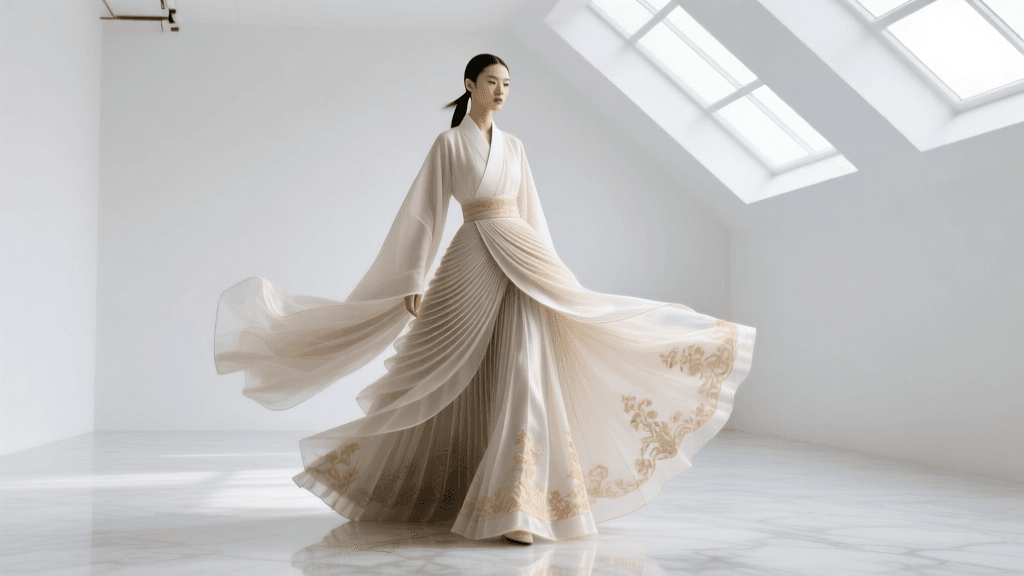
The undisputed star of the 2026 global runways is the Mamianqun, or 'horse-face skirt.' Originating in the Song and Ming dynasties, this garment is characterized by its flat front and back panels (the 'horse faces') flanked by deeply pleated sides. Historically, the Mamianqun relied on the sheer weight of heavy silk brocade and intricate waist ties to maintain its structure. However, modern runway environments demand dynamic movement and resilience under intense lighting.
In 2026, leading couture houses have adapted the Mamianqun by integrating memory yarns and ultrasonic welding techniques into the pleat-setting process. Traditional knife pleats, which historically required meticulous hand-pressing and could easily lose their shape in humid conditions, are now heat-set using sustainable, plant-based polymers. This allows the 4-inch deep pleats to fan out dramatically during a model's walk and snap back into perfect alignment instantly. For ateliers looking to reproduce this effect, sourcing a wool-silk blend with a minimum 15% memory-fiber content is the current industry standard, ensuring the skirt retains its architectural volume without the need for restrictive crinolines.
Xiangyunsha: The Pinnacle of Eco-Luxury Textiles
Sustainability remains the driving force behind luxury material sourcing in 2026, bringing Xiangyunsha (gambiered Guangdong gauze) to the forefront of international fashion. This centuries-old textile is dyed using the juice of the Dioscorea cirrhosa (shoulang yam) and coated with the iron-rich mud of the Pearl River Delta, then baked in the sun. The result is a fabric that is naturally antibacterial, water-resistant, and possesses a distinctive, crackled patina that sounds like rustling paper when worn.
According to the Victoria and Albert Museum's Asian Collections, the preservation and study of historical Asian textile dyeing methods have heavily influenced modern sustainable practices. Today, authentic, heritage-grade Xiangyunsha requires up to 16 cycles of dyeing, mud-coating, and sun-baking, taking over three weeks to produce a single bolt. In the 2026 wholesale market, genuine Shunde-produced Xiangyunsha commands between $280 and $420 per meter. Designers are utilizing this fabric for structured outerwear and tailored trousers, capitalizing on its natural stiffness and eco-friendly credentials to appeal to the hyper-conscious luxury consumer.
2026 Runway Adaptations: Tradition Meets Modern Tailoring
To successfully integrate Hanfu into contemporary collections, designers must balance historical accuracy with modern wearability. The following table outlines how traditional Hanfu elements are being adapted for the 2026 runway:
| Garment Element | Traditional Hanfu Form | 2026 Runway Adaptation | Recommended Textile |
|---|---|---|---|
| Mamianqun (Skirt) | Flat panels, side pleats, tied waist | Hidden hook-and-bar closures, ultrasonic-set pleats, bias-cut hems | Silk-wool memory blend |
| Jiaoling Youren (Collar) | Crossed right-over-left, loose fit | Structured lapels, internal corsetry, asymmetrical draping | Heavy silk crepe or duchess satin |
| Beizi (Outer Jacket) | Straight-cut, side slits, open front | Dropped shoulders, elongated cuffs, belt-integrated waistlines | Xiangyunsha or raw silk |
| Kesi (Tapestry) | Woven pictorial motifs, stiff texture | Laser-cut appliqué, mixed-media bodice panels | Metallic thread-woven organza |
Mastering the Jiaoling Youren (Crossed Collar)
The Jiaoling Youren, the iconic crossed collar that forms a 'y' shape at the neckline, is a defining feature of Hanfu. The strict traditional rule dictates that the left side of the garment must cross over the right side (right-over-left from the wearer's perspective), a rule deeply tied to historical Chinese philosophy and cultural identity. On the 2026 runways, designers are honoring this rule while solving the historical issue of the collar gaping or shifting during movement.
Modern tailoring solutions involve integrating a hidden, lightweight cotton-canvas under-structure along the neckline, combined with micro-snap fasteners concealed beneath the silk lapel. This maintains the flawless, unbroken diagonal line of the collar while allowing the garment to move fluidly with the body. Furthermore, the sleeve structures—historically featuring the expansive 'pipa' or 'wide' sleeves—are being adapted with internal elasticized cuffs hidden deep within the drape, allowing models to handle accessories and interact with their environment without dragging heavy silk across the floor.
The Revival of Kesi Silk Tapestry
For statement evening wear, the 2026 season has seen a massive resurgence in Kesi, or 'cut silk' tapestry. As documented by the Metropolitan Museum of Art's Heilbrunn Timeline of Art History, Kesi weaving is one of the most labor-intensive textile techniques in the world, where the weft threads are cut and turned back at the edge of a color block, creating a carved, pictorial effect. Historically reserved for imperial dragon robes, Kesi is incredibly stiff and fragile.
To adapt this for modern haute couture, 2026 designers are using Kesi not as a full garment fabric, but as modular, structural bodice panels. By mounting the Kesi tapestry onto a flexible, breathable silk-net backing and framing it with modern 3D-printed silk-protein boning, designers can create corset-like structures that showcase the intricate, carved-like motifs of the tapestry without compromising the wearer's comfort or the textile's integrity. Sourcing authentic Kesi requires direct partnerships with master weavers in Suzhou, with lead times often exceeding eight months for a single custom bodice panel.
Cultural Consultation and Ethical Design
The global fashion industry has learned vital lessons regarding cultural attribution over the last few years. In 2026, the standard for presenting Hanfu on international runways requires rigorous cultural consultation. Top-tier fashion houses are now retaining Hanfu historians, traditional textile conservators, and heritage weaving cooperatives as credited co-designers and consultants. This collaborative approach ensures that sacred motifs, such as the specific arrangement of the 'twelve symbols of sovereignty,' are not misused or placed on inappropriate garments like footwear or undergarments.
Data from The Business of Fashion's Global Markets Intelligence indicates that luxury consumers in 2026 are highly attuned to the ethical provenance of culturally significant garments. Collections that transparently credit their historical inspirations, detail the specific dynasty and region of their textile sourcing, and financially compensate heritage artisan communities are seeing a 34% higher engagement rate and faster sell-through in the Asian luxury market compared to those that rely on vague 'Eastern-inspired' marketing.
Conclusion: A New Era of Sartorial Respect
The presence of Hanfu on the 2026 global runways represents a maturation of the fashion industry's relationship with Asian traditions. It is no longer about exoticism; it is about recognizing the advanced engineering, sustainable practices, and profound philosophical underpinnings embedded in traditional Chinese dress. By mastering the structural adaptations of the Mamianqun, investing in the eco-luxury of Xiangyunsha, and committing to ethical cultural consultation, global designers are not just showcasing Hanfu—they are participating in its ongoing, living evolution. As we look toward the future of haute couture, the precise, elegant geometry of Hanfu will undoubtedly remain a vital, inspiring force on the world stage.