Kimono Tanmono Cutting: Zero-Waste Construction Guide 2026
The Philosophy of the Tanmono: Zero-Waste Before It Was a Trend
In an era where the global fashion industry is aggressively pivoting toward sustainability, the traditional Japanese kimono offers a masterclass in zero-waste design. At the heart of this garment is the tanmono, a standardized bolt of fabric that dictates the entire construction process. Unlike Western tailoring, which relies on curved patterns that leave behind significant fabric scraps, the kimono is constructed entirely from straight, rectangular cuts. As we move through 2026, contemporary designers and sustainable fashion advocates are increasingly looking back at this centuries-old Asian tradition to inform modern, eco-conscious garment construction.
The genius of the kimono lies not just in its aesthetic elegance, but in its mathematical precision. Every inch of the tanmono is utilized, and the garment can be entirely disassembled, washed, and re-sewn without degrading the fabric's integrity. According to the Victoria and Albert Museum's comprehensive guide to the Kimono, this approach to textile conservation and garment longevity is deeply rooted in Japanese cultural history, where textiles were historically considered highly valuable assets.
Anatomy of the Kimono Bolt
To understand kimono construction, one must first understand the canvas. A standard tanmono bolt is woven to specific dimensions: typically around 36 centimeters (14 inches) in width and 12 meters (13 yards) in length. This narrow width is a historical artifact of the traditional backstrap loom and the physical limitations of hand-spinning silk threads.
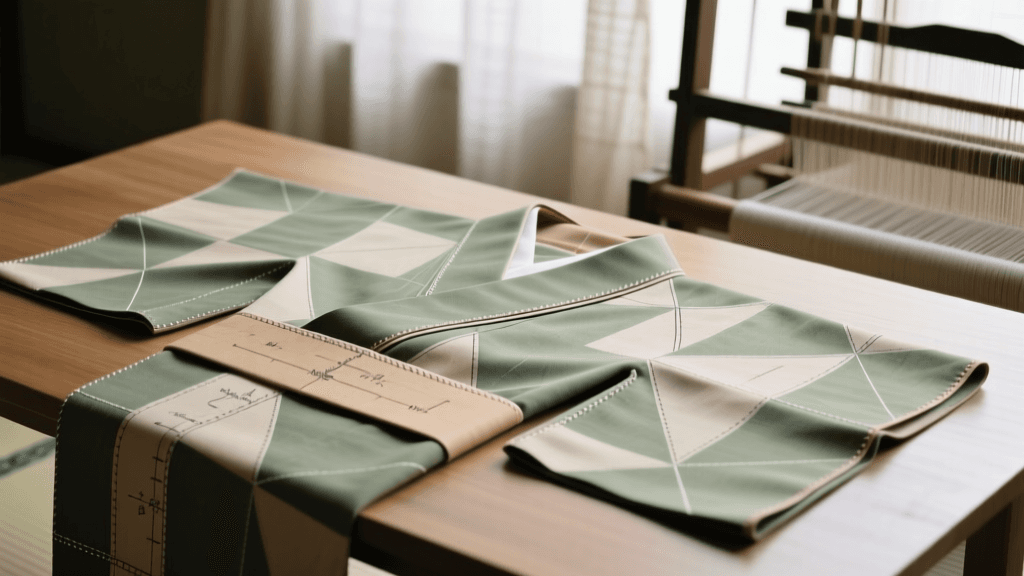
Because the fabric is so narrow, the kimono cannot be cut to fit the width of the human body in a single piece. Instead, the garment is constructed by joining multiple vertical panels. A standard women's kimono requires exactly one full bolt of fabric, which is divided into specific sections:
- Migoro (Body Panels): Two main panels that form the front and back of the torso.
- Okumi (Front Overlap Panels): Two narrower panels added to the front edges to create the overlapping closure.
- Sode (Sleeves): Two rectangular panels that form the iconic deep, hanging sleeves.
- Eri (Collar): A long, narrow strip folded and attached to the neckline.
- Tomoe (Under-collar): A secondary strip used to reinforce and shape the collar.
This modular approach means that the width of the kimono is determined by the width of the bolt, while the length is determined by the wearer's height. As noted by The Metropolitan Museum of Art's Heilbrunn Timeline of Art History, this structural logic allows the garment to be easily resized or passed down through generations, a stark contrast to the planned obsolescence of modern fast fashion.
Flat-Pattern Geometry: Straight Lines and Right Angles
Western bespoke tailoring is sculptural; it uses darts, curved armholes, and princess seams to mold flat fabric to the three-dimensional contours of the human body. Kimono construction, conversely, is architectural. It relies on flat-pattern geometry, utilizing only straight lines and right angles.
There are no curved armholes or set-in sleeves in a traditional kimono. The sleeves are attached to the body panels via straight horizontal seams, leaving the underarm area open (in women's kimono) to allow for movement and ventilation. The shaping of the garment does not occur during the cutting or sewing phase; rather, it occurs during the kitsuke (dressing) process, where the wearer uses padding, ties (himo), and the obi (sash) to mold the flat garment to their body.
Step-by-Step: Traditional Kimono Assembly in 2026
For modern makers and historical costumers exploring Asian traditions in 2026, replicating the kimono construction process requires a shift in mindset. Here is the traditional workflow:
- Measuring (Ki-jitsu): The maker calculates the required panel lengths based on the wearer's height and arm span. Unlike Western patterns, measurements are taken in straight lines from the floor to the shoulder, and wrist to wrist.
- Marking and Cutting: Using a shaku (traditional Japanese ruler) and a hera (a bamboo or bone spatula), the maker marks the fabric. The hera is used to score the silk along the grain line, allowing the fabric to be torn or cut perfectly straight without fraying excessively.
- Basting (Shitsuke): Before any permanent stitching, the panels are basted together using long, easily removable running stitches. This allows the maker to check the drape and alignment of the patterns (especially crucial for e-moyo, or continuous picture patterns).
- Sewing: The kimono is sewn entirely by hand using a simple running stitch. The seam allowance is typically 1.5 cm. Crucially, the seam allowances are left untrimmed and un-clipped, preserving the structural integrity of the silk.
Comparison Chart: Tanmono vs. Western Bespoke Tailoring
| Feature | Kimono (Tanmono Construction) | Western Bespoke Tailoring |
|---|---|---|
| Pattern Geometry | Straight lines, rectangles, right angles | Curved lines, darts, complex shaping |
| Fabric Waste | Zero-waste (entire bolt is used) | High waste (15-30% offcuts from curved cutting) |
| Seam Finishing | Raw edges folded inward; untrimmed allowances | Serged, overlocked, or bound to prevent fraying |
| Fit and Shaping | Achieved during dressing via wrapping and tying | Achieved during construction via cutting and sewing |
| End-of-Life | Disassembled, washed, re-dyed, or repurposed | Difficult to deconstruct; often discarded |
The Arai-Hari Maintenance System
One of the most remarkable aspects of kimono construction is that it is designed for deconstruction. Because the garment is sewn with a simple running stitch, it can be entirely taken apart at the end of a season or when it becomes soiled. This process is known as arai-hari.
Once disassembled, the individual rectangular panels are washed, stretched on a bamboo frame (hari), and dried. This re-tensions the silk fibers, removes wrinkles, and restores the fabric's original luster. The panels can then be re-sewn into a fresh kimono. According to Encyclopedia Britannica's entry on traditional Japanese dress, this cyclical maintenance system meant that a high-quality silk kimono could outlive its original owner, with the fabric eventually being repurposed into children's clothing, futon covers, or patchwork textiles once it began to wear thin.
Sourcing Materials and Tools for Modern Makers in 2026
For sewing enthusiasts and sustainable fashion students in 2026 looking to practice tanmono construction, sourcing the right materials is easier than ever, though it requires knowing where to look.
Where to Source Tanmono
- Vintage Silk Bolts: Online marketplaces like Etsy and specialized Japanese antique dealers offer unworn, vintage tanmono bolts (often from the mid-20th century) ranging from $80 to $250 USD. These are ideal for learning the cutting process without the fear of ruining expensive modern silk.
- Modern Reproduction Cotton: For practice, many makers use standard quilting cotton. To replicate the tanmono experience, buy fabric that is 44 inches wide and cut it down to 14-inch strips, simulating the narrow loom width before piecing the garment together.
- Direct from Japan: Retailers such as Kyoto-based Yamato or online shops specializing in wafuku (Japanese clothing) sell authentic, newly woven tanmono in silk, linen, and hemp, typically costing between $300 and $1,500 USD depending on the dyeing technique (e.g., yuzen or shibori).
Essential Tools for the 2026 Workspace
To construct a kimono authentically, you must abandon the rotary cutter and modern measuring tape. Equip your workspace with:
- Shaku (Japanese Ruler): A traditional ruler marked in sun and shaku units. One shaku is approximately 30.3 cm. Using traditional measurements helps maintain the correct proportions of the garment.
- Hera (Marking Spatula): A smooth, pointed tool made of bamboo or agate used to score fold lines and seam allowances on silk without leaving permanent marks or snagging the delicate threads.
- Kakehari (Tension Clamp): A small, spiked wooden clamp used to hold the fabric taut while sewing, ensuring the running stitch remains perfectly even.
Adapting Tanmono Logic for Contemporary Wardrobes
As the fashion industry faces intense scrutiny over textile waste in 2026, the principles of the tanmono are being adapted by modern zero-waste designers. By restricting their fabric widths and utilizing only orthogonal cutting lines, contemporary brands are creating modular, wrap-style coats, tunics, and trousers that echo the kimono's geometry while fitting modern lifestyles.
Understanding the construction techniques of Asian dress traditions is not merely an exercise in historical preservation; it is a vital toolkit for the future of sustainable fashion. By embracing the straight line, the untrimmed seam, and the philosophy of total fabric utilization, modern makers can create garments that honor the past while protecting the future.