Styling Kimono for Every Body Type and Gender Identity
The Myth of 'One Size Fits All' in Traditional Japanese Garments
The kimono is universally recognized as a masterpiece of Japanese textile art and cultural heritage. However, a common misconception among international enthusiasts and first-time renters is that the kimono operates on a strict 'one size fits all' principle. In reality, the traditional Japanese garment is a masterclass in modular tailoring, structural wrapping, and personalized adjustment. Unlike Western fashion, which relies on darts, zippers, and pre-cut curves to hug the body, the kimono is constructed from straight seams cut from a single bolt of fabric known as a tanmono. According to the Victoria and Albert Museum, the kimono's structural simplicity belies the complex, highly individualized art of wearing it, known as kitsuke.
This architectural difference means that the kimono does not conform to the body; rather, the body is shaped to suit the garment. Through the strategic use of padding, folding, and binding, the kimono can be styled to flatter and accommodate an incredibly diverse range of body types and gender expressions. Whether you are navigating a rental experience in Kyoto, purchasing a vintage piece online, or exploring gender-inclusive wafuku (Japanese clothing), understanding how to manipulate the silhouette is essential for both comfort and aesthetic authenticity.
Dressing Diverse Body Types: Practical Adjustments
Because the kimono is essentially a T-shaped tube, achieving the correct fit requires managing excess fabric and creating a specific cylindrical silhouette. Here is how to approach styling for different physical proportions.
Petite Frames
For individuals under 155 cm (5'1"), the primary challenge is managing the mitake (back length) of the kimono. Standard women's kimono are typically tailored for heights around 158 to 162 cm. To adjust, the ohashori—the horizontal fold of fabric tied at the waist—must be made deeper. While a standard ohashori is about 5 to 7 cm deep, petite wearers may need to fold 15 cm or more of excess fabric. To prevent the heavy silk from bulging, use a koshihimo (waist tie) placed slightly higher on the ribcage, and secure the excess fabric flat against the torso using a datejime (wide under-belt). For the sleeves, ensure the sode (sleeve hem) falls gracefully at the wrist; if it extends past the knuckles, the garment is too large and will restrict hand movement.
Tall Proportions
Individuals over 170 cm (5'7") often struggle with standard vintage kimono, which were cut for historically shorter average heights. A tall wearer requires a kimono with a longer mitake and deeper sleeves. If the ohashori is too shallow or non-existent, the kimono will pull tightly across the shoulders, causing the collar to gap at the nape of the neck. When shopping, look for modern bespoke pieces or specific vintage cuts labeled as shinchou-taka (tall height). Alternatively, tall individuals can embrace a modern styling hack: wearing the kimono slightly shorter, allowing the ankles to show, which is increasingly accepted in contemporary, casual summer yukata styling.
Curvy and Plus-Size Bodies
Western styling emphasizes the waist and bust, but traditional kimono aesthetics demand a smooth, cylindrical silhouette. For curvy or plus-size bodies, the goal is to fill in the natural dips of the waist and the small of the back. This is achieved using himopadding or specially designed kimono towels wrapped around the waist and bust. While this may seem counterintuitive to those accustomed to corsetry or shapewear that compresses, creating a straight line prevents the delicate silk from pulling, wrinkling, or tearing under tension. Furthermore, the obi (sash) provides substantial lumbar support. As noted in cultural guides like Tofugu's comprehensive kimono resources, the layering of the hadajuban (under-kimono) and nagajuban helps protect the outer silk while providing a comfortable, breathable barrier that accommodates all body sizes without restricting movement.
The beauty of the kimono lies not in how it reveals the natural contours of the body, but in how it creates a new, intentional silhouette that serves as a canvas for textile art and personal expression.
Beyond the Binary: Gender-Inclusive Kimono Fashion
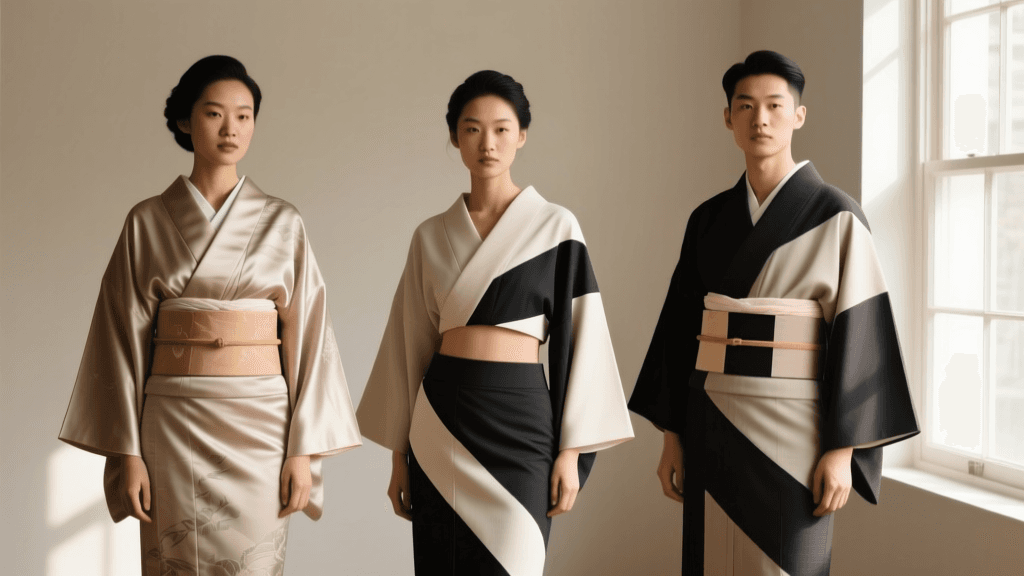
Historically, the Edo period established strict sumptuary laws that heavily gendered Japanese clothing, dictating colors, patterns, and sleeve lengths. Today, however, the kimono is experiencing a renaissance as a medium for gender-inclusive and non-binary expression.
Traditional Masculine vs. Feminine Styling
Traditional womenswear (onna-mono) is characterized by vibrant colors, intricate nature motifs, and the ohashori fold. The sleeves are attached to the body with a deep, open curve. Menswear (otoko-mono), conversely, features subdued colors (navy, charcoal, olive), subtle geometric or crepe textures, and family crests (mon). Crucially, men's kimono are worn without an ohashori; the hem is tied exactly at the ankle, and the sleeves are nearly entirely attached to the torso. The obi for men is tied lower on the hips in a simple, flat knot, whereas women's obi are tied higher and feature elaborate, sculptural bows.
The Rise of Genderless (Jendaresu) Styling
The modern jendaresu (genderless) movement in Japan has profoundly influenced how younger generations approach traditional garments. Non-binary and gender-nonconforming individuals are increasingly mixing elements of both wardrobes. A popular gender-inclusive approach involves wearing a dark, uncrested kimono paired with a vibrant, patterned haori (jacket) or a boldly lined inner garment. The heko obi—a soft, scarf-like sash traditionally worn by men and children—is highly favored in genderless styling because it lacks the rigid, gendered connotations of the formal maru obi or nagoya obi. Additionally, pairing a kimono with hakama (pleated trousers) is a powerful way to achieve an androgynous, scholarly silhouette that transcends traditional gender binaries.
Technical Adjustments and Measurement Guide
When purchasing or renting a kimono, understanding your measurements in relation to the garment's dimensions is crucial. Below is a structured guide to help you identify the right adjustments based on your body type and gender presentation.
| Body Type / Presentation | Primary Challenge | Traditional Solution | Modern / Inclusive Adaptation |
|---|---|---|---|
| Petite (Under 155cm) | Excess length in torso and sleeves | Deep Ohashori fold, higher waist ties | Ankle-baring hem for casual Yukata |
| Tall (Over 170cm) | Shoulder tension, short hemline | Custom Tanmono weaving, deeper sleeves | Embracing the 'no-ohashori' menswear style |
| Curvy / Plus-Size | Fabric pulling at bust and hips | Towel padding to create cylindrical shape | Wafuku bras, elastic Datejime for comfort |
| Masculine-Presenting | Achieving straight, hip-level drape | No Ohashori, Himo tied at hip bones | Pairing with Hakama and rigid Haori jackets |
| Non-Binary / Genderless | Navigating rigid gendered accessories | Mixing Otoko-mono and Onna-mono pieces | Using Heko Obi, bold linings, modern footwear |
Essential Undergarments for Inclusive Fit
To achieve these silhouettes comfortably, the right foundation garments are non-negotiable. Ensure you have the following:
- Susuyoke: A wrap-skirt worn under the kimono to prevent friction and protect the silk from body oils.
- Kimono Bra / Sarashi: Designed to minimize the bust and create a flat canvas without the discomfort of Western compression binders.
- Eri-sugata: A false collar that ensures the nagajuban collar sits perfectly at the nape of the neck, a critical focal point in kimono aesthetics.
Navigating Inclusive Rentals and Retail
For tourists visiting Japan, the Japan National Tourism Organization highlights that many modern rental shops in hubs like Asakusa and Higashiyama are now equipped with 'plus-size' and 'tall' inventories, as well as gender-neutral styling packages. When booking a rental, always communicate your height and general build in advance so the kitsuke-shi (dressing professional) can prepare the correct tanmono widths and padding.
For those building a personal collection, the vintage market offers the best diversity in sizing. Because vintage kimono were hand-sewn, they can be carefully unspooled and re-tailored to fit taller or broader frames—a process known as shitate-naoshi. Ultimately, the kimono is a living, breathing garment. By understanding the mechanics of its wrap and the cultural history of its silhouette, wearers of all body types and gender identities can claim this beautiful tradition as their own, transforming a historical artifact into a deeply personal statement of modern identity.