Kimono Straight-Line Cutting: Zero-Waste Construction in 2026
The Blueprint of Sustainability: Kimono Construction in 2026
As the global fashion industry faces intense regulatory scrutiny in 2026 under frameworks like the EU’s Strategy for Sustainable and Circular Textiles, designers and artisans are increasingly looking to historical methodologies for solutions to the modern waste crisis. Among the most sophisticated and enduring of these traditional systems is the Japanese kimono. Far from being a mere historical artifact, the kimono represents a masterclass in zero-waste garment construction. Through its unique chokusen-dachi (straight-line cutting) method and modular assembly, the kimono offers a blueprint for sustainable, circular fashion that remains profoundly relevant today.
Unlike Western tailoring, which relies on curved seams, darts, and complex grading that inevitably leave behind 15% to 20% of fabric as offcuts, the kimono is engineered to utilize every single thread of its source material. In this comprehensive guide, we explore the intricate geometry, specialized tools, and circular lifecycle of traditional kimono construction, and examine how contemporary artisans are adapting these techniques for the modern wardrobe in 2026.
The Foundation: Understanding the Tanmono Bolt
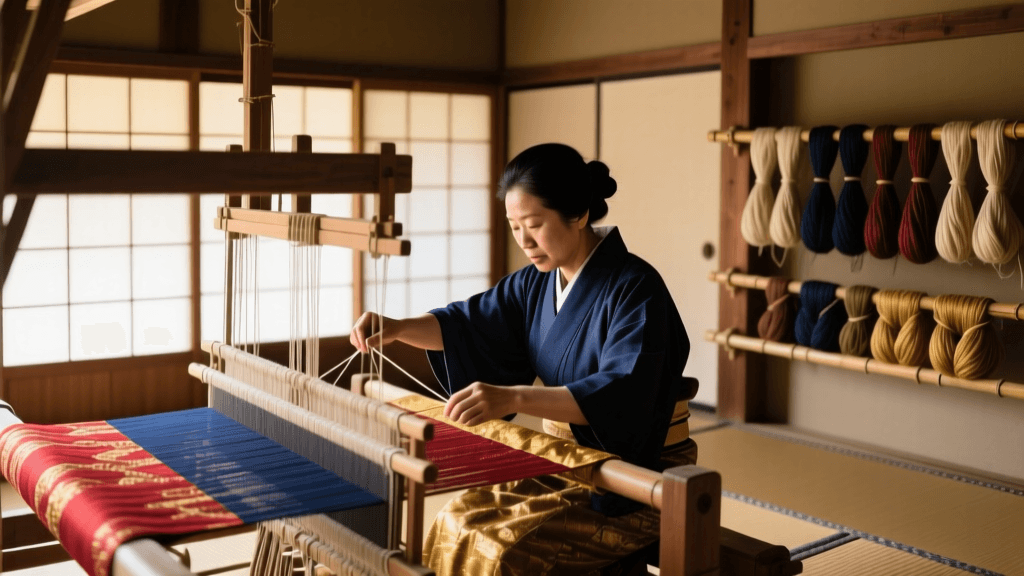
The zero-waste philosophy of the kimono begins long before the cutting shears touch the cloth; it begins at the loom. Traditional kimono fabric is woven in a specific format known as tanmono. A standard tanmono bolt measures approximately 36 centimeters (about 14 inches) in width and 12 to 13 meters (roughly 40 feet) in length. This precise dimension is not arbitrary; it is mathematically calculated to yield exactly one adult-sized kimono with virtually no waste.
The selvedge edges (the tightly woven finished edges of the fabric) play a critical structural role. Because the fabric is narrow, the kimono is constructed from multiple long panels sewn together rather than large, wide pieces. The selvedges are intentionally incorporated into the seams, providing structural integrity and preventing fraying without the need for modern overlocking or serging machines. According to the Victoria and Albert Museum's Asian collections, this narrow-loom weaving technique was historically driven by the limitations of hand-operated backstrap and floor looms, but it inadvertently created one of the most ecologically sound textile systems in human history.
Chokusen-Dachi: The Geometry of Straight Lines
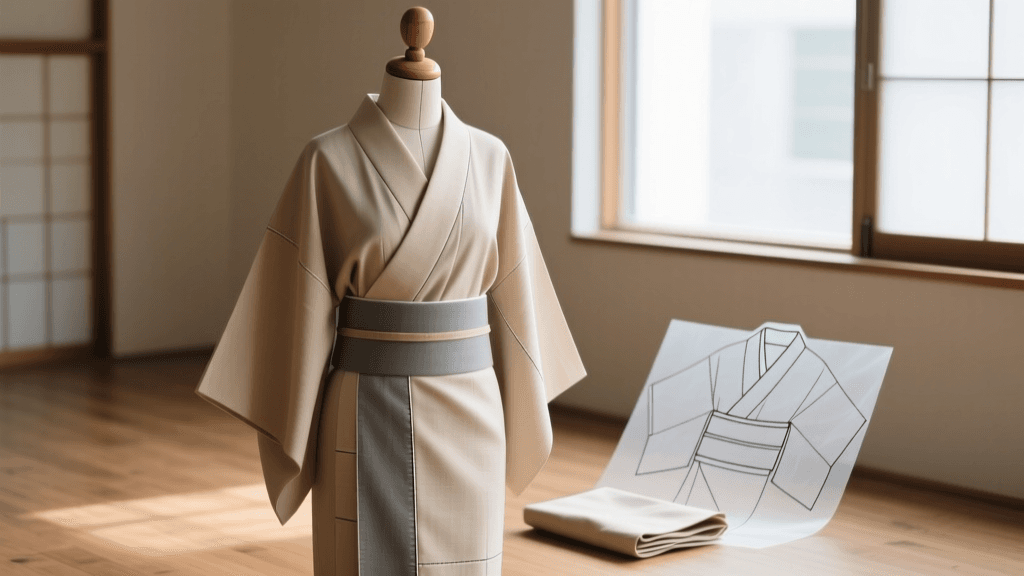
The term chokusen-dachi translates to 'straight-line cutting.' In this system, the tanmono is cut exclusively in straight lines, utilizing the full width of the 36cm bolt. There are no curved armholes, no tapered waistlines, and no diagonal bias cuts. The garment achieves its three-dimensional drape not through the shaping of the fabric pieces, but through the way the flat, rectangular panels are folded, wrapped, and secured around the body using the obi (sash).
The Eight Essential Panels
A standard women's kimono is constructed from eight primary rectangular panels, each cut directly from the tanmono bolt. These include:
- Migoro (Body Panels): Two long panels that form the front and back of the torso.
- Sode (Sleeves): Two panels that create the deep, pouch-like sleeves, which can also serve as built-in pockets.
- Okumi (Front Overlaps): Two narrower panels that are folded to create the overlapping front lapels, crucial for the iconic V-neckline.
- Eri (Collar): One long, folded panel that forms the neckband.
Any remaining fabric from the 12-meter bolt is utilized for the kake-eri (decorative outer collar) or kept as a continuous, uncut remainder that can be used for future repairs or accessories. The Japan Foundation frequently highlights how this exact mathematical division of the tanmono reflects a deep cultural respect for materials, ensuring that the labor of the weaver and the bounty of nature are never discarded.
Kise: The Art of the Hidden Seam Allowance
One of the most brilliant, yet frequently overlooked, construction techniques in kimono making is the kise. When two panels are sewn together, the seam allowance is not pressed flat or finished with a zigzag stitch. Instead, the seam is folded slightly over (usually by about 2 to 3 millimeters) so that the actual stitching line is hidden and protected beneath a fold of fabric.
This technique serves multiple purposes. First, it protects the silk threads from friction and wear, vastly extending the garment's lifespan. Second, it creates a soft, rounded edge at the seam rather than a hard, pressed ridge, which contributes to the kimono's fluid drape. In 2026, as luxury fashion houses seek ways to eliminate synthetic seam tapes and plastic interfacings, the kise technique offers a purely structural, zero-waste method for finishing seams that relies entirely on the artisan's tension control and precision.
Modular Assembly and Shitsuke Basting
Unlike Western garments, which are permanently assembled with tight, reinforced machine stitching, the kimono is designed for disassembly. The panels are sewn together using a simple running stitch (hon-nui), and the structural integrity of the garment relies heavily on shitsuke—temporary basting stitches.
These long, loose basting threads are used to hold the hem, sleeves, and collar in place during the fitting process and even during storage. More importantly, this modular, lightly stitched construction allows the kimono to be easily taken apart. This is not a design flaw; it is a deliberate feature that enables the ultimate circular lifecycle process known as arai-hari.
Arai-Hari: The Ultimate Circular Lifecycle
Before the advent of modern dry cleaning, washing a heavily layered, silk kimono would have destroyed its shape and finish. The solution was arai-hari, a meticulous cleaning and restoration process. When a kimono became soiled, the artisan would carefully unpick every single seam, returning the garment to its original flat, rectangular panels.
These panels were then washed, stretched on wooden boards (ita-bari) or tensioned with bamboo poles (kakehari) to dry and realign the fabric grain. Once dry and re-starched, the panels were sewn back together, essentially creating a brand-new garment. In the context of 2026's circular economy mandates, arai-hari represents the gold standard of garment longevity. It allows a single tanmono to be resized, repaired, and passed down through generations, completely bypassing the modern 'take-make-dispose' model. Archives at the Metropolitan Museum of Art's Asian Art Department showcase historical kimonos that have undergone this process dozens of times, surviving centuries of continuous wear.
Comparing Construction Paradigms: 2026 Perspectives
To understand the sheer efficiency of the kimono's construction, it is helpful to contrast it with standard Western tailoring methods currently dominating the global apparel market.
| Feature | Western Tailoring (Standard 2026) | Kimono Chokusen-Dachi (Traditional) |
|---|---|---|
| Fabric Waste | 15% - 25% (Curved offcuts discarded) | 0% (Entire tanmono bolt utilized) |
| Seam Finishing | Overlocking, serging, synthetic tapes | Kise (Folded seam allowance, no synthetic aids) |
| End-of-Life | Landfill, downcycling, or fiber shredding | Arai-hari (Unpicked, washed, resewn, or repurposed) |
| Sizing Adaptability | Limited (Requires complex grading and recutting) | Highly adaptable (Flat panels can be repositioned) |
| Structural Shaping | Darts, pleats, curved armholes, bias cuts | Wrapping, folding, and tensioning via Obi |
Tools of the Trade: Artisanal Precision
Executing the chokusen-dachi method requires specialized tools that have remained largely unchanged for centuries, though modern artisans in 2026 often blend these with digital aids. The traditional toolkit includes:
- Shaku: A traditional bamboo or wooden ruler used for measuring the precise 36cm increments.
- Hera: A smooth, spatula-like tool made of bamboo or tortoiseshell. The artisan rubs the hera along a straight edge to create a temporary, visible crease on the silk, eliminating the need for chalk or chemical marking pens that could stain the delicate fibers.
- Kote: A specialized, narrow iron used to press the kise folds and seams with pinpoint accuracy.
While contemporary ateliers in Kyoto and Tokyo now utilize laser-guided cutting tables for mass-producing casual cotton yukatas, high-end silk kimono artisans still rely on the hera and hand-shears to ensure the microscopic tolerances required for perfect panel alignment.
2026 Innovations: Modernizing the Straight-Line
In 2026, the principles of tanmono and chokusen-dachi are experiencing a renaissance among avant-garde and sustainable fashion designers worldwide. Armed with modern CAD (Computer-Aided Design) software, designers are mapping straight-line, zero-waste patterns onto upcycled textiles and deadstock fabrics that do not conform to the traditional 36cm width.
By utilizing algorithmic nesting, designers can simulate the tanmono effect on wider, modern fabrics, ensuring that the 'offcuts' are designed as intentional, integrated components of the garment—such as detachable pockets, modular collars, or matching scrunchies—rather than waste. Furthermore, the modular, basted assembly technique is being adopted by sustainable denim and outerwear brands, allowing customers to return garments for professional disassembly, cleaning, and panel replacement, mimicking the arai-hari lifecycle in a modern, scalable context.
Conclusion
The Japanese kimono is far more than a beautiful cultural garment; it is a triumph of sustainable engineering. The chokusen-dachi straight-line cutting method and the tanmono bolt system prove that zero-waste design is not a modern invention, but a time-tested discipline. As the fashion industry navigates the stringent environmental demands of 2026 and beyond, the kimono’s legacy of modularity, zero-waste geometry, and circular longevity offers invaluable lessons for the future of global apparel construction.