Decoding Kimono Silks: Chirimen, Rinzu, and Yuzen Dyeing
Introduction to Kimono Silk Craftsmanship
The Japanese kimono is not merely a garment; it is a canvas of meticulous craftsmanship, reflecting centuries of textile innovation and aesthetic philosophy. At the heart of this tradition lies the profound relationship between the silk fabric and the dyeing techniques used to adorn it. Understanding the nuances of kimono silk—specifically the textural differences between Chirimen and Rinzu—and the mastery of Yuzen dyeing is essential for collectors, cultural enthusiasts, and practitioners of traditional Japanese arts. According to the Metropolitan Museum of Art, the evolution of the kimono from the kosode of the Muromachi period to the highly structured garments of the Edo period was intrinsically linked to advancements in silk weaving and resist-dyeing technologies.
The Foundation: Understanding Traditional Kimono Silks
Before a single brushstroke of dye touches the fabric, the silk itself must be engineered. The choice of weave dictates the garment's drape, formality, and how it absorbs color. Master weavers in regions like Nishijin (Kyoto) and Kiryu (Gunma) spend decades perfecting these textile structures.
Chirimen (Crepe Silk): The Master of Drape and Dye
Chirimen is the undisputed workhorse of high-end kimono craftsmanship. Unlike flat silk weaves, Chirimen is created using highly twisted yarns. The weft threads are twisted alternately to the left and right (S-twist and Z-twist), while the warp threads remain relatively untwisted. During the finishing process, the fabric is washed in hot water, causing the tightly twisted yarns to contract. This results in a characteristic pebbled, crepe-like surface known as 'shibo'.
Actionable Insight: The 'shibo' texture scatters light, giving Chirimen a deep, matte elegance that prevents the garment from looking overly flashy. More importantly, the microscopic ridges created by the crepe texture allow dye to penetrate deeply and evenly, making it the absolute best canvas for intricate Yuzen dyeing. A standard bolt ('tanmono') of high-quality Chirimen silk costs between $300 and $800 USD before dyeing.
Rinzu (Damask Silk): Woven Elegance
Rinzu is a silk damask, woven on a jacquard loom to create subtle, tone-on-tone patterns within the fabric itself. It possesses a soft, luxurious luster and a heavier, more fluid drape than Chirimen. Because the patterns are woven rather than dyed, Rinzu is often used for formal garments like the 'uchikake' (wedding overcoat) or high-end 'furisode'.
Actionable Insight: When purchasing Rinzu, examine the fabric under direct light. High-quality Rinzu will show crisp, distinct woven motifs (such as cranes or pine needles) that contrast beautifully with the matte ground. Due to the complex jacquard weaving process, a bolt of Rinzu typically starts at $1,000 USD.
Tsumugi (Pongee): The Rustic Exception
While Chirimen and Rinzu utilize continuous filament silk, Tsumugi is woven from spun silk floss, resulting in a fabric with slubs (uneven thicknesses) that resembles linen or cotton. Historically worn by commoners because it was made from imperfect silk, it is now highly prized for its understated, rustic elegance ('wabi-sabi'). Tsumugi is rarely used for Yuzen dyeing; instead, it is typically dyed using 'kasuri' (ikat) or 'shibori' (tie-dye) techniques.
Comparative Guide to Kimono Silk Fabrics
| Fabric Type | Weave Structure | Texture & Drape | Formality Level | Est. Bolt Cost (USD) |
|---|---|---|---|---|
| Chirimen | Crepe (Alternating S/Z Twist) | Pebbled, Matte, Excellent Drape | Medium to High | $300 - $800 |
| Rinzu | Jacquard Damask | Smooth, Lustrous, Heavy Drape | High (Formal/Ceremonial) | $1,000 - $2,500 |
| Tsumugi | Plain Weave (Spun Silk) | Slubbed, Crisp, Rustic | Low (Casual/Street) | $400 - $1,200 |
The Mastery of Yuzen Dyeing
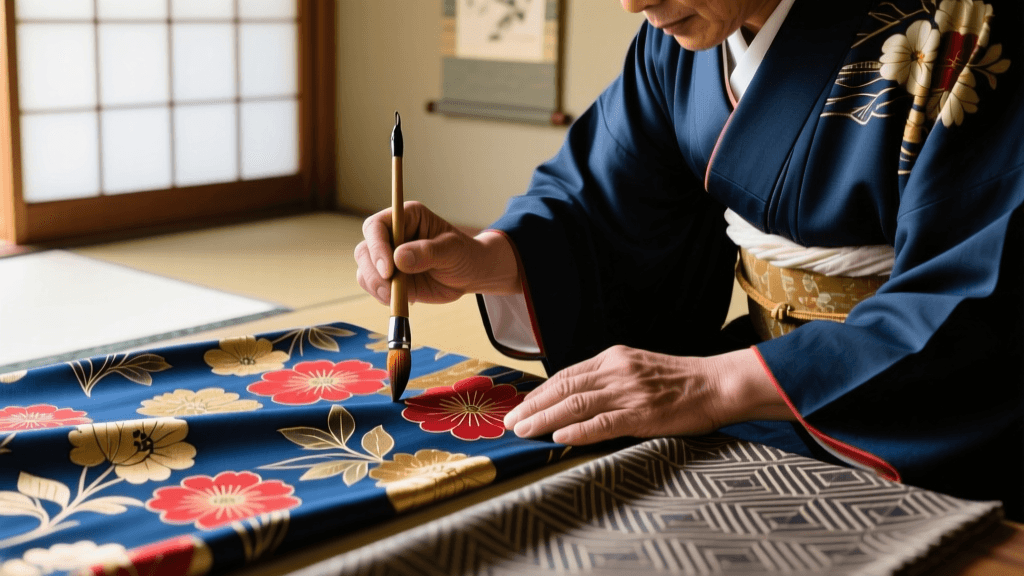
Yuzen is a resist-dyeing technique that allows artisans to paint intricate, multi-colored designs directly onto silk, free from the geometric constraints of weaving or tie-dyeing. Named after Miyazaki Yuzensai, a fan painter from the late 17th century, this technique revolutionized kimono fashion. The Victoria and Albert Museum notes that Yuzen allowed the pictorial and narrative motifs of the Edo period to flourish across the sweeping canvas of the kimono, turning the garment into a wearable painting.
Kyo-Yuzen vs. Kaga-Yuzen
- Kyo-Yuzen (Kyoto): Characterized by vibrant, diverse color palettes, extensive use of gold leaf ('haku'), and stylized, classical motifs. The aesthetic is opulent, highly formal, and heavily influenced by the imperial court.
- Kaga-Yuzen (Kanazawa): Known for its strict adherence to the 'Kaga Five Colors' ('kaga gosai': indigo, crimson, ochre, grass green, and purple). Kaga-Yuzen focuses on hyper-realistic botanical and natural motifs, often employing a technique called 'bokashi' (color gradation) and leaving intentional worm-eaten leaf details for realism.
The Step-by-Step Yuzen Process
- Shita-e (Sketching): The artisan draws the design on the silk using a disappearing ink made from dayflower juice ('aobana').
- Itome-nori (Paste Application): A thick rice-paste resist is carefully piped along the outlines of the sketch. This paste prevents dyes from bleeding into adjacent areas.
- Iro-sashi (Coloring): Artisans hand-paint the dyes within the resist boundaries using fine brushes.
- Jizome (Background Dyeing): Once the painted areas are covered with resist paste, the background is dyed.
- Mushi (Steaming): The fabric is steamed at 100°C to fix the dyes into the silk fibers.
- Mizumoto (Washing): The fabric is washed in cold, running water to remove all rice paste and excess dye, revealing the crisp, white resist lines.
Practical Guide: Commissioning and Caring for Silk Kimono
For those looking to acquire or maintain authentic silk kimono, understanding the logistics of the craft is vital. The intersection of traditional tailoring and modern preservation requires specific knowledge.
Measurements and the Tanmono
Kimono are not cut from wide bolts of fabric like Western clothing. They are constructed from a 'tanmono', a narrow bolt measuring approximately 37 to 38 centimeters (about 15 inches) wide and 12 meters (about 13 yards) long. Because the fabric is woven to this exact width, the kimono is tailored using straight seams with minimal cutting, allowing the garment to be entirely deconstructed and re-dyed or re-tailored. When commissioning a custom Yuzen kimono, the artisan will dye the motifs specifically mapped to your body measurements ('chakutaku') so that the primary designs fall perfectly on the front panels and back seams.
Costs and Timelines
Authentic, hand-painted Yuzen Chirimen kimono are significant investments. A standard hand-painted 'homongi' (visiting kimono) takes 3 to 6 months to complete and costs between $4,000 and $12,000 USD. Masterpiece-level furisode with heavy gold leaf application can exceed $20,000 USD and take over a year to produce. Be wary of Yuzen-style garments priced under $500; these are almost certainly digitally printed or silk-screened using synthetic stencils ('kata-yuzen'), lacking the characteristic raised white resist lines of true hand-painted ('tegaki') Yuzen.
Preservation and Maruarai
Never attempt to wash a silk kimono in water. The Chirimen crepe texture will irreparably shrink, and the water-soluble dyes will bleed. Instead, rely on 'maruarai', the traditional Japanese method of full-garment spot cleaning and solvent washing. A professional maruarai service costs between $80 and $150 USD and should be performed every 3 to 5 years, or immediately if the garment is exposed to high humidity or spills. Store your silk kimono folded in acid-free 'tatoushi' paper, inside a wooden drawer made of paulownia ('kiri'), which naturally regulates humidity and repels insects.
'The beauty of a true Yuzen kimono lies not just in the vibrancy of its colors, but in the pristine white lines of the itome-nori resist. It is the absence of color that defines the masterpiece.' — Master Artisan of the Kyoto Museum of Traditional Crafts.
Conclusion
The creation of a traditional Japanese kimono is a symphony of specialized crafts, from the meticulous twisting of silk threads to create Chirimen, to the patient application of rice paste in Yuzen dyeing. By understanding the distinct properties of these fabrics and the rigorous processes required to adorn them, collectors and enthusiasts can better appreciate the immense cultural and material value woven into every thread of these iconic garments.