Decoding Imperial Chinese Robes: Rank, Color And Symbolism
The Visual Language of Imperial Power
For centuries, the Chinese imperial court operated under strict sumptuary laws that transformed clothing into a rigid, highly codified visual language. In traditional Chinese society, particularly during the Ming (1368–1644) and Qing (1644–1912) dynasties, what a person wore was not a matter of personal preference but a direct reflection of their social status, political rank, and ethnic identity. The Da Ming Huidian (Collected Statutes of the Ming Dynasty) and the subsequent Da Qing Huidian meticulously documented these sartorial regulations, ensuring that every thread, color, and motif served a distinct administrative purpose. To the trained eye of a courtier, a single glance at an official's robe could reveal their exact position within the sprawling imperial bureaucracy, their military or civil designation, and their proximity to the Emperor.
"In Qing China, clothing was a primary marker of identity, indicating not only one's ethnicity but also one's rank, status, and occupation."
— The Metropolitan Museum of Art, Heilbrunn Timeline of Art History
Understanding these rank and color codes is essential for historians, antique textile collectors, and modern Hanfu enthusiasts seeking to accurately recreate or appreciate historical garments. This guide decodes the intricate symbolism of imperial Chinese robes, offering actionable insights into the motifs, colors, and accessories that defined the elite of ancient China.
The Strict Color Codes of the Court
Color was the most immediate indicator of rank and imperial favor. The dyeing process was expensive and heavily regulated, with certain hues reserved exclusively for the royal family. The unauthorized use of imperial colors was considered an act of treason, punishable by severe penalties.
- Bright Yellow (Ming Huang): Reserved exclusively for the Emperor. This color represented the center of the universe and the earth element in Chinese cosmology.
- Apricot Yellow (Xing Huang): Designated for the Crown Prince and the Emperor's direct sons.
- Golden Yellow (Jin Huang): Worn by the Emperor's grandsons and high-ranking imperial princes.
- Blue and Stone Blue (Shi Qing): The standard colors for civil and military officials' semi-formal robes (jifu). The specific shade of blue often indicated seniority, with deeper, richer indigo and lapis shades favored by higher-ranking ministers.
- Red and Crimson: Often used for highly formal court ceremonies, weddings, and by top-tier officials during specific state sacrifices.
- Black, Brown, and Dull Earth Tones: Strictly mandated for commoners, merchants, and the lowest-ranking clerks. Sumptuary laws explicitly forbade the lower classes from wearing bright colors, silk, or embroidered motifs.
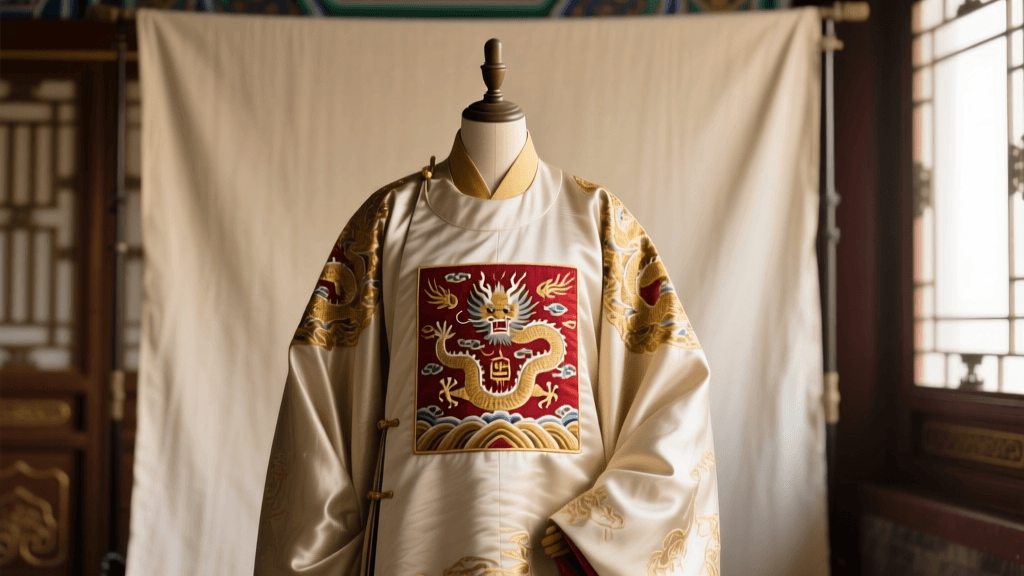
As noted by the Victoria and Albert Museum, the use of dragon motifs alongside these colors further stratified the court. The five-clawed dragon (long) was the Emperor's emblem, while the four-clawed dragon (mang or python) was granted to high-ranking nobles and officials as a mark of supreme imperial favor.
The Buzi (Mandarin Squares): A Wearable Resume
While color indicated broad categories of status, the buzi—commonly known in the West as the "Mandarin Square"—provided exact rank identification. Introduced during the Ming dynasty and refined under the Qing, the buzi was a pair of embroidered squares worn on the front and back of an official's outer surcoat (bufu). Because the surcoat opened down the center front, the front square was typically split into two halves, while the back square remained whole.
The motifs were divided into two primary categories: birds for civil officials (representing literary elegance and administrative grace) and beasts for military officials (representing courage, strength, and martial prowess). According to Encyclopedia Britannica, these squares were not merely decorative; they were legally binding insignia that dictated how an official was addressed, where they stood in court formations, and what privileges they commanded.
Table of Qing Dynasty Civil and Military Rank Motifs
| Rank | Civil Motif (Bird) | Military Motif (Beast) |
|---|---|---|
| 1st Rank | Red-Crowned Crane | Qilin (Mythical Unicorn) |
| 2nd Rank | Golden Pheasant | Lion |
| 3rd Rank | Silver Pheasant | Leopard |
| 4th Rank | Wild Goose | Tiger |
| 5th Rank | Silver Pheasant (Lark in some eras) | Black Bear |
| 6th Rank | White Egret | Panther |
| 7th Rank | Mandarin Duck | Rhinoceros (or Tiger in late Qing) |
| 8th Rank | Quail | Rhinoceros |
| 9th Rank | Paradise Flycatcher | Sea Horse (Mythical aquatic horse) |
Actionable Identification Tip: When examining antique buzi, look for the sun motif. Civil birds are almost always depicted facing or flying toward a red sun (symbolizing the Emperor), while military beasts are typically shown staring straight ahead or looking over their shoulder, symbolizing vigilance and readiness.
Hat Finials and Belt Buckles: Completing the Uniform
The buzi did not work in isolation. An official's rank was corroborated by the finial (knob) on their winter and summer court hats (dingmao) and the materials used in their belt buckles. This multi-layered approach ensured that rank was visible from a distance (via the hat) and up close (via the surcoat and belt).
- 1st Rank: Ruby hat finial; jade belt with gold trim.
- 2nd Rank: Coral hat finial; gold belt with jade inlay.
- 3rd Rank: Sapphire hat finial; gold belt.
- 4th Rank: Lapis Lazuli hat finial; silver-gilt belt.
- 5th Rank: Crystal hat finial; silver belt with gold trim.
- 6th Rank: Opaque white glass (imitating jade) hat finial; silver belt.
- 7th & 8th Rank: Plain gold or gold-plated brass finials; horn or dark wood belts.
- 9th Rank: Plain brass or silver finials; horn belts.
For modern collectors, matching an antique hat finial to its corresponding buzi is a rare and highly prized achievement, as these items were often separated and sold to different buyers in the early 20th century.
Craftsmanship: Kesi, Embroidery, and Dyes
The technique used to create a buzi or dragon robe was as indicative of wealth and rank as the motif itself. The most prestigious technique was kesi (cut silk), a tapestry weaving method that created intricate, unbroken color fields. Kesi was incredibly time-consuming and expensive, usually reserved for the Emperor, the imperial family, and top-ranking officials who could afford to commission master weavers in Suzhou.
More common were squares created using satin stitch embroidery, seed stitch (for the intricate scales of dragons or feathers of birds), and gold couching. In gold couching, threads of spun gold or gold-wrapped silk were laid on the surface of the fabric and stitched down with fine silk threads, creating a raised, luminous effect that caught the candlelight in the imperial halls. The background was often filled with auspicious symbols like bats (symbolizing good fortune), clouds (representing the heavens), and the lishui (diagonal stripes at the bottom representing the deep sea and waves).
Actionable Guide for Collectors and Hanfu Enthusiasts
Whether you are an antique textile collector or a Hanfu tailor aiming for historical accuracy, understanding the physical parameters of these garments is crucial.
1. Sizing and Dimensions
Authentic Qing dynasty Mandarin squares are remarkably consistent in size due to court regulations. A standard buzi measures approximately 29.8 cm x 29.8 cm (11.7 inches). If you are commissioning a historically accurate reproduction for a bufu (surcoat), ensure your tailor adheres to these dimensions. Modern tourist-shop reproductions often shrink this to 20 cm or inflate it to 35 cm, immediately marking the garment as historically inaccurate.
2. Authenticating Antique Buzi
When purchasing antique squares (typically dating from the mid-19th to early 20th century), examine the reverse side. Genuine hand-embroidered pieces will show neat, deliberate stitching, though some loose threads may be present. Machine embroidery, introduced in the late 19th and early 20th centuries, will show perfectly uniform, interlocking loop stitches on the back. Additionally, check the dyes: late Qing pieces often feature synthetic aniline dyes (introduced in the 1860s), which appear harsh and fade to a distinct purplish-pink. Earlier pieces use natural vegetable and mineral dyes, which age into softer, more complex earth tones.
3. Market Costs and Valuation
- Late Qing Reproductions / Tourist Pieces (c. 1920s-1950s): $50 – $150. Often feature machine embroidery or crude handwork.
- Authentic 19th Century Embroidered Squares (Good Condition): $400 – $1,200. Prices spike for military beasts (like the Qilin or Lion) as they are rarer than civil birds.
- Ming Dynasty or Early Qing Kesi Squares: $5,000 – $25,000+. These are museum-quality investments requiring climate-controlled preservation.
4. Preservation and Display
Silk is highly susceptible to light damage and humidity. If you acquire an antique buzi, never frame it with standard glass. Use UV-filtering museum glass and ensure the textile is mounted using acid-free, unbleached cotton backing. Avoid hanging the frame in direct sunlight or near HVAC vents, as fluctuating humidity will cause the silk fibers to become brittle and shatter.
Modern Revival and Cultural Legacy
Today, the intricate symbolism of imperial Chinese robes has transcended its original bureaucratic purpose. In the modern Hanfu movement and contemporary Chinese haute couture, motifs like the red-crowned crane, the fierce qilin, and the sweeping lishui waves are reclaimed as symbols of cultural heritage and artistic excellence. While the strict sumptuary laws have long been abolished, the profound respect for the craftsmanship, color theory, and symbolic depth of traditional Chinese dress remains a vital, living tradition. By understanding the rank and color codes of the past, modern wearers and collectors can fully appreciate the genius of a sartorial system that turned the human body into a canvas of cosmic and political order.