Kimono Silk Road Imports: 2026 Guide To Historical Trade Textiles
The Global Arteries of Japanese Garments
When we envision the traditional Japanese kimono, it is easy to imagine an isolated, purely domestic art form cultivated in the quiet weaving towns of Kyoto and Kanazawa. However, the truth is far more cosmopolitan. The kimono is a canvas that chronicles centuries of global exchange, maritime exploration, and overland caravans. As of 2026, the intersection of historical textile trade routes and modern digital archiving has sparked a massive renaissance in identifying, collecting, and preserving these imported masterpieces.
From the overland Silk Road that brought Persian geometric motifs to the maritime Nanban trade that introduced Indian chintz, historical imports fundamentally altered the trajectory of Japanese fashion. Today, collectors and preservationists are looking beyond domestic silk to understand the hybrid garments born from international commerce. According to the UNESCO Silk Roads Programme, the exchange of textile technologies and raw materials across Eurasia created a shared visual language that Japanese artisans eagerly adapted, localized, and perfected.
Key Historical Imports That Shaped the Kimono
To navigate the 2026 antique textile market, one must first understand the primary categories of historical imports that influenced kimono construction and surface design.
Kara-ori: The Chinese Brocade Legacy
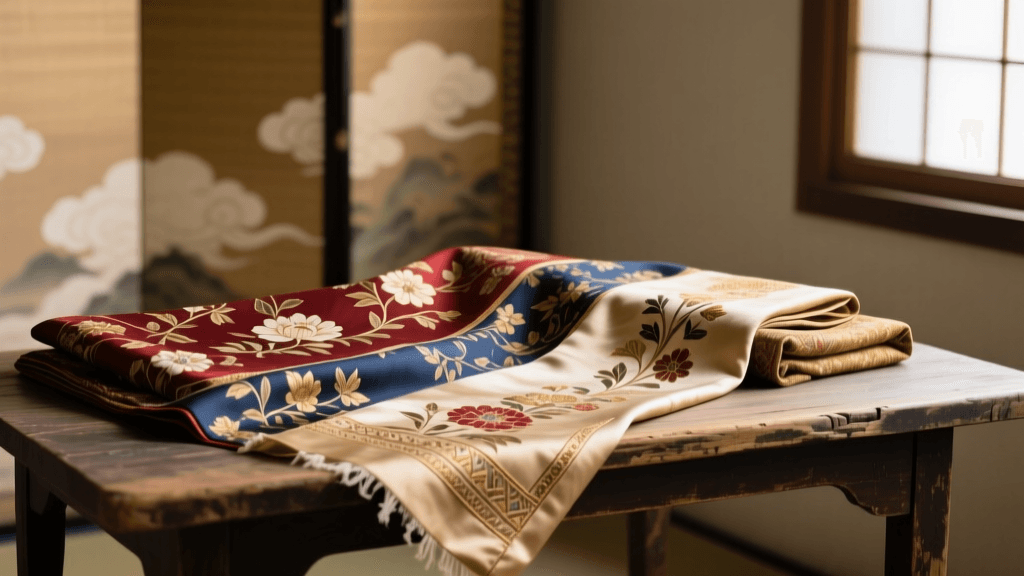
Kara-ori translates literally to "Chinese weave." Imported primarily during the Muromachi (1336–1573) and Edo (1603–1867) periods, these luxurious, heavily patterned brocades were originally reserved for the shogunate, high-ranking samurai, and Noh theater costumes. Woven with supplementary weft threads of gold and silver leaf, Chinese brocades introduced complex motifs like the phoenix, cloud bands, and peonies. By the late Edo period, domestic weavers in Nishijin began replicating these techniques, but true imported kara-ori fragments remain highly coveted by museum curators and elite collectors today.
Sarasa: Indian Chintz and the Nanban Trade
Perhaps no import disrupted Japanese textile norms quite like sarasa (Indian chintz). Brought by Portuguese and Dutch merchants during the Nanban (Southern Barbarian) trade era, these cotton fabrics featured vibrant, colorfast floral patterns achieved through complex mordant dyeing and resist techniques. Curators at the Victoria and Albert Museum's Asian Collections note that Indian chintz was so highly prized in Japan that it was frequently repurposed into uchikake (outer robes), kosode linings, and prestigious tea ceremony accessories. Because Japan lacked native colorfast cotton dyeing techniques at the time, sarasa represented a technological marvel.
Persian Roundels and Central Asian Motifs
The famous shippou (seven treasures) pattern, characterized by interlocking circles, and the karakusa (arabesque) vine motifs both trace their lineage back to Persian and Central Asian textiles that filtered into Japan via China and the Korean peninsula. These geometric and botanical imports were seamlessly integrated into Japanese yuzen dyeing and surihaku (gold leaf application) techniques, creating a hybrid aesthetic that is distinctly Japanese yet globally rooted.
2026 Collector’s Market: Identifying Trade-Route Textiles
The vintage kimono market in 2026 is highly sophisticated. With the advent of smartphone-based spectral imaging apps, collectors can now verify the presence of natural indigo, madder root, and imported synthetic aniline dyes on the spot. However, identifying the structural and motif-based evidence of historical trade routes requires a trained eye.
When scouring antique markets like Kyoto’s Toji Temple flea market or specialized online auction houses, look for these distinguishing features of trade-route textiles:
- Asymmetrical Floral Sprays: Indicative of early European and Indian chintz influences, breaking away from traditional Japanese symmetrical placement.
- Metallic Thread Oxidation: Authentic imported kara-ori often features silver threads that have oxidized to a deep, uniform black, unlike modern 20th-century synthetic metallics.
- Hybrid Fiber Blends: Garments featuring a silk exterior with a heavy, imported cotton lining often point to the repurposing of prized foreign trade goods.
2026 Market Valuation Table: Historical Import Motifs
| Textile / Motif Type | Historical Origin | Identifying Features (2026 Market) | Est. 2026 Auction Value (USD) |
|---|---|---|---|
| Authentic Edo Sarasa (Chintz) | India / Coromandel Coast | Madder-dyed cotton, floral sprays, repurposed as obi or kosode lining | $3,500 - $8,000+ |
| Ming Dynasty Kara-ori Fragments | China | Heavy silk brocade, gold leaf weft, cloud band motifs | $1,200 - $4,500 (per fragment) |
| Persian Roundel Adaptations | Persia via Silk Road | Interlocking medallions, early yuzen resist dyeing on silk | $800 - $2,200 |
| Nanban Trade Velvet (Birodo) | Portugal / Netherlands | Cut voided velvet, often used in haori collars or sword bags | $1,500 - $3,000 |
Modern 2026 Revivals by Contemporary Artisans
The fascination with historical imports is not limited to antique collectors. In 2026, a new generation of Japanese artisans is actively reviving these lost trade techniques. Weavers in the Nishijin district are utilizing digital jacquard looms programmed with 3D scans of surviving kara-ori fragments housed in the Kyoto National Museum to recreate the exact tension and sheen of Ming dynasty brocades.
Similarly, natural dyers in Okinawa and Kyushu are experimenting with historical mordant recipes to recreate the vibrant, colorfast reds and yellows of imported Indian sarasa, applying them to modern, lightweight kimono silks. These contemporary revival pieces are highly sought after by international buyers who appreciate the fusion of ancient global trade history with cutting-edge 2026 sustainable weaving practices.
Archival Preservation for Hybrid Trade Textiles
Preserving kimonos that feature imported materials requires specialized knowledge, particularly because these garments often combine disparate fibers—such as a delicate domestic silk exterior with a rigid, imported cotton or velvet lining. In 2026, archival standards for these hybrid textiles are stringent.
Climate Control and Smart Monitoring
Mixed-fiber garments react differently to humidity. Silk requires a stable environment to prevent shattering, while cotton and wool are susceptible to mold and pest infestations. The current 2026 conservation standard dictates maintaining a relative humidity (RH) of exactly 45% to 50%, with temperatures kept between 18°C and 20°C (64°F - 68°F). Serious collectors now utilize wireless, Bluetooth-enabled micro-sensors placed inside archival storage boxes to monitor micro-climate fluctuations in real-time via smartphone applications.
Proper Storage Materials
Never store historical trade textiles in standard plastic bins, which off-gas volatile organic compounds (VOCs) that degrade natural dyes. Instead, wrap the kimono in unbuffered, acid-free tatou (traditional Japanese paper) or modern archival-grade Tyvek. For heavily embroidered kara-ori or velvet birodo imports, the garments must be stored flat rather than folded. Folding causes irreversible stress fractures in the metallic threads and crushes the velvet pile. Use acid-free tissue paper to gently stuff the sleeves and bodice, maintaining the garment's three-dimensional structure without placing tension on the historical seams.
Conclusion
The kimono is far more than a symbol of isolated Japanese tradition; it is a wearable archive of global connectivity. From the dusty caravans of the Silk Road to the bustling maritime ports of the Nanban trade, historical imports provided the raw materials, motifs, and technological inspiration that elevated Japanese textile arts to their zenith. As we navigate the 2026 collector’s market, understanding these trade routes allows us to appreciate the kimono not just as a beautiful garment, but as a profound testament to centuries of cross-cultural exchange. Whether you are authenticating a fragment of Ming brocade or preserving a repurposed Indian chintz obi, you are actively safeguarding the physical legacy of the ancient global economy.