Zero-Waste Kimono Construction Techniques for 2026 Makers
The Renaissance of Zero-Waste Asian Garment Construction
As the global fashion industry faces stringent sustainability mandates in 2026, contemporary designers and home sewists are looking to the past for solutions. The traditional Japanese kimono stands as the ultimate masterclass in zero-waste pattern drafting and garment construction. Unlike Western tailoring, which relies on curved seams, darts, and significant fabric offcuts, the kimono is engineered from a single, continuous bolt of fabric using a strictly rectangular cutting system. According to The Metropolitan Museum of Art's Heilbrunn Timeline of Art History, the kimono's T-shaped, straight-line construction is not merely an aesthetic choice, but a profound reflection of textile preservation and respect for the material.
For modern makers in 2026, understanding these historical Asian dress traditions offers a blueprint for creating sustainable, modular, and deeply intentional wardrobes. This guide explores the core construction techniques of the kimono, from the mathematics of the tanmono bolt to the meticulous art of shitsuke basting, providing actionable steps to integrate these methods into your current sewing practice.
The Tanmono System: Mathematics of the Rectangle
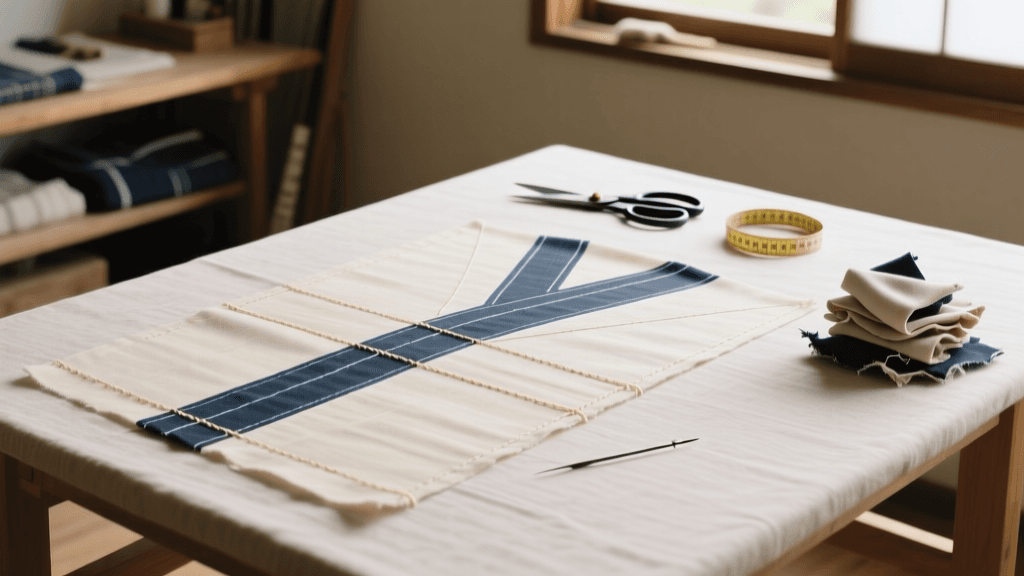
The foundation of kimono construction is the tanmono, a standard bolt of fabric woven specifically for garment making. A traditional kimono tanmono measures approximately 36 centimeters (14.2 inches) in width and 11 to 12 meters (12 to 13 yards) in length. This exact dimension is not arbitrary; it is mathematically calculated to yield one complete adult kimono with absolutely zero fabric waste.
The garment is constructed from eight primary rectangular panels: two main body panels (mi-goro), two sleeve panels (sode), two front overlap panels (okumi), and a collar (eri). Because there are no curved armholes or tailored waistlines, the fabric's structural integrity remains unbroken. In 2026, as zero-waste pattern drafting software becomes mainstream, the tanmono system remains the gold standard for efficiency. When a maker cuts a kimono, the only 'waste' is the minimal thread used in the seams, and even the leftover fabric from the sleeve openings (sodeguchi) is traditionally repurposed for zori (sandals) or small pouches.
Shitsuke: The Art of Basting Over Pinning
In Western sewing, metal pins and plastic clips are the default tools for holding seams together before machine stitching. In traditional Japanese kimono making, metal pins are almost never used. Instead, makers rely on shitsuke, a highly specific form of temporary hand-basting. This technique is especially critical when working with delicate silks, brocades, or modern sustainable cupros that are prone to snagging and distortion.
Why Shitsuke is Superior for Delicate Textiles
Metal pins create micro-perforations in silk fibers and can cause the fabric layers to shift or pucker as they pass under a presser foot. Shitsuke uses a soft, easily breakable cotton basting thread that holds the fabric flat and perfectly aligned without introducing tension or holes. According to conservation experts at the Smithsonian National Museum of Asian Art, the temporary nature of these stitches allows the garment to be adjusted dynamically during the fitting process, a necessity when drafting the complex waist fold (ohashori).
Step-by-Step Shitsuke Technique for 2026 Makers
- Thread Selection: Use 100% cotton basting thread. Avoid polyester, as it is too strong and can tear delicate silk when removed.
- Stitch Length: For long, straight kimono seams, use a running stitch approximately 1 centimeter (0.4 inches) in length.
- The Anchor Knot: Do not use bulky knots. Start your basting with a simple loop and a single backstitch to anchor the thread, ensuring it pulls out smoothly later.
- Tension Control: The thread must lie flat against the fabric. If the basting is too tight, the seam will ripple; if too loose, the layers will slide. Maintain a relaxed, even tension.
Seam Allowances and the Ara-Hari Philosophy
Perhaps the most revolutionary aspect of kimono construction for the modern sustainable fashion movement is the treatment of seam allowances. In Western tailoring, seam allowances are often trimmed, graded, and finished with sergers to prevent fraying, permanently locking the garment into its current size and shape. Kimono seams are entirely different.
The standard seam allowance in a kimono is quite generous, often ranging from 1.5 to 2.5 centimeters. However, these allowances are never cut away. Instead, the raw edges are folded inward toward the seam line and enclosed within the fold of the fabric itself. This creates a clean, finished edge without the need for overlocking or binding.
This construction method facilitates ara-hari, the traditional practice of completely unsewing a kimono for washing. Historically, silk could not be submerged in water without losing its shape or luster. By unsewing the garment, the maker could wash the individual flat panels, stretch them on wooden boards to dry (shinshi), and then re-sew the kimono, making it look brand new. In 2026, this modular approach to garment care is being adopted by avant-garde sustainable brands to extend the lifecycle of luxury textiles, allowing garments to be resized, repaired, or reconfigured across decades.
Comparison: Kimono vs. Western Tailoring
Understanding the structural differences between Asian and Western garment construction is vital for makers looking to expand their technical repertoire. The table below outlines the core distinctions.
| Construction Feature | Traditional Japanese Kimono | Standard Western Tailoring |
|---|---|---|
| Pattern Geometry | Straight lines, pure rectangles | Curved lines, darts, gussets |
| Fabric Waste | Zero waste (entire bolt utilized) | 15% to 25% offcut waste |
| Seam Finishing | Folded and enclosed (un-cut) | Serged, overlocked, or bound |
| Assembly Method | Hand-basted (shitsuke), then sewn | Pinned or clipped, then sewn |
| Garment Lifecycle | Modular (can be unsewn and resized) | Fixed (difficult to alter significantly) |
Drafting the Okumi and Eri: The Front Closure
The front overlap (okumi) and the collar (eri) are where the rectangular system demonstrates its true genius. The okumi is not a separate piece sewn onto the front; it is cut from the same continuous panel as the main body (mi-goro). The fabric is simply folded back on itself to create the overlapping front closure, ensuring the grainline remains perfectly straight and the pattern motifs flow uninterrupted across the body.
The collar (eri) is a long, narrow rectangle, typically cut at 15 centimeters wide and folded in half lengthwise to create a finished width of 7.5 centimeters. It is attached to the neckline using a precise basting technique that allows the collar to curve gently around the neck without the need for clipping or notching the seam allowance. The Victoria and Albert Museum Asian Collections frequently highlights how this un-notched collar construction preserves the structural integrity of heavily embroidered or metallic-woven silks, preventing the fraying that would occur if the fabric were clipped to fit a curve.
Sourcing Authentic Materials in 2026
For makers ready to attempt these techniques, sourcing the correct materials is the first step. While weaving a custom 36cm tanmono bolt can be prohibitively expensive, the secondary market in 2026 is thriving. Vintage, unworn silk tanmono bolts (often referred to as shitate-agari or ready-to-sew bolts) can be sourced from specialized Japanese textile exporters and online auction houses.
As of early 2026, a standard vintage silk tanmono ranges from $80 to $150 USD, while newly woven, artisanal silk bolts from regions like Kyoto or Niigata can command prices between $400 and $1,200 USD. For practice, modern makers often substitute with 36cm wide organic cotton or linen wraps, which mimic the drape and weight of traditional everyday kimono textiles without the high cost of silk.
Adapting Traditional Techniques for Modern Wardrobes
You do not need to construct a full formal kimono to benefit from these techniques. The haori (a shorter, open-front jacket) utilizes the exact same rectangular cutting system but requires less fabric and offers a highly versatile layering piece for contemporary 2026 streetwear. By applying shitsuke basting and enclosed seam allowances to a modern haori drafted from deadstock denim or heavyweight linen, makers can create zero-waste, modular outerwear that honors Asian dress traditions while fitting seamlessly into a modern, sustainable lifestyle.
'The kimono is not merely a garment; it is a temporary arrangement of a continuous textile. We are simply borrowing the fabric's form for a time.'
— Traditional Kyoto Textile Proverb
By embracing the mathematics of the tanmono, the patience of shitsuke, and the longevity of ara-hari, today's sewists can elevate their craft. These Asian construction techniques prove that true sustainability in fashion is not a modern invention, but a historical practice waiting to be rediscovered.