Kimono Extreme Weather Guide 2026: Rain, Snow & Heat
The Challenge of Modern Climates on Traditional Silk
As we navigate the accelerating climate shifts of 2026, wearing traditional Japanese garments requires more than just an understanding of aesthetics and etiquette; it demands practical, weather-ready adaptations. Japan's distinct four seasons have historically dictated the rhythm of kimono wear, but recent years have brought unprecedented summer heatwaves, torrential typhoon rains, and unpredictable winter snowfalls. For modern enthusiasts and cultural practitioners, preserving the integrity of delicate silks while maintaining personal comfort in extreme weather is a top priority.
The kimono is inherently adaptable. Its layered nature allows for insulation in the cold, while its open, flat-cut construction promotes airflow in the heat. However, when faced with extreme conditions, traditional methods must be augmented with modern innovations. According to the Victoria and Albert Museum's comprehensive guide to the kimono, the garment has always been a reflection of both social status and environmental harmony. Today, that harmony involves integrating advanced textiles and protective gear without compromising the silhouette's elegant lines.
Beating the Summer Heat: Ro, Sha, and Cooling Tech
Japanese summers are notoriously hot and humid. To combat this, traditional wardrobes rely on specific seasonal fabrics, primarily Ro and Sha. Ro features a leno weave where warp threads are twisted in pairs, creating tiny, structured gaps that allow for exceptional breathability. Sha is a lighter, more sheer gauze weave. In 2026, master weavers in regions like Nishijin and Kawamata are producing these fabrics using ultra-fine, high-twist yarns that maximize airflow while maintaining the crisp drape required for formal summer events.
However, fabric alone is rarely enough to survive a 35°C (95°F) July afternoon. The secret to modern summer kimono wear lies in the undergarments, known as juban. In 2026, the market has seen a surge in specialized cooling hadajuban (innermost undershirt) and susoyoke (half-slip) made from advanced moisture-wicking and contact-cooling synthetic blends. Brands have adapted technologies similar to those used in high-performance athletic wear, creating kimono-specific underlayers that pull sweat away from the skin and actively lower surface temperature.
For casual summer wear, the cotton yukata remains the undisputed champion. Modern yukata often feature shijira-ori (a textured crepe weave) which prevents the fabric from clinging to sweaty skin. Pairing a yukata with a breathable bamboo-fiber koshihimo (tying sash) ensures that the garment stays secure without trapping excess heat around the torso.
Navigating the Rain: Kappa, Geta, and Nano-Coatings
Rain is the natural enemy of silk. A sudden downpour can cause water spots, shrinkage, and irreversible dye bleeding. Historically, kimono wearers relied on the kappa, a traditional raincoat made from oiled paper or treated cotton, to protect their garments. While vintage oiled-paper kappa are beautiful collector's items, they are heavy and lack breathability. The 2026 iteration of the kappa utilizes lightweight, matte-finished Gore-Tex and hydrophobic nano-polyesters that mimic the drape of silk while offering absolute waterproofing.
Footwear is equally critical. Standard zori sandals will quickly become waterlogged and ruined in a puddle. For rainy days, traditionalists turn to taka-ashida geta—wooden clogs with exceptionally high teeth (often 5 to 7 centimeters tall) that elevate the kimono hem well above the wet pavement. To modernize this, 2026 has introduced durable, transparent silicone zori covers that slip over standard formal sandals, providing an emergency waterproof barrier without requiring a complete change of footwear.
Furthermore, textile conservationists now recommend the use of specialized, silk-safe hydrophobic nano-sprays. Unlike the heavy aerosol waterproofers of the past decade, these 2026 formulations create a microscopic, breathable barrier on the silk's surface, causing light rain to bead up and roll off without altering the fabric's hand-feel or trapping moisture inside the fibers.
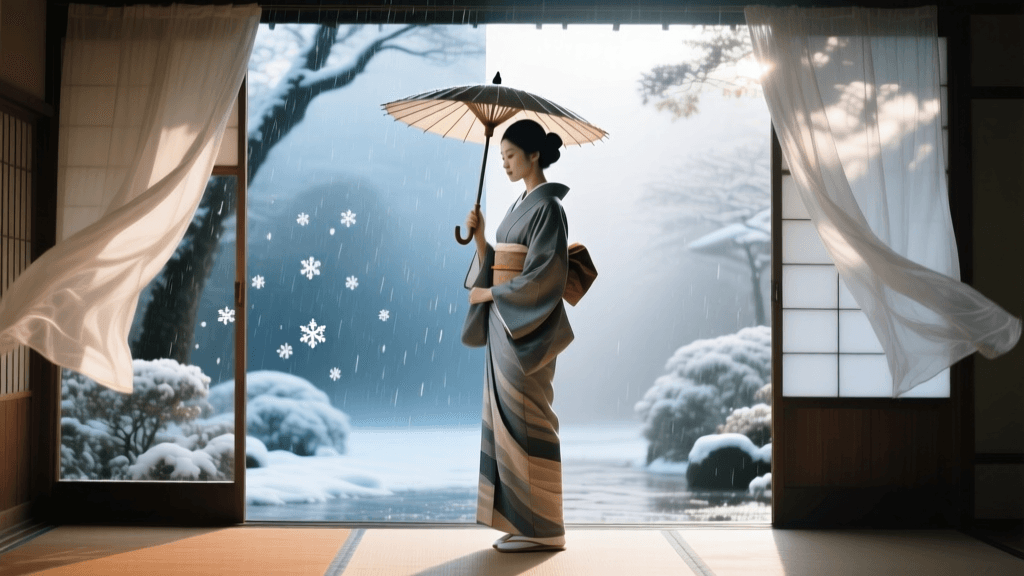
Braving the Snow: Strategic Layering and Insulation
Winter kimono wear is an art of hidden insulation. The visual elegance of the kimono relies on a smooth, cylindrical silhouette, meaning bulky winter coats are generally avoided in favor of strategic layering. The foundational layer, the nagajuban (under-kimono), transitions from lightweight silk or hemp in the summer to heavy wool, flannel, or modern thermal synthetics in the winter.
Over the kimono, women often wear a michiyuki (a square-necked overcoat) or a haori (a hip- or thigh-length jacket). In 2026, many high-end haori are constructed with hidden, ultralight down inserts or battery-operated graphene heating panels woven directly into the lining. These panels connect to a discreet, pocket-sized power bank, providing hours of radiant heat without adding visible bulk.
Extremities require special attention. Standard cotton tabi (split-toe socks) offer zero insulation against freezing snow. Winter tabi are lined with thermal fleece or wool blends. Additionally, disposable or rechargeable kairo (heat packs) are essential. The strategic placement of kairo is crucial for core temperature regulation: one is typically placed on the lower back (koshi), one on the lower abdomen, and smaller adhesive packs are applied to the soles of the feet or the ankles to prevent the cold from traveling up the legs.
2026 Kimono Weather Adaptation Matrix
To help you plan your wardrobe, refer to the following adaptation matrix detailing the best garments and technologies for specific extreme weather scenarios.
| Weather Condition | Primary Garment / Accessory | 2026 Material Innovation | Protection Level |
|---|---|---|---|
| Extreme Heat (>32°C) | Ro Kimono & Cooling Juban | Contact-cooling synthetic underlayers; leno-weave silk | High (Airflow & Moisture Wicking) |
| Heavy Rain / Typhoon | Modern Kappa & Taka-ashida | Matte Gore-Tex raincoats; silicone zori overshoes | Maximum (Waterproof Elevation) |
| Freezing Snow (<0°C) | Wool Nagajuban & Heated Haori | Graphene-lined heating panels; thermal fleece tabi | Maximum (Core & Extremity Insulation) |
| High Humidity / Mold Risk | Silk-safe Desiccants & Airflow Hangers | Activated charcoal wardrobe inserts; cedarwood hangers | High (Preservation & Drying) |
Post-Exposure Care and Maintenance
Surviving extreme weather is only half the battle; proper post-exposure care is what ensures your garments last for generations. After wearing a kimono in high humidity or rain, it must never be folded immediately. The garment should be hung on a specialized, wide-shouldered kimono hanger (emono-kake) in a well-ventilated, climate-controlled room for at least 24 hours to allow trapped moisture to evaporate.
For snow and winter wear, brushing the hem with a soft-bristled garment brush is essential to remove salt, mud, or slush before it dries and sets into the silk. The Metropolitan Museum of Art's historical overview of Japanese dress emphasizes that the longevity of these textiles relies heavily on meticulous, proactive conservation. If a silk kimono does suffer water damage, do not attempt to wash it at home. Seek out a professional arai-hari service—a traditional Japanese cleaning method where the kimono is completely unstitched, washed as flat panels of fabric, and then re-sewn, ensuring the removal of all stains and the restoration of the fabric's original tension.
Conclusion
The kimono is not a fragile relic confined to climate-controlled museums; it is a living, breathing garment meant to be worn in the real world. As detailed in the Metropolitan Museum of Art's resource on Japanese textiles, the evolution of Japanese dress has always been intertwined with material innovation. By embracing the advanced cooling fabrics, hydrophobic treatments, and thermal layering techniques available in 2026, you can honor the beauty of Asian traditions while confidently stepping out into the rain, snow, and sweltering heat.