Kimono Extreme Weather Guide 2026: Rain, Snow & Heat
The Evolution of Kimono in a Changing Climate
Japan's weather is notoriously diverse, ranging from the sweltering, humid summers of Kyoto to the heavy, persistent snowfalls of Hokkaido and the Sea of Japan coast. In 2026, as global temperature shifts bring more intense summer heatwaves and increasingly unpredictable rainy seasons, wearing a traditional kimono requires strategic, modern adaptations. The kimono is not merely a static historical artifact; it is a living, breathing garment that has continuously evolved alongside Japan's climate. According to the Japan Meteorological Agency, shifting climate patterns have led to a higher frequency of extreme weather days, making traditional weather-proofing techniques more relevant than ever. Today's kimono wearers blend centuries-old textile wisdom with cutting-edge 2026 material science to maintain elegance and comfort, no matter what the sky decides to do.
Beating the Heat: Summer Kimono Adaptations
The Japanese summer is characterized by oppressive humidity and intense solar radiation. Historically, the transition to summer wear, known as koromogae, involved switching to unlined (hitoe) and sheer garments. In 2026, the cornerstone of summer kimono dressing remains the use of specialized open-weave silks, primarily Ro and Sha. Ro features a leno weave with distinct horizontal and vertical stripes of open gaps, while Sha is a lighter, more delicate gauze weave that offers maximum airflow.
However, the true revolution in 2026 summer kimono wear lies beneath the silk. Modern juban (undergarments) are now frequently crafted from advanced contact-cooling synthetic blends, such as high-grade Toyo Rayon infused with Qmax 0.3+ cooling yarns. These under-layers wick sweat away from the body and provide an immediate cooling sensation upon contact with the skin, preventing the outer silk from clinging or staining. Additionally, traditional Kyo-wasanbon cooling powders, now formulated with natural menthol and bamboo charcoal, are applied to the skin to lower body temperature and absorb excess moisture before dressing.
Summer Fabric Comparison Chart
| Fabric Type | Weave Structure | Transparency | Best Use Case | 2026 Avg Price (USD) |
|---|---|---|---|---|
| Ro (Silk) | Leno weave with striped gaps | Medium | Formal summer events, tea ceremonies | $450 - $800 |
| Sha (Silk) | Open gauze weave | High | High-heat outdoor festivals, July/August | $350 - $600 |
| Chijimi (Crepe) | Twisted yarns creating texture | Low | Early summer, casual outings | $200 - $400 |
| Modern Cooling Synthetics | Tightly woven moisture-wicking | None (Used for Juban) | Undergarments for extreme heat | $60 - $120 |
Navigating the Rain: Tsuyu (Rainy Season) Survival
The Tsuyu, or rainy season, poses the greatest threat to traditional silk garments. Water can cause silk to shrink, warp, and permanently stain. Historical rain garments preserved at the Tokyo National Museum reveal that Edo-period travelers relied on heavy, oiled paper amagappa (rain capes) and woven straw coats. While beautiful, these are entirely impractical for the modern commuter.
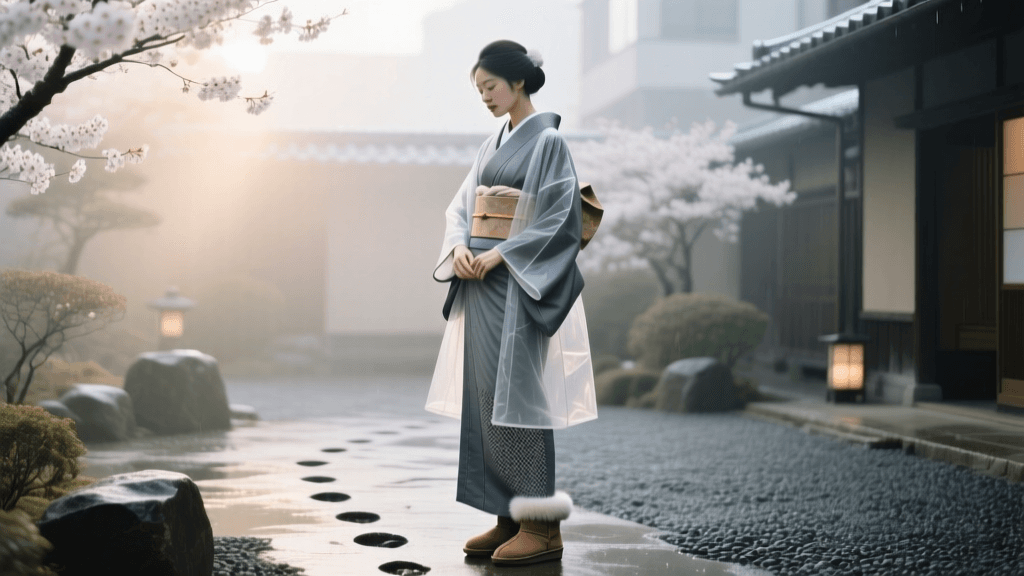
In 2026, the modern kimono wearer relies on lightweight, breathable Teflon-coated kimono rain ponchos. These contemporary amagappa are designed with hidden magnetic closures and adjustable hems that snap up to keep the fabric away from muddy puddles. They fold down into a compact pouch that easily fits into a standard handbag. For the lower half of the body, suso-yoke (hem guards) made from water-resistant synthetic crepe are wrapped around the waist beneath the kimono to protect the delicate silk hem from accidental splashes.
Footwear during the rainy season requires specialized gear. Traditional shigure geta (rain clogs) feature a built-in toe cover to protect the tabi socks. Today, these are often paired with modern silicone shigure-dai (rain covers) that stretch over standard zori sandals, providing a waterproof seal that keeps the hanao (thongs) and the wearer's feet completely dry while navigating slick urban streets.
Embracing the Snow: Winter Layering & Footwear
Winter in regions like Kanazawa, Niigata, and Sapporo brings freezing temperatures and deep snow. The philosophy of winter kimono dressing is rooted in kasane, the art of strategic layering. Rather than relying on a single heavy garment, warmth is achieved by trapping air between multiple thin layers. A standard winter ensemble begins with a quilted nagajuban (full-length under-kimono) lined with silk floss or modern thermal batting.
Over the kimono, a haori (short jacket) or a michiyuki (square-necked coat) is worn. In 2026, many high-end michiyuki coats feature outer shells treated with eco-friendly DWR (Durable Water Repellent) finishes, allowing snow to brush off without melting into the fabric. When traveling to snowy cultural heritage sites, the Japan National Tourism Organization notes that proper footwear is essential for both safety and preserving traditional aesthetics.
Historically, winter travelers wore yuki-wara-zori, straw sandals stuffed with extra straw for insulation and traction. While authentic yuki-wara-zori are still crafted by master artisans in snowy prefectures, most modern wearers opt for waterproof leather zori with thick, non-slip rubber soles. These are paired with thermal, water-resistant tabi socks featuring fleece-lined interiors and reinforced rubber toe caps, ensuring that the feet remain warm and dry even when walking through fresh powder.
The Art of Kasane: Hidden Winter Warmth
Beyond the visible layers, the secret to surviving extreme cold in a kimono lies in hidden accessories. Haramaki (belly warmers) made from cashmere or merino wool are worn tightly around the core to retain body heat. Leg warmers designed specifically to fit under tabi socks protect the calves, while specialized silk-lined stole (shawls) are draped elegantly over the shoulders beneath the haori. In 2026, discreet, rechargeable graphene heating pads are also available, slipping into the pockets of the haori or resting against the lower back to provide up to eight hours of continuous, adjustable warmth without adding bulk to the silhouette.
2026 Essential Weather Gear Checklist & Costs
Building a weather-resistant kimono wardrobe requires an investment in specialized accessories. Below is a checklist of essential 2026 gear for the dedicated kimono enthusiast, complete with current market pricing.
- Modern Amagappa (Rain Poncho): A lightweight, water-resistant coat with magnetic closures and snap-up hems. Essential for the Tsuyu season. Estimated Cost: $85 - $150 USD.
- Silicone Shigure-Dai (Zori Rain Covers): Stretchable, waterproof covers that protect traditional sandals from puddles and mud. Estimated Cost: $20 - $35 USD per pair.
- Contact-Cooling Juban (Summer Undergarment): Moisture-wicking, Qmax-rated synthetic under-kimono that prevents sweat damage to outer silk layers. Estimated Cost: $70 - $130 USD.
- Water-Resistant Michiyuki Coat: A winter overcoat treated with DWR finish to shed snow and light sleet, featuring a thermal inner lining. Estimated Cost: $250 - $500 USD.
- Thermal Rubber-Soled Tabi: Fleece-lined split-toe socks with reinforced, water-resistant rubber soles for snowy terrain. Estimated Cost: $45 - $80 USD.
- Graphene Heating Pads: Ultra-thin, rechargeable warming pads designed to slip into kimono sleeves or haori pockets for extreme cold. Estimated Cost: $60 - $90 USD.
Conclusion
The kimono is a testament to human ingenuity and the deep, abiding connection between Japanese culture and the natural world. As we navigate the extreme weather patterns of 2026, the adaptations we make—from the sheer, breathing weaves of summer Ro silk to the insulated, water-resistant layers of winter kasane—ensure that this magnificent garment remains a vibrant part of daily life. By respecting traditional techniques and embracing modern textile innovations, wearers can step out into the rain, snow, and blistering heat with confidence, knowing their attire is as resilient as it is beautiful.