Kimono Storage Preservation 2026: Archival Care Guide
The Art and Science of Kimono Preservation in 2026
Preserving a traditional Japanese kimono is an intricate balance of honoring historical craftsmanship and utilizing modern archival science. Whether you are managing a single family heirloom or curating a vast collection of Edo-period textiles, the organic nature of silk, hemp, and cotton makes them highly susceptible to environmental degradation. In 2026, the standard for kimono storage preservation has evolved, merging centuries-old Japanese techniques with advanced climate monitoring technology to ensure these garments survive for future generations.
Unlike Western historical garments that are often stored on padded hangers, kimono are strictly stored flat and folded. This method prevents stress on the shoulder seams and maintains the structural integrity of the tanmono (bolt of fabric) from which they were originally constructed. However, flat storage introduces its own challenges, primarily regarding humidity fluctuations, acid migration, and pest infiltration. According to guidelines published by the American Institute for Conservation, improper storage environments can lead to irreversible silk shattering and dye bleeding within just a few seasons.
Climate Control: The Invisible Guardian
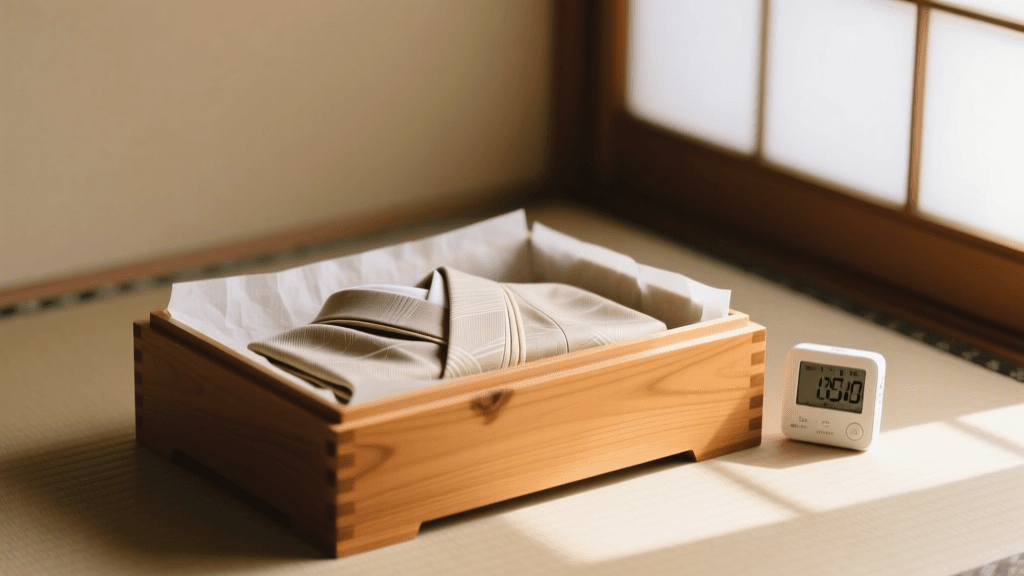
The most critical factor in kimono collection management is environmental stability. Silk is a protein fiber that reacts violently to rapid shifts in temperature and relative humidity (RH). In 2026, professional collectors and private archivists rely on smart, Wi-Fi-enabled data loggers to monitor micro-climates inside storage rooms and individual cabinetry.
Ideal Environmental Metrics
- Temperature: Maintain a consistent 18°C to 20°C (64°F to 68°F). Higher temperatures accelerate the chemical breakdown of silk proteins and promote mold growth.
- Relative Humidity (RH):strong> Keep RH strictly between 45% and 55%. Humidity below 40% causes silk to become brittle, while levels above 60% invite mold spores and metallic thread tarnishing.
- Light Exposure: Store garments in total darkness. Ultraviolet (UV) and even ambient visible light will cause irreversible fading of natural dyes like indigo and safflower.
To achieve this, modern collection managers utilize museum-grade HVAC systems equipped with HEPA and activated carbon filtration to remove airborne pollutants and sulfur compounds that can tarnish the gold and silver leaf often found in formal uchikake (wedding kimono).
Traditional vs. Modern Storage Materials
The physical materials that touch or surround a kimono are just as important as the air around it. The traditional Japanese approach to textile storage remains the gold standard, though it is now supplemented by modern archival plastics.
Tatoushi: The Archival Wrapping Paper
A kimono should never be stored bare. It must be wrapped in tatoushi, a specialized, acid-free, and lignin-free paper. Traditional tatoushi is made from high-quality mulberry (kozo) fibers, which possess exceptionally long, interlocking strands that provide immense tensile strength without shedding lint. Standard dimensions for a kimono tatoushi sheet are approximately 85 cm by 65 cm. When wrapping, the paper acts as a buffer against sudden humidity spikes and prevents acid migration from outer storage boxes.
Kiri-bako: Paulownia Wood Storage Boxes
For long-term preservation, the kiri-bako (paulownia wood box) is unmatched. Paulownia is a lightweight, fast-growing timber that possesses natural fire-retardant properties and a unique cellular structure that allows it to 'breathe.' When the ambient humidity rises, the wood absorbs moisture and swells, sealing the box's joints and creating a stable micro-climate inside. When the air dries, the wood contracts, allowing the interior to ventilate. This natural hygrometric regulation is why the Victoria and Albert Museum and other global institutions frequently utilize similar breathable wooden enclosures for their Asian textile archives.
Comparing Storage Vessels for Kimono Collections
Choosing the right outer vessel depends on your budget, space, and the value of the textiles. Below is a comparison of the most common storage methods utilized by collectors in 2026.
| Storage Method | Breathability | Pest Resistance | Cost (2026 Estimate) | Best Use Case |
|---|---|---|---|---|
| Paulownia Box (Kiri-bako) | Excellent | High (Natural) | $150 - $400 per box | Heirloom silk, formal wear, long-term archival |
| Archival Polypropylene Bin | Poor (Sealed) | Excellent | $40 - $90 per bin | Bulk storage, cotton/yukata, flood-prone areas |
| Cotton Storage Cover | High | Low | $15 - $30 per cover | Short-term storage, frequent rotation garments |
| Traditional Tansu (Chest) | Moderate | Moderate | $800 - $3,000+ | Display rooms, dedicated climate-controlled spaces |
Pest Management: Protecting Silk Without Chemicals
The larvae of clothes moths and carpet beetles feed on keratin and fibroin, the proteins that make up silk and wool. Historically, collectors relied on naphthalene or paradichlorobenzene mothballs. In 2026, these volatile organic compounds (VOCs) are strictly avoided in professional conservation, as they can chemically react with metallic threads, degrade synthetic linings, and leave a pervasive, nearly impossible-to-remove odor in the silk fibers.
Instead, modern preservation utilizes natural Japanese camphor (shounou), extracted from the Cinnamomum camphora tree. Camphor provides a gentle, natural deterrent that sublimates safely without damaging delicate dyes. Additionally, collectors deploy non-toxic pheromone traps in the periphery of the storage room to monitor and intercept male moths before they can mate, providing an early warning system without introducing poisons to the storage environment.
The Hon-Datami Folding Technique
Proper folding is essential to prevent permanent creasing and fiber breakage. The hon-datami method is the universally accepted standard for folding a kimono. This technique aligns the seams and ensures the garment folds into a neat, flat rectangle that fits perfectly within a standard tatoushi wrapper.
- Lay the kimono face down on a clean, flat surface.
- Fold the left side of the body along the back seam.
- Fold the right side over the left, aligning the front panels.
- Fold the sleeves back so they do not overlap the body's edge, creating a straight vertical line.
- Fold the bottom hem up to the collar, and then fold the garment in half or thirds depending on the length and the size of your storage box.
Crucial Tip: Never store kimono with the obi (sash) tied or wrapped around them. The obi must be stored separately, as the stiffeners and metallic threads inside can cause indentations and dye transfer onto the kimono's silk.
Digital Cataloging and Collection Management
As collections grow, physical tracking becomes insufficient. In 2026, best practices in kimono collection management involve digital cataloging. Conservators and private collectors use specialized museum CMS (Collection Management Systems) or customized relational databases to track each garment's provenance, condition reports, and exhibition history.
By assigning a unique, acid-free Tyvek barcode or QR tag to the outside of each tatoushi wrapper, collectors can scan the package with a tablet to instantly view high-resolution photographs, weave analysis, and conservation notes without having to physically open the box and expose the silk to light and handling oils. This integration of traditional physical preservation with modern digital asset management ensures that the cultural and historical data attached to each garment is preserved just as meticulously as the textile itself.
Conclusion
Preserving a kimono collection is a profound responsibility that bridges the past and the future. By respecting traditional methodologies like paulownia storage and hon-datami folding, while embracing 2026's advancements in climate monitoring and digital cataloging, collectors can ensure these masterpieces of Asian textile art remain vibrant and intact. For further reading on global textile conservation standards, the Metropolitan Museum of Art's Textile Conservation Department offers extensive resources on the ongoing care of historical silk garments.