Mastering Kimono Chokusen-Dachi: Straight-Line Cutting Guide 2026
The Enduring Genius of Kimono Construction
The construction of the traditional Japanese kimono stands as a masterclass in geometric precision, modular design, and sustainable fashion. Unlike Western tailoring, which historically relies on curved seams, complex darts, and significant fabric waste to contour the human body, the kimono employs a radically different technique known as Chokusen-dachi (straight-line cutting). As the global fashion industry grapples with severe environmental crises in 2026, the zero-waste philosophy inherent in this centuries-old method has transitioned from a historical curiosity to a vital blueprint for modern sustainable design.
At its core, the kimono is not tailored to the individual's body shape; rather, the body is draped within the garment's architectural structure. This approach requires a profound understanding of fabric grain, tension, and temporary construction methods. According to the Metropolitan Museum of Art's Heilbrunn Timeline of Art History, the fundamental structure of the kimono has remained remarkably consistent for centuries, precisely because its straight-line construction maximizes fabric utility and allows for endless lifecycle maintenance.
The Philosophy of Zero-Waste: Understanding Tanmono
To understand Chokusen-dachi, one must first understand the canvas upon which it is executed: the Tanmono. A Tanmono is a narrow, continuous bolt of fabric woven specifically for kimono construction. In 2026, while standard Western fabric bolts measure 115 to 150 centimeters in width, a traditional silk Tanmono remains woven to a strict width of approximately 36 to 40 centimeters (about 14 to 15 inches), with a length of roughly 12 to 13 meters.
This specific dimension is not arbitrary. It is mathematically calculated to yield exactly one adult-sized kimono with virtually zero fabric waste. Every single centimeter of the Tanmono is utilized in the final garment or its structural reinforcements. There are no off-cuts discarded on the atelier floor. When a kimono is cut, it is divided into eight primary rectangular panels. Because the edges of the Tanmono (the selvedge) are finished during the weaving process, the side seams of the kimono require no hemming, further preserving the integrity and width of the fabric.
The Eight Core Panels of Chokusen-Dachi
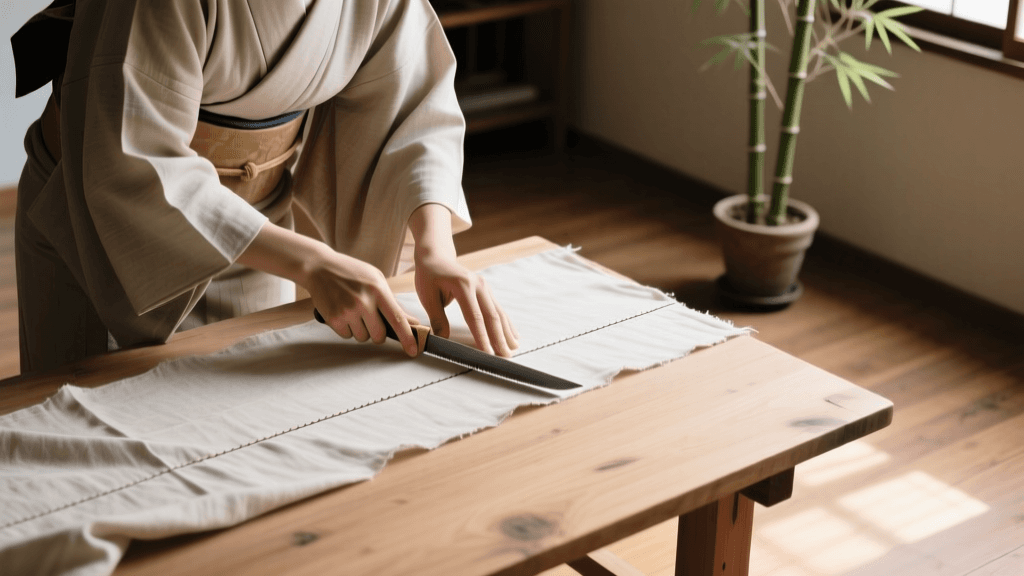
The straight-line cutting method dissects the Tanmono into specific, standardized rectangles. These panels are then sewn together using straight seams. The beauty of this system lies in its modularity; if a panel becomes damaged, it can be replaced, or the panels can be rearranged to hide wear and tear.
| Panel Name | Japanese Term | Quantity | Function and Dimensions |
|---|---|---|---|
| Body Panels | Migoro | 2 | Forms the front and back of the main torso. Cut to the full length of the wearer's height plus hem allowance. |
| Sleeves | Sode | 2 | Rectangular panels attached to the Migoro. The depth of the sleeve drop (Takesode) denotes formality and age. |
| Front Overlaps | Okumi | 2 | Narrower vertical strips attached to the front Migoro to create the overlapping front closure. |
| Collar | Eri | 1 | A long, folded strip that forms the neckband and extends down the front edges of the Okumi. |
Because all panels are cut along the straight grain or directly across the weft, the fabric maintains its natural structural integrity. There is no bias stretching, which means the garment hangs with a distinct, sculptural weight that defines the traditional Japanese silhouette.
Shitsuke: The Art of Temporary Basting
In Western garment construction, the final stitch is the ultimate goal. In kimono construction, the final stitch is merely one phase of a garment's long life. The secret to the kimono's longevity is Shitsuke, the intricate art of temporary basting. Kimono are constructed using a specialized running stitch that is designed to be easily removed.
Why design a garment to be taken apart? The answer lies in the traditional cleaning method known as Arai-hari. When a kimono becomes soiled, it is completely disassembled into its original eight flat panels. These panels are then washed, stretched on bamboo frames (Shinshi), and dried. Once clean and perfectly flat, the garment is re-basted and re-sewn. This process ensures that the fabric never suffers the distortion, shrinkage, or stress associated with modern machine washing and dry cleaning.
In 2026, master artisans in Kyoto and Tokyo are utilizing advanced, biodegradable basting threads that offer high visibility during the construction phase but break down safely if microscopic fibers are left behind during the Arai-hari process. The basting stitch (Shitsuke-ito) is applied with specific tension—tight enough to hold the heavy silk layers in perfect alignment during the final stitching, but loose enough to be pulled out in one continuous motion when the garment requires cleaning.
2026 Innovations: Blending Heritage with Modern Technology
While the core philosophy of Chokusen-dachi remains untouched, the tools of the trade have evolved. The Victoria and Albert Museum's extensive Asian collections frequently highlight how traditional craftsmanship adapts to new eras, and 2026 is no exception. Contemporary kimono ateliers are now integrating non-invasive technology to preserve fragile vintage fabrics.
- Augmented Reality (AR) Pattern Projection: Instead of using traditional bamboo spatulas (Hera) to mark cutting lines directly onto delicate, centuries-old silk, modern artisans use overhead AR projectors. These projectors cast precise, illuminated cutting guides directly onto the Tanmono, ensuring perfect grain alignment without any physical contact or chemical chalk residue.
- Digital Tension Meters: When basting heavy brocade or delicate ro silk, maintaining uniform thread tension is critical. Artisans now use micro-digital tension meters attached to their basting needles to ensure that the temporary stitches do not warp the bias edges of the Okumi panels.
- Laser-Guided Selvedge Alignment: To guarantee that the straight-line cuts are perfectly parallel to the woven selvedge, low-heat laser levels are employed on the cutting tables, eliminating human error and ensuring the geometric purity of the Chokusen-dachi method.
Furthermore, the Japanese government continues to support these evolving practices. As noted by the Ministry of Economy, Trade and Industry (METI), the designation of Traditional Craft Products ensures that while tools may modernize for preservation and efficiency, the fundamental hand-crafted techniques and zero-waste material usage remain strictly protected.
Actionable Guide: Practicing Straight-Line Cutting at Home
For modern sewists, upcyclers, and sustainable fashion students looking to apply Chokusen-dachi principles in 2026, you do not need a silk Tanmono to begin. You can adapt the straight-line cutting method using standard linen or cotton fat quarters and yardage to create modular, zero-waste loungewear or robes.
Step 1: Calculate Your Modular Rectangles
Measure your desired garment length from the nape of the neck to the ankle. This is your Migoro length. Cut two identical rectangles from your fabric. Unlike Western patterns, do not cut armholes. The sleeves (Sode) will be attached as separate rectangular blocks directly to the side edges of the Migoro.
Step 2: Implement the Shitsuke Basting Method
Before committing to your final seams, use a high-contrast, smooth cotton thread to baste the panels together. Use a long running stitch (approximately 1 cm per stitch). This allows you to try on the modular blocks, adjust the overlap of the front panels, and ensure the grain lines hang perfectly perpendicular to the floor.
Step 3: The Hidden Seam Allowance
In traditional kimono construction, seam allowances are not trimmed or graded. They are folded inward and basted flat against the interior of the garment. This creates a self-lined, weighted interior that gives the kimono its characteristic drape. When sewing your straight-line garment, leave a generous 2 cm seam allowance, fold it inward, and secure it with a blind stitch to mimic this structural weighting.
Conclusion
The Chokusen-dachi method is a testament to the idea that true luxury lies in respect for materials. By treating fabric as a precious, finite resource and utilizing straight-line geometry, traditional Japanese dressmakers created a garment that transcends seasonal trends and physical wear. As we move through 2026, the integration of modern preservation technology with these ancient zero-waste techniques offers a profound lesson for the future of global garment construction: the most sustainable fashion is that which is designed to be taken apart, renewed, and worn for generations.