Kimono Buying Guide: Furisode, Houmongi, and Komon Compared
Navigating the World of Traditional Japanese Garments
Stepping into the world of traditional Japanese clothing can feel like learning an entirely new language. The kimono is not merely a single, uniform garment; it is a complex, deeply symbolic system of sartorial rules dictated by season, age, marital status, and the specific formality of an occasion. For collectors, cultural enthusiasts, and those looking to invest in authentic Asian fashion, understanding these distinctions is paramount before making a purchase.
According to the Metropolitan Museum of Art, the kimono evolved from the kosode (a garment with small sleeve openings) during the Muromachi period, eventually becoming the principal article of dress for all classes in the Edo period. Today, while everyday wear in Japan has largely Westernized, the kimono remains a vital cultural artifact and a highly sought-after fashion piece globally. This comprehensive buying guide will break down three of the most prominent kimono types—Furisode, Houmongi, and Komon—helping you make an informed, culturally respectful, and aesthetically pleasing purchase.
The Furisode: The Formal Statement of Youth
The Furisode, which translates to 'swinging sleeve,' is the most formal kimono worn by unmarried women. It is instantly recognizable by its dramatic, floor-sweeping sleeves, which can measure anywhere from 85 to 114 centimeters in length. Historically, these long sleeves were not just decorative; they served a social function.
The Victoria and Albert Museum notes that the furisode's dramatic sleeves were traditionally used by young women to signal romantic interest or to ward off evil spirits during coming-of-age ceremonies. Today, the furisode is the standard attire for Seijin no Hi (Coming of Age Day), university graduation ceremonies, and formal weddings where the wearer is an unmarried guest or a participant.
Types of Furisode
When shopping for a furisode, you will encounter three distinct sub-categories based on sleeve length:
- Kofurisode (Short Furisode): Sleeves measure around 85 cm. Often worn for graduation ceremonies paired with a hakama (pleated skirt).
- Chufurisode (Medium Furisode): Sleeves measure around 100 cm. The most common and versatile type, frequently seen at Coming of Age ceremonies.
- Ohfurisode (Large Furisode): Sleeves measure 114 cm or more. Extremely formal, heavy, and typically reserved for brides or high-profile ceremonial events.
Buying Advice: Authentic new furisodes are among the most expensive garments in Japan, often costing between ¥300,000 and ¥1,000,000 ($2,000 to $7,000 USD) due to the intricate Yuzen dyeing and heavy silk brocade (rinzu). For international buyers, the vintage market offers stunning mid-century furisodes for $150 to $400 USD, though you must carefully inspect the silk for dry rot or discoloration along the folds.
The Houmongi: The Elegant Visitor
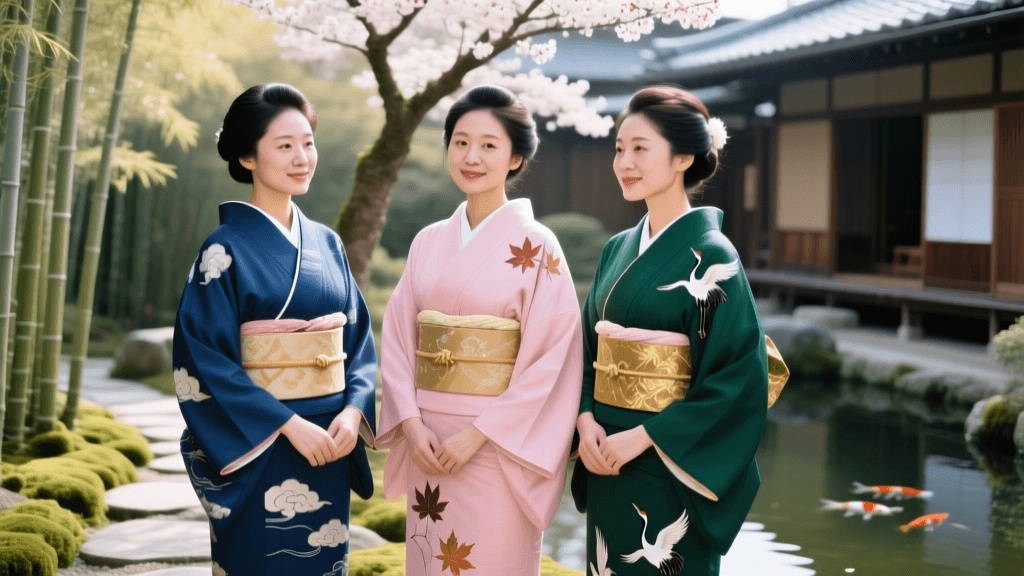
If the furisode is the statement piece of youth, the Houmongi (literally 'visiting wear') is the hallmark of refined elegance for adult women, regardless of marital status. The defining characteristic of a houmongi is its eba-moyo (picture pattern). Unlike other kimonos where patterns are dyed onto individual bolts of fabric before sewing, the houmongi's design is painted across the seams, creating a continuous, unbroken panoramic picture when the garment is laid flat or worn.
Houmongi are highly versatile and sit just below the ultra-formal Kurotomesode and Irotomesode in the hierarchy of formality. They are the perfect purchase for attending tea ceremonies, formal gallery openings, upscale dinner parties, and weddings (as a married guest).
Fabric and Motif Considerations
When evaluating a houmongi for purchase, pay close attention to the background color and the motifs. Pastel backgrounds (like pale pink, mint, or sky blue) with motifs of cherry blossoms, pine, or cranes are appropriate for joyous occasions and younger wearers. Darker backgrounds (navy, deep plum, or black) with subdued, abstract, or autumnal motifs are better suited for mature women or more somber, formal events. Expect to pay $500 to $2,000 for a new, tailor-made houmongi, or $80 to $250 for a high-quality vintage piece.
The Komon: The Everyday Charm
For those seeking a kimono that bridges the gap between traditional art and wearable, everyday fashion, the Komon ('fine pattern') is the ideal choice. Komon are characterized by small, repeating patterns that cover the entire garment. Because the pattern does not align across the seams and lacks the formality of a continuous picture, the komon is considered casual or semi-formal wear.
A highly prized sub-category to look out for is the Edo Komon. Originating in the Edo period, these garments feature micro-patterns that appear as a solid color from a distance but reveal incredibly intricate, stenciled designs (like tiny dots or geometric shapes) upon close inspection. The Japan Foundation frequently highlights Edo Komon in cultural exhibitions as a masterclass in the subtle, understated elegance valued in Japanese aesthetics.
Buying Advice: Komon are the most accessible entry point for kimono collectors. They are widely available in Japanese 'recycle' (vintage) shops and online marketplaces. Prices range from $30 to $150 for vintage pieces, making them perfect for modern styling, cosplay, or wearing to casual cultural festivals.
Kimono Comparison Chart
| Feature | Furisode | Houmongi | Komon |
|---|---|---|---|
| Formality Level | Very Formal | Semi-Formal to Formal | Casual to Semi-Formal |
| Target Wearer | Unmarried Women | All Adult Women | All Adult Women |
| Pattern Style | Large, bold, auspicious motifs | Eba-moyo (continuous picture) | Small, repeating all-over print |
| Sleeve Length | 85 cm - 114+ cm | Standard (approx. 50 cm) | Standard (approx. 50 cm) |
| Avg. Vintage Price | $150 - $400 USD | $80 - $250 USD | $30 - $150 USD |
Crucial Sizing and Measurements
Unlike Western clothing, kimonos are not sized by bust or waist. They are essentially rectangular panels wrapped around the body. When buying online or from a dealer, you must understand two critical measurements:
- Mitake (Total Length): Measured from the back of the neck to the hem. A kimono should ideally be equal to your height, or up to 10 cm longer. The extra fabric is folded at the waist to create the ohashori, a horizontal tuck that allows for height adjustments and provides a layered aesthetic. If the mitake is shorter than your height minus 20 cm, the kimono cannot be worn traditionally.
- Yuki (Sleeve Span): Measured from the center back of the neck, across the shoulder, and down to the wrist. The ideal yuki measurement reaches the wrist bone when the arm is extended at a 45-degree angle. Standard vintage yuki is around 62-64 cm, which may feel slightly short for taller Western buyers.
Where to Buy: New, Vintage, and Online
If you are traveling to Japan, Kyoto remains the undisputed capital for kimono shopping. The Nishijin district offers brand-new, master-crafted textiles, while the Toji Temple flea market (held on the 21st of every month) is a treasure trove for vintage komon and houmongi. In Tokyo, the Asakusa district and the Oedo Antique Market provide excellent options.
For international buyers, purchasing online requires a reputable dealer. Websites specializing in Japanese antiques often provide detailed condition reports, noting any shimi (stains) or hi (sun fading). Always request photos of the interior lining, as yellowing or brittleness here indicates degraded silk that will tear upon wearing.
'The beauty of the kimono lies not just in its silk, but in its lifecycle. Purchasing a vintage kimono is an act of sustainable fashion, preserving centuries of artisanal dyeing techniques that are slowly fading from modern textile production.'
Care and Maintenance
Silk kimonos require specialized care. Never attempt to wash a silk furisode or houmongi at home. In Japan, kimonos are cleaned through a process called maru-hari, where the garment is completely unstitched, washed, stretched on wooden frames to remove wrinkles, and then re-sewn. While full maru-hari is difficult to find outside of Japan, specialized dry cleaners who handle bridal wear and museum textiles can spot-clean minor stains. Always store your kimonos flat, folded along their original creases, wrapped in acid-free tissue paper or traditional tatoushi (washi paper envelopes) to allow the silk to breathe and prevent moisture buildup.
Final Thoughts on Your Purchase
Whether you are investing in a breathtaking, heavily embroidered Furisode for a museum-quality collection, a sweeping Houmongi for elegant cultural events, or a charming Komon for everyday wear, understanding the structural and cultural nuances of these garments will ensure your purchase is both authentic and deeply appreciated. Take your time to study the motifs, verify the measurements, and respect the incredible artisanal heritage woven into every thread.