Kimono Storage Preservation 2026: Archival Care & Collection Guide
The Urgency of Kimono Preservation in 2026
As we navigate the shifting climate patterns and increased urban humidity fluctuations of 2026, the preservation of traditional Japanese garments has never been more critical. Silk, the foundational fiber of most formal kimono, is a protein-based textile highly susceptible to environmental degradation. According to the American Institute for Conservation (AIC) Textile Wiki, fluctuations in relative humidity (RH) and prolonged exposure to acidic compounds are the primary catalysts for silk fiber embrittlement. For collectors, curators, and cultural enthusiasts, managing a kimono collection requires moving beyond simple closet storage and embracing a rigorous, museum-grade archival methodology.
In 2026, the intersection of traditional Japanese preservation techniques and modern conservation science offers collectors unprecedented tools to protect their investments. Whether you are safeguarding a fragile Meiji-era uchikake or a contemporary hand-painted yuzen silk kimono, understanding the micro-climate of your storage environment is paramount.
The Science of Silk and Acid Hydrolysis
To properly store a kimono, one must first understand what destroys it. Silk fibroin is vulnerable to a process known as acid hydrolysis. When silk is exposed to acidic environments—often caused by off-gassing from cheap wood pulp cardboard, synthetic dyes, or atmospheric pollutants—the peptide bonds within the protein chain break down. This results in the characteristic shattering and yellowing seen in poorly preserved vintage textiles.
Furthermore, light exposure, particularly ultraviolet (UV) and high-energy visible (HEV) blue light, causes photo-oxidation. The National Park Service Museum Handbook strictly mandates that textiles in long-term storage be kept in total darkness. In 2026, this means ensuring your storage vessels are completely opaque and situated away from any ambient light leaks in your climate-controlled storage rooms.
The Foundation: Hon-Datami Folding and Tatou Paper
The Japanese have refined the art of kimono storage over centuries. The standard folding method, known as hon-datami, is designed to distribute stress evenly across the seams and prevent permanent creasing of the delicate silk. Unlike Western garment folding, which often stacks layers haphazardly, hon-datami aligns the sleeves and body panels in a precise rectangular geometry that matches the dimensions of traditional wrapping paper.
This wrapping paper, called tatou, is the first line of defense in kimono preservation. Historically made from high-quality washi (Japanese paper), modern archival tatou is manufactured to be strictly acid-free, lignin-free, and buffered with calcium carbonate to maintain an alkaline reserve. As of early 2026, a standard set of 10 museum-grade tatou sheets (typically measuring 70cm x 90cm) costs approximately $45 to $60 USD from specialized conservation suppliers.
"Never store a silk kimono directly against bare wood, painted surfaces, or standard cardboard. The migration of acids and volatile organic compounds (VOCs) will permanently stain and weaken the protein fibers within a single season."
Choosing the Right Storage Vessel: Tansu vs. Archival Plastics
For centuries, the tansu (traditional Japanese chest) made from Paulownia wood (kiri) has been the gold standard for kimono storage. Paulownia is uniquely suited for this task: it is lightweight, naturally fire-resistant, and possesses a cellular structure that swells in high humidity to seal out moisture, and shrinks in dry conditions to allow the textile to breathe. Furthermore, it contains natural tannins that deter pests.
However, sustainably harvested, properly seasoned Paulownia tansu are incredibly expensive in 2026, often starting at $1,500 USD for a multi-drawer chest. For many modern collectors, archival-grade plastics and acid-free corrugated boards offer a more accessible alternative. Below is a comparison of the primary storage materials used in contemporary collection management.
| Storage Material | Pros | Cons | 2026 Est. Cost (Per Unit) |
|---|---|---|---|
| Paulownia Wood (Kiri) | Natural humidity buffering; traditional aesthetic; pest resistant. | Very expensive; heavy; requires periodic maintenance and airing. | $800 - $2,500+ |
| Archival Coroplast (PP) | Inert; lightweight; custom sizes; completely acid-free. | No natural humidity buffering; requires strict external climate control. | $60 - $120 |
| Injection-Molded Polypropylene | Durable; airtight (good for anoxic pest treatments); stackable. | Can trap moisture if sealed incorrectly; non-breathable. | $40 - $85 |
| Acid-Free Cardboard | Breathable; affordable; easy to assemble. | Susceptible to water damage; degrades over decades; less structural support. | $25 - $45 |
Micro-Climate Monitoring in 2026
Relying on a single wall-mounted thermostat is no longer sufficient for serious collection management. The micro-climate inside a drawer or storage box can differ drastically from the ambient room environment. In 2026, collectors are utilizing Bluetooth Low Energy (BLE) hygrometers and smart sensors (such as the latest Govee or SwitchBot archival monitoring nodes) placed directly inside the storage vessels.
These devices log temperature and relative humidity (RH) data to cloud dashboards, alerting collectors via smartphone if the RH drops below the critical 45% threshold (which causes silk to become brittle) or spikes above 55% (which invites mold growth and dye bleeding). Maintaining a stable RH between 48% and 52%, with temperatures around 68°F (20°C), is the universally accepted standard for protein-based textiles.
Integrated Pest Management (IPM): Moving Beyond Camphor
Webbing clothes moths (Tineola bisselliella) and carpet beetles are the natural predators of silk. Traditionally, Japanese households relied on camphor or naphthalene mothballs. However, modern conservation science strongly advises against these chemical fumigants for long-term archival storage. The volatile oils in camphor can react with metallic threads (such as gold and silver leaf applied via surihaku techniques) causing them to tarnish or blacken, and can sometimes destabilize certain synthetic dyes used in mid-century Showa-era garments.
Instead, the Canadian Conservation Institute recommends a strict Integrated Pest Management (IPM) approach. This involves:
- Quarantine and Inspection: Always inspect new acquisitions under UV and bright LED light before introducing them to your main collection.
- Anoxic Treatment: For active infestations, sealing the garment in an airtight barrier film (like Escal) and flushing it with inert argon gas or nitrogen to deprive pests of oxygen.
- Pheromone Traps: Utilizing non-toxic sticky traps baited with species-specific pheromones to monitor for male moth activity in the storage room.
- Cryogenic Freezing: Flash-freezing garments in specialized archival freezers at -20°C for 72 hours to kill all life stages of pests, followed by slow thawing in a sealed bag to prevent condensation.
Step-by-Step Archival Wrapping Protocol
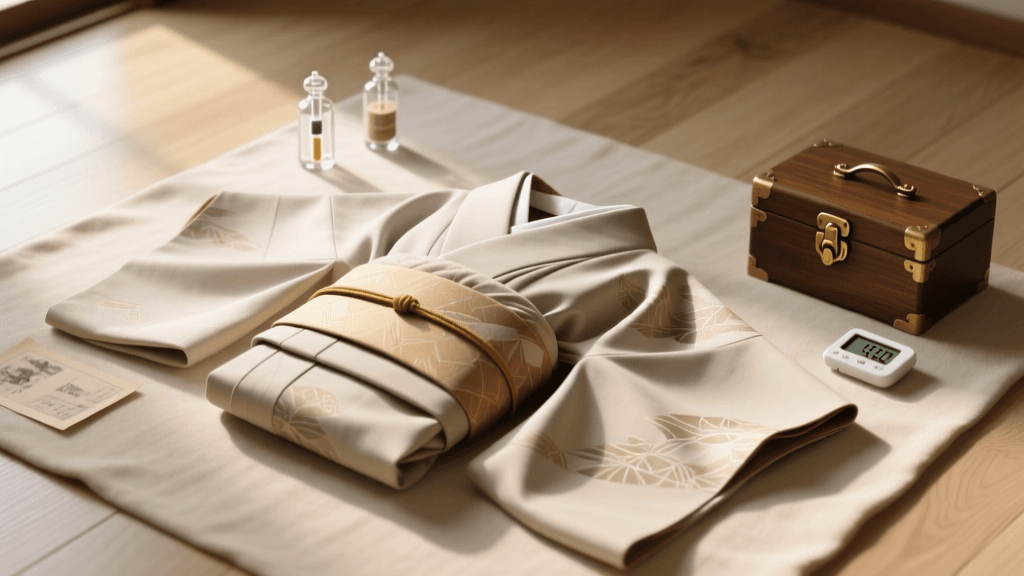
When preparing your kimono for long-term storage, follow this meticulous protocol to ensure maximum longevity:
- Airing (Mushiboshi): Before storing, air the kimono indoors in a dry, shaded, and well-ventilated room for 24 hours to release any trapped moisture or odors. Never expose it to direct sunlight.
- Surface Cleaning: Gently brush the surface with a clean, ultra-soft natural bristle brush to remove microscopic dust and particulate matter that can attract pests or hold moisture.
- Folding: Execute the hon-datami fold on a clean, acid-free work surface. Ensure your hands are freshly washed and completely dry, or wear unbleached cotton archival gloves.
- Padding: Place small rolls of acid-free, unbuffered tissue paper inside the major folds to prevent sharp creases that could eventually lead to fiber breakage along the fold lines.
- Wrapping: Lay the tatou paper flat. Place the folded kimono in the center. Fold the paper over the garment in an envelope style, ensuring no bare silk is exposed to the air.
- Labeling: Use an archival-safe pigment pen to write the catalog number, date of storage, and a brief description on the outside of the tatou paper. Never use adhesive labels or sticky notes directly on the paper or garment.
- Placement: Place the wrapped bundle into your chosen storage vessel. Avoid stacking more than three kimono on top of one another to prevent crushing the lower garments and compressing the padding.
Conclusion
Preserving a kimono collection is an act of cultural stewardship. By combining the time-honored Japanese practices of hon-datami folding and tatou wrapping with 2026 advancements in smart climate monitoring and inert pest management, collectors can ensure these magnificent textiles survive for future generations to study and admire. The investment in proper archival materials is ultimately an investment in the enduring legacy of Asian textile arts.