Kabuki, Noh & Bunraku Theater Kimono Costumes 2026
The Intersection of Japanese Performing Arts and Textile Mastery
When we discuss the kimono, we often picture the elegant garments worn during tea ceremonies, coming-of-age festivals, or summer fireworks displays. However, the most extravagant, technically complex, and historically significant kimono in Japan are not found on the streets of Kyoto or Tokyo; they are found on the stage. In 2026, the intersection of heritage preservation and contemporary stagecraft continues to elevate traditional Japanese theater costumes to the status of high art. The kimono utilized in Kabuki, Noh, and Bunraku are not merely clothing; they are vital storytelling devices, engineered to manipulate light, convey spiritual essence, and withstand the rigorous physical demands of theatrical performance.
Understanding the distinct textile traditions of these three theatrical forms requires a deep dive into their unique silhouettes, weaving techniques, and stage mechanics. As global interest in traditional Asian garments surges this year, institutions like the Tokyo National Museum have expanded their 2026 exhibition schedules to showcase the intricate layering and structural engineering of theatrical kimono. This guide explores the magnificent costumes of Japan’s three major classical theater forms, offering actionable insights for collectors, textile enthusiasts, and cultural travelers.
The Grandeur of Kabuki: Extravagance in Motion
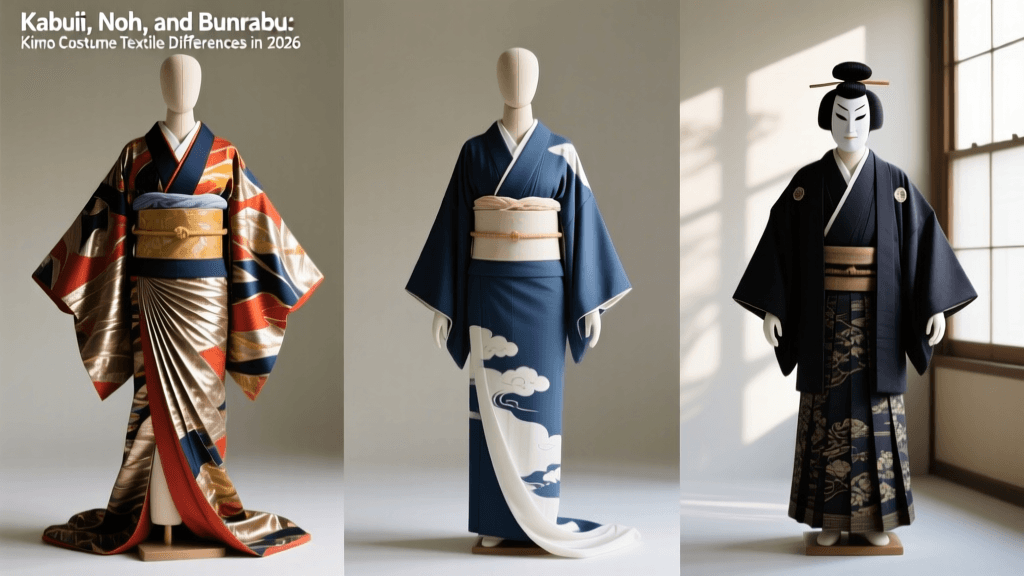
Kabuki is a theater of excess, drama, and dynamic movement. Emerging in the Edo period, Kabuki costumes are designed to amplify the actor’s presence, often utilizing heavy brocades, vibrant Yuzen dyeing, and dramatic silhouettes. The most iconic garment in the Kabuki wardrobe is the hikizuri, a trailing kimono worn primarily by onnagata (male actors playing female roles) and high-ranking courtesan characters.
The Mechanics of the Hikizuri and Hikinuki
Unlike a standard street kimono, the hikizuri features an elongated hem that trails gracefully across the stage. To manage this excess fabric during dance sequences, actors employ a technique called suso-sabaki, a fluid kicking motion that sweeps the heavy silk out of the way. The sheer weight of a full Kabuki costume, including the heavily padded date-obi and multiple under-layers, can exceed 20 kilograms. This weight forces the actor into a grounded, sliding gait that is quintessential to Kabuki movement.
Perhaps the most thrilling costume mechanism in Kabuki is the hikinuki (quick change). During a dramatic climax, stage assistants (kuroko) pull specific basting threads on the actor's outer kimono. In a fraction of a second, the garment drops and transforms into a completely different kimono underneath, symbolizing a sudden shift in the character’s emotion, social status, or supernatural revelation. In 2026, the Kabukiza Theatre in Tokyo continues to host masterclasses and special exhibitions detailing the precise tailoring required to ensure these quick-changes never fail on stage.
The Subtlety of Noh: Spiritual Weight and Masking
If Kabuki is the theater of the physical and emotional, Noh is the theater of the spiritual and the subconscious. Noh costumes, known collectively as shozoku, do not aim for historical realism. Instead, they are designed to conceal the actor’s human form, transforming them into a vessel for the spirit, deity, or demon they are portraying. The visual language of Noh relies heavily on texture, stiffness, and the interplay of light on metallic threads.
Karaori and Surihaku: Weaving the Divine
The most prestigious garment in Noh is the karaori, a stiff, heavily brocaded robe traditionally woven in the Nishijin district of Kyoto. The karaori is woven with such density and tightness that it stands away from the body, creating a bell-like silhouette that completely masks the actor's natural proportions. The stiffness of the silk is intentional; it restricts sudden movements, enforcing the slow, deliberate, and highly stylized sliding walk (hakobi) of the Noh performer.
Another hallmark of Noh costuming is the surihaku, a garment featuring intricate patterns applied directly to the fabric using gold or silver leaf. Unlike embroidery, which catches light in a fragmented way, surihaku reflects light in broad, continuous sheets. When a Noh actor performing a ghostly or demonic role tilts their head, the surihaku catches the stage lighting, creating an eerie, otherworldly luminescence. As of 2026, master weavers in Kyoto are utilizing advanced climate-controlled looms to maintain the precise humidity required for applying delicate gold leaf to silk, ensuring these ancient techniques survive for future generations.
Bunraku Puppetry: Miniature Mastery and Illusion
Bunraku, the traditional puppet theater of Japan, presents a unique set of challenges for kimono artisans. The puppets (ningyō) are approximately one-half to two-thirds the size of a human, and each is operated by three visible puppeteers. The costumes must not only look authentic from a distance but also accommodate the complex mechanics of the puppeteers' hands and arms.
Engineering the Puppet Kimono
A Bunraku kimono is a marvel of structural engineering. The garments are tailored with split backs and specialized internal rigging. The main puppeteer (omozukai) inserts their left arm through a specialized opening in the kimono's torso to operate the puppet's head and left hand, while their right arm operates the puppet's right hand. The kimono must be heavily padded with cotton wadding to create the illusion of a fleshy, three-dimensional human body beneath the silk.
Furthermore, the sleeves (sode) of a Bunraku kimono are often weighted with small lead inserts or bamboo stiffeners. This allows the puppeteers to manipulate the sleeves to simulate the wind catching the fabric, or to convey the trembling of a weeping character. The textiles used in Bunraku are scaled perfectly; artisans use the exact same Yuzen dyeing and Nishijin weaving techniques as full-sized kimono, but miniaturized to ensure the patterns do not overwhelm the puppet's delicate wooden face.
Comparative Guide: Theatrical Kimono at a Glance
To fully appreciate the nuances of these three art forms, it is helpful to compare their textile applications side-by-side. The following table outlines the primary differences in costume engineering for the 2026 stage.
| Feature | Kabuki | Noh | Bunraku |
|---|---|---|---|
| Primary Garment | Hikizuri (trailing kimono) | Karaori (stiff brocade robe) | Miniaturized layered kosode |
| Visual Goal | Extravagance, emotional amplification | Spiritual essence, concealing the human form | Realistic human illusion at a smaller scale |
| Weight & Structure | Extremely heavy (up to 20kg), padded obi | Stiff, stands away from the body, moderate weight | Lightweight but heavily padded for 3D volume |
| Key Mechanism | Hikinuki (quick-change thread pulls) | Suso-sabaki (deliberate fabric sweeping) | Split-back rigging for puppeteer arm insertion |
| Primary Textile | Vibrant Yuzen dyed silk, heavy brocade | Nishijin-ori, Surihaku (gold/silver leaf) | Scaled-down Yuzen and Rinzu (silk satin) |
Experiencing Theatrical Kimono in 2026
For textile enthusiasts and cultural travelers planning a visit to Japan in 2026, witnessing these garments in their intended environment is essential. The National Theatre of Japan and its affiliated regional venues offer comprehensive English audio guides that specifically highlight the costume changes and textile symbolism during performances.
Where to Look and How to Book
- Kabuki: Book a seat in the first balcony (Level 1) at the Kabukiza Theatre. This elevated angle provides the perfect vantage point to observe the trailing hem of the hikizuri and the mechanics of the hikinuki quick-changes without the stage lip obscuring the lower half of the costume.
- Noh: Attend a performance at the National Noh Theatre in Tokyo. Sit in the front row of the orchestra section. Noh relies on subtle shifts in light; being close allows you to see the microscopic texture of the surihaku gold leaf and the stiff weave of the karaori.
- Bunraku: Visit the National Bunraku Theatre in Osaka. Request a seat on the right side of the house, which offers a clearer view of the main puppeteer’s arm mechanics inside the kimono torso, revealing the genius of the garment's hidden tailoring.
Preservation and Modern Textile Conservation
The preservation of theatrical kimono is a race against time. The sweat, friction, and sheer physical stress of stage performances degrade silk fibers rapidly. In 2026, conservation labs have introduced non-invasive spectrophotometry to analyze fading dyes on vintage Edo-period stage costumes, allowing restorers to custom-mix natural indigo and safflower dyes that perfectly match the original hues. Furthermore, the integration of digital archiving means that the precise weaving drafts for complex Noh karaori patterns are now backed up on cloud servers, ensuring that if a master weaver's physical draft books are lost, the mathematical blueprint for the loom survives.
Whether you are a collector of vintage textiles, a student of Asian traditions, or simply an admirer of masterful craftsmanship, the kimono of Kabuki, Noh, and Bunraku represent the absolute pinnacle of Japanese garment engineering. They remind us that clothing is not just a covering, but a dynamic, living participant in the art of storytelling.