Kabuki Noh Bunraku Theater Kimono Costumes: 2026 Guide
The Enduring Legacy of Japanese Theatrical Textiles in 2026
When we discuss traditional Japanese garments, the conversation often centers on formal wear for weddings, tea ceremonies, or seasonal festivals. However, the most technically complex, historically rich, and visually stunning iterations of the kimono are found on the classical stage. In 2026, the intersection of traditional textile arts and performing arts remains a vibrant field, with master artisans continuing to craft specialized garments for Japan’s three major classical theater forms: Kabuki, Noh, and Bunraku. According to the Japan Arts Council, which oversees the National Theatre of Japan, the preservation of these specialized theatrical costumes is paramount to maintaining the authenticity of the performances. Each theater form demands entirely different structural modifications, textile weights, and visual motifs from the kimono. For collectors, textile historians, and theater practitioners, understanding the nuanced differences between a Kabuki hikizuri, a Noh karaori, and a Bunraku puppet garment is essential. This guide breaks down the unique construction techniques, material innovations, and 2026 sourcing realities for these magnificent theatrical costumes.
Kabuki Costumes: The Spectacle of Silk, Padding, and Stage Presence
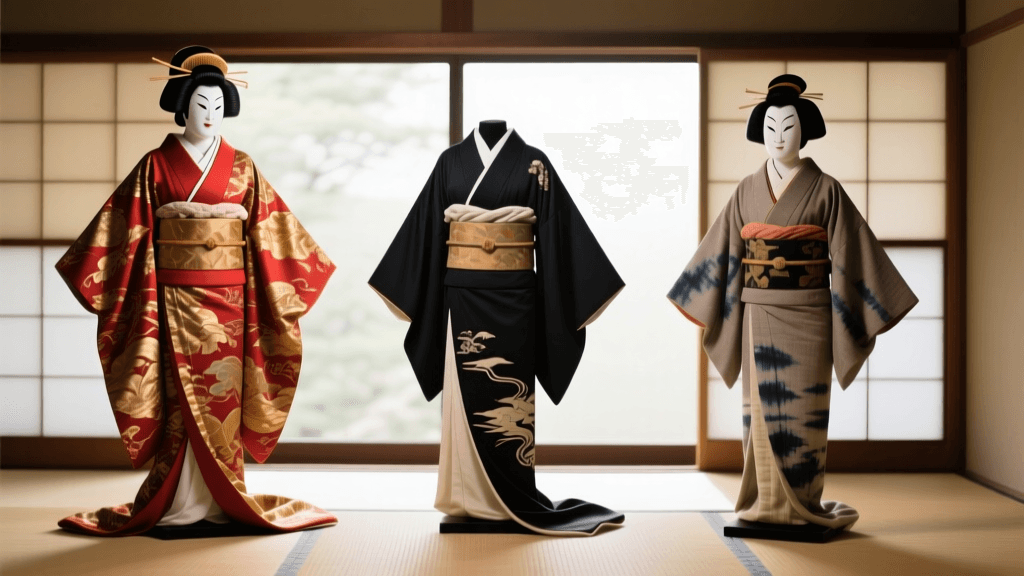
Kabuki theater is defined by its dramatic flair, exaggerated movements, and visual extravagance. The kimono worn by Kabuki actors are not merely clothing; they are architectural extensions of the character's personality and social status. The most iconic garment in the Kabuki wardrobe is the hikizuri, a trailing kimono primarily worn by onnagata (male actors specializing in female roles) and high-ranking courtesan characters. Unlike a standard formal kimono, the hikizuri features a heavily padded hem that allows the fabric to trail beautifully across the stage without tangling around the actor's feet during dynamic choreography.
In 2026, the construction of a professional-grade Kabuki hikizuri involves up to three kilograms of specialized cotton padding sewn directly into the lower hem and the back of the neck. This padding creates the exaggerated, swooping silhouette that defines the Kabuki aesthetic. Furthermore, the obi (sash) used in Kabuki is vastly different from standard formal wear. For villainous or samurai roles, actors often wear a massive, stiff heko obi or a heavily structured tateya knot that can extend nearly two feet outward from the back, requiring internal bamboo or lightweight carbon-fiber armatures to maintain its shape under hot stage lights.
Textile-wise, Kabuki costumes heavily utilize Yuzen dyeing and kinsai (gold paste application) to create bold, high-contrast patterns that read clearly from the back rows of the theater. While pure silk remains the gold standard, 2026 has seen touring Kabuki troupes increasingly adopt advanced, high-sheen synthetic blends for secondary cast members. These modern fabrics reduce luggage weight and resist the heavy perspiration caused by stage lighting, while perfectly mimicking the light-reflective properties of traditional Nishijin silk brocades.
Noh Theater Garments: Subtlety, Symbolism, and the Art of Shozoku
If Kabuki is a spectacle of the external, Noh theater is a meditation on the internal. Recognized globally and protected on UNESCO's Intangible Cultural Heritage registry alongside other Japanese classical arts, Noh relies on profound subtlety. The costumes, collectively known as shozoku, are designed to convey the essence of a character—be it a grieving mother, a demonic spirit, or a noble warrior—through layered symbolism rather than overt extravagance.
The cornerstone of the Noh wardrobe is the karaori, a stiff, heavily brocaded jacket woven in the Nishijin district of Kyoto. The karaori is woven using a complex floating-weft technique that makes the garment incredibly rigid, almost like armor. This stiffness is intentional; it forces the actor to move with deliberate, gliding steps, naturally producing the ethereal, ghost-like movement characteristic of Noh. In 2026, a newly commissioned, hand-woven karaori from a master Nishijin weaver can take up to eight months to complete, with market prices frequently exceeding $18,000 USD due to the scarcity of artisans capable of executing the traditional uke-ori (floating weave) technique.
Another critical Noh garment is the surihaku, a robe featuring intricate patterns created by pressing gold or silver leaf directly into the silk using a specialized adhesive paste. Unlike Kabuki's painted gold, surihaku catches the dim, natural light of the Noh stage in a way that seems to shimmer with an otherworldly glow. The way the collar (eri) is worn is also strictly codified. For female or youthful roles, the collar is pulled back slightly to expose the nape of the neck—a traditional marker of vulnerability and beauty. For warrior or demon roles, the collar is worn tightly against the neck, and the sleeves are often padded to create a broad, imposing shoulder silhouette.
'In Noh, the costume does not merely dress the actor; it dictates the actor's physical reality. The stiffness of the karaori and the weight of the mask force the performer into a state of moving meditation, where the garment becomes the spirit itself.' — Principle of Noh Costume Wearing, Kyoto Noh Costume Association Guidelines.
Bunraku Puppetry: Engineering Kimono for Three Operators
Bunraku, Japan’s traditional puppet theater, presents a unique engineering challenge for kimono artisans. As documented by the UNESCO heritage listings for Ningyo Johruri Bunraku, the main puppets are roughly two-thirds the size of a human and are operated by three visible puppeteers. The omozukai (head and left hand), hidarizukai (right hand), and ashizukai (legs) must manipulate the puppet in perfect unison. Therefore, the kimono worn by these puppets cannot be constructed like human garments; they must be specifically engineered to accommodate the rigging, the operators' hands, and the illusion of autonomous movement.
A standard kimono sleeve would collapse limply when manipulated by a puppeteer's control rod. To solve this, Bunraku kimono feature internal structural modifications. In 2026, artisans utilize lightweight, eco-friendly tungsten weighting and flexible bamboo inserts sewn into the sode (sleeves) and the hem. This ensures that when the puppeteer lifts the arm, the sleeve drapes with the heavy, natural gravity of real silk, rather than bunching up unnaturally around the rod.
Additionally, the interior of a Bunraku kimono is fitted with a complex network of hidden ties and loops. These allow the omozukai to secure the garment to the puppet's wooden torso, preventing the kimono from slipping during vigorous battle scenes or emotional collapses. The textiles used are often slightly scaled down in pattern size compared to human kimono, ensuring the motifs do not look comically oversized on the smaller puppet frame. Because Bunraku puppets do not perspire, these garments can be preserved for decades, with some major troupes in Osaka still utilizing meticulously restored Meiji-era textiles for their most prestigious historical plays.
Comparative Analysis: Theater Kimono at a Glance
To understand the distinct requirements of each theatrical form, it is helpful to compare their structural and material profiles side-by-side. The following table outlines the primary differences for collectors and theater students in 2026.
| Theater Form | Primary Garment Type | Key Textile & Technique | Structural Modification | Est. 2026 Sourcing Cost (USD) |
|---|---|---|---|---|
| Kabuki | Hikizuri (Trailing Kimono) | Yuzen Dyeing, Kinsai (Gold Paste) | Heavy hem padding (up to 3kg), extended obi armatures | $4,500 - $12,000 |
| Noh | Karaori (Brocade Jacket) | Nishijin-ori, Uke-ori (Floating Weave) | Extreme fabric stiffness, specialized collar folding | $15,000 - $25,000+ |
| Bunraku | Puppet Kosode | Rinzu (Figured Satin), Surihaku | Internal rigging loops, tungsten sleeve weights, scaled motifs | $2,000 - $6,000 |
Sourcing and Preserving Theater Kimono in 2026
For collectors, vintage dealers, and international theater groups looking to source authentic Japanese theatrical kimono in 2026, the market requires specialized knowledge. Standard antique kimono shops in Kyoto or Tokyo rarely carry true stage garments, as these are usually held in the private archives of acting families (the iemoto system) or managed by theatrical production houses like Shochiku.
However, secondary market opportunities do exist. When minor troupes disband or when theatrical estates are liquidated, genuine Kabuki hikizuri and Noh chosoku (long vests) occasionally surface at high-end auction houses in Tokyo, such as the Est-Ouest International auctions. When evaluating a potential purchase, collectors must look for the telltale signs of stage use. A genuine Kabuki kimono will feature reinforced, heavily stitched padding in the hem that is entirely absent in standard formal wear. A genuine Noh garment will have a remarkably stiff collar and wider-than-average shoulder seams designed to accommodate the rigid posture of the performer.
Preservation is equally critical. The heavy metallic threads used in Noh karaori and the gold paste on Kabuki garments are highly susceptible to humidity and oxidation. In 2026, best practices for archival storage dictate keeping these garments flat in custom-built, acid-free tatou (paper wrappers) within climate-controlled environments maintained at exactly 50% relative humidity. Folding these heavy garments on standard kimono hangers will cause the metallic threads to snap and the heavy silk weaves to warp permanently over time.
Conclusion
The kimono of Kabuki, Noh, and Bunraku represent the absolute pinnacle of Japanese textile engineering. They are not merely clothes, but vital, functional components of a centuries-old storytelling tradition. Whether it is the sweeping, padded trails of a Kabuki courtesan, the stiff, shimmering brocade of a Noh spirit, or the meticulously weighted sleeves of a Bunraku puppet, these garments demand our deepest respect. As we move through 2026, supporting the master weavers of Nishijin and the specialized dyers of Kyoto ensures that the magic of the Japanese classical stage will continue to captivate audiences for generations to come.