Mastering Japanese Hand-Looms & Weaving Methods in 2026
The Resurgence of Japanese Hand-Weaving in 2026
In 2026, the global fashion and interior design industries have witnessed a profound shift toward slow fashion and heritage craftsmanship. At the forefront of this movement is the revival of Japanese traditional looms and hand-weaving methods. As consumers increasingly seek garments with a verifiable lineage and sustainable lifecycle, the meticulous art of Japanese textile weaving has transitioned from a niche historical practice to a highly sought-after luxury commodity. According to the Ministry of Economy, Trade and Industry (METI), government-backed initiatives in 2026 have successfully paired aging master weavers with a new generation of tech-savvy apprentices, ensuring that centuries-old techniques survive and thrive in the modern market.
This comprehensive guide explores the intricate mechanics of Japan’s heritage looms, the regional weaving methods that define its textile landscape, and how artisans, collectors, and travelers can engage with these traditions today.
Anatomy of the Heritage Loom: Jibata vs. Takahata
To understand Japanese hand-weaving, one must first understand the tools. Unlike the massive, automated jacquard looms of the industrial revolution, traditional Japanese looms are deeply ergonomic, designed to work in harmony with the human body and the natural environment.
Jibata (The Floor Loom)
The Jibata is one of the oldest and most fundamental looms in Japanese history. Translating roughly to "floor loom," it is characterized by its low profile and the weaver's seated position directly on the tatami mat. The warp threads are anchored to a fixed point at the front and tensioned by a backstrap that wraps around the weaver’s lower back. This unique tensioning system requires the weaver to use their core muscles and body weight to maintain the precise tension of the warp.
In 2026, the Jibata remains the preferred loom for weaving narrow, highly intricate bands, sashes, and delicate silk ribbons. The rhythmic leaning forward and backward creates a meditative, almost dance-like motion. Because the weaver controls the tension physically, the resulting textile possesses a subtle, organic irregularity that machines cannot replicate—a hallmark of true wabi-sabi aesthetics.
Takahata (The High Treadle Loom)
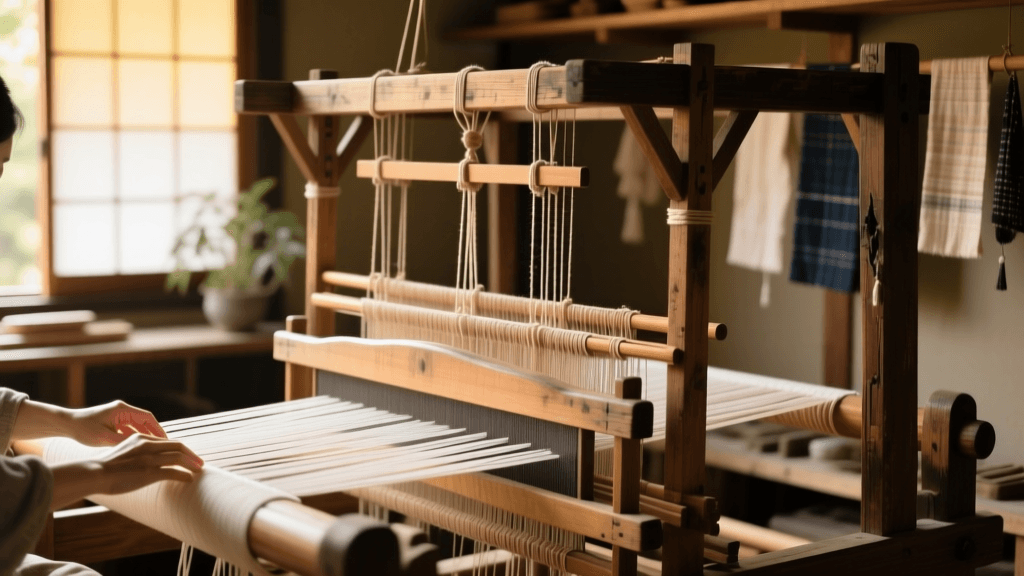
The Takahata, or "high loom," represents a significant evolution in Japanese weaving technology. Elevated off the ground and constructed from a robust wooden frame, the Takahata utilizes foot treadles to manipulate the harnesses and open the shed (the space between warp threads). This frees the weaver’s hands to rapidly pass the shuttle (hi) and beat the weft into place with the reed (osa).
The Takahata allows for wider fabrics and more complex multi-harness patterns. It is the workhorse of regional textile hubs, capable of producing everything from everyday cotton kimono fabrics to complex ramie textiles. Modern 2026 iterations of the Takahata often feature reinforced joinery and sustainably sourced Japanese cypress (hinoki), prized for its acoustic resonance and durability.
Regional Weaving Methods and Textile Mastery
Japan’s diverse microclimates have given rise to highly specialized regional weaving methods. The interplay between local flora, water quality, and ancestral knowledge creates textiles that are intrinsically tied to their geography.
Nishijin-ori (Kyoto Brocade)
Originating in the Nishijin district of Kyoto, Nishijin-ori is the pinnacle of Japanese luxury weaving. Famous for its opulent brocades and intricate gold and silver thread work, this method often requires multiple weavers to operate a single loom—one to manage the complex pattern harnesses and another to weave the base fabric. In 2026, a fully hand-woven, authentic Nishijin-ori obi (kimono sash) commands prices ranging from $4,000 to over $15,000, reflecting the hundreds of hours of labor. Visitors can observe these masterpieces in person at the Nishijin Textile Center, which continues to host daily demonstrations and archival exhibitions.
Ojiya-chijimi (Niigata Ramie)
In the heavy snow country of Niigata Prefecture, weavers produce Ojiya-chijimi, a lightweight, crinkled ramie fabric ideal for humid summers. The secret to its signature texture lies in the weft threads, which are tightly twisted and bound with a special sizing before weaving. Once woven, the fabric is washed in hot water and rubbed to remove the sizing, causing the weft to shrink and create a beautiful, cooling crepe surface. The final step, yukizarashi (snow bleaching), involves laying the fabric on the snowfields in late winter, where the ozone generated by the melting snow naturally bleaches the fibers to a pristine, luminous white.
Kurume-kasuri (Fukuoka Indigo)
Kasuri is the Japanese equivalent of ikat, where threads are tie-dyed before weaving. Kurume-kasuri, from Fukuoka, is renowned for its deep, fermented indigo (aizome) and intricate pictorial patterns. The weaver must perfectly align the pre-dyed warp and weft threads with every pass of the shuttle to ensure the pattern emerges clearly. The margin for error is less than a millimeter, requiring immense concentration and visual acuity.
Comparison Chart: Looms and Regional Textiles
| Textile Name | Region | Primary Loom Type | Key Material | 2026 Market Application |
|---|---|---|---|---|
| Nishijin-ori | Kyoto | Takahata / Jacquard | Silk, Metallic Threads | Luxury Obi, High-end Interior |
| Ojiya-chijimi | Niigata | Takahata | Ramie (Choma) | Summer Kimono, Resort Wear |
| Kurume-kasuri | Fukuoka | Takahata | Cotton, Indigo | Denim Alternatives, Streetwear |
| Kumihimo (Braids) | Nationwide | Jibata / Marudai | Silk, Gold Leaf | Obijime, Jewelry, Accessories |
The Sensory and Zen Experience of Hand-Weaving
To engage with Japanese hand-weaving is to engage in a full-body sensory experience. The rhythmic clack-thump of the wooden batten beating the weft into place acts as a metronome, inducing a state of flow akin to Zen meditation. The smell of the workshop is a complex bouquet: the earthy, fermented tang of the indigo vats, the sweet, grassy scent of raw ramie, and the dry, clean aroma of aged hinoki wood.
In 2026, wellness retreats in rural Japan have begun incorporating "Weaving Zen" workshops, recognizing the cognitive and emotional benefits of the loom. The tactile feedback of the threads passing through the fingers grounds the practitioner in the present moment. Unlike digital creation, which is ephemeral, the physical accumulation of woven rows provides immediate, tangible proof of one's labor and focus.
2026 Preservation, Travel, and Sourcing Guide
For collectors, designers, and cultural enthusiasts looking to source authentic Japanese textiles or experience the craft firsthand in 2026, strategic planning is essential. The Japan National Tourism Organization (JNTO) has recently expanded its heritage craft trails, making remote weaving villages more accessible than ever before.
- Kyoto Immersion: Book a multi-day apprenticeship in the Nishijin district. While observing is easy, hands-on weaving requires booking at least six months in advance due to the high demand from international design students.
- Niigata Snow Bleaching Tours: Travel to Ojiya in late February or early March to witness the breathtaking yukizarashi process. The contrast of the vibrant textiles against the blinding white snow is a photographer's dream and a profound cultural spectacle.
- Sourcing Ethically: When purchasing textiles in 2026, always look for the official METI "Traditional Craft Product" seal. This guarantees that the item was hand-woven using traditional materials and techniques by certified artisans, rather than mass-produced in overseas factories.
- Supporting Young Artisans: Seek out independent weaving cooperatives on platforms like Instagram and specialized Japanese craft e-commerce sites. Many young weavers in 2026 are blending traditional Takahata techniques with contemporary, minimalist color palettes aimed at modern global interiors.
By understanding the mechanics of the Jibata and Takahata, and respecting the regional nuances of Nishijin, Ojiya, and Kurume, we do more than just preserve history. We ensure that the soulful, deliberate art of Japanese hand-weaving continues to drape, comfort, and inspire the world in 2026 and beyond.