Japanese Traditional Looms & Hand-Weaving Methods Guide 2026
The 2026 Renaissance of Japanese Textile Arts
In 2026, the global artisan market has witnessed a profound resurgence in traditional Japanese hand-weaving. As contemporary makers and fashion designers increasingly reject the homogenization of fast fashion, the tactile, meditative practices of Japanese textile heritage offer both a creative sanctuary and a sustainable alternative. Understanding the mechanics of historical looms and the intricate hand-weaving methods developed over centuries is no longer just an academic pursuit; it is a vital, living practice. According to the Metropolitan Museum of Art's Heilbrunn Timeline of Art History, Japanese textiles have long been celebrated for their technical complexity and profound aesthetic philosophy, a legacy that modern weavers are actively preserving and adapting today.
This comprehensive guide explores the anatomy of traditional Japanese looms, specifically the Jibata and Takahata, and details the revered hand-weaving methods like Kasuri and Tsuzure-ori. Whether you are an experienced weaver looking to expand your repertoire or a textile enthusiast seeking to understand the 2026 landscape of heritage crafts, this article provides actionable insights, historical context, and practical setups.
Understanding the Jibata (Backstrap Loom)
The Jibata, or backstrap loom, is one of the oldest and most intimate weaving tools in Japanese history. Unlike rigid frame looms, the Jibata relies on the weaver's own body to create warp tension. One end of the warp is secured to a fixed point, such as a pillar or a heavy table leg, while the other end is attached to a backstrap that wraps around the weaver's lower back.
Mechanics and Modern Application
The weaver controls the tension by leaning forward or backward, allowing for micro-adjustments that are impossible on rigid looms. In 2026, artisanal studios in Kyoto and rural weaving cooperatives in Okinawa continue to use the Jibata for creating narrow, highly intricate bands, obi sashes, and ceremonial textiles. The portability of the Jibata makes it an excellent entry point for modern weavers with limited studio space. A high-quality, modernized wooden Jibata kit, complete with a hand-carved shuttle and heddle rod, typically costs between $250 and $450 in the current market, representing a significant investment in durable, heritage-grade equipment.
Mastering the Takahata (High Loom)
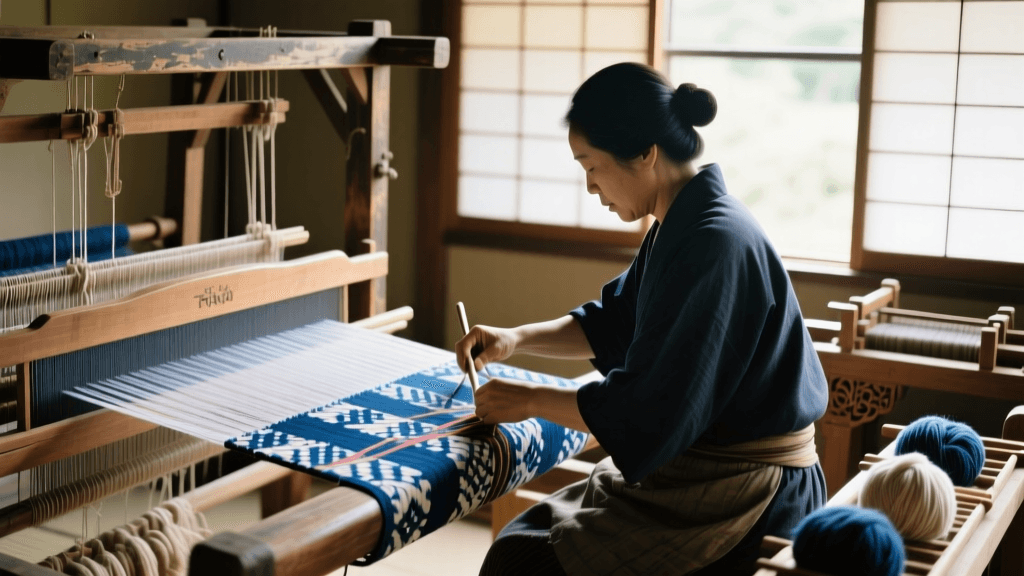
For wider fabrics, particularly the standard 14-inch to 15-inch wide kimono silk panels, the Takahata (high loom) is the traditional instrument of choice. The Takahata is a rigid, multi-shaft treadle loom that elevates the weaver, allowing them to use their feet to operate the harnesses while their hands manage the shuttle and the beater.
Structure and Production
The Takahata features a sophisticated pulley system and a heavy reed (osa) that beats the weft tightly into place. The rhythmic coordination of hands and feet required to operate a Takahata is often compared to playing a complex musical instrument. In 2026, master weavers in the Nishijin district of Kyoto utilize updated Takahata looms that integrate ergonomic seating and refined tension brakes, reducing the physical strain of long weaving sessions while maintaining the entirely manual, non-automated nature of the craft. Sourcing an authentic, handcrafted Takahata today requires commissioning a specialist woodworker, with prices starting around $3,500 and reaching upwards of $8,000 for looms crafted from aged hinoki cypress.
Essential Hand-Weaving Methods
The loom is merely the canvas; the true magic of Japanese textiles lies in the preparation and the weaving methodology. The official Kogei Japan portal highlights several techniques that are designated as Intangible Cultural Properties, ensuring their survival and continued practice in the modern era.
Kasuri (Ikat) Resist Dyeing and Weaving
Kasuri is the Japanese iteration of ikat, a technique where the warp threads, weft threads, or both are tightly bound with string to resist dye before they are woven. The most celebrated variant, Kurume Kasuri, involves a painstaking process of tying thousands of individual knots. When woven, the slight misalignment of the dyed threads creates a characteristic blurred, organic edge (kasuri-ashi) that is highly prized.
In 2026, the indigo dyeing process for Kasuri has seen eco-friendly innovations. Artisans are utilizing organic, cold-water fermentation vats that reduce water waste while producing the deep, living blues (aizome) that repel insects and resist fading. Weaving Kasuri requires immense concentration; the weaver must constantly adjust the weft threads with a small needle to ensure the patterns align perfectly row by row.
Tsuzure-ori (Tapestry Weaving)
Tsuzure-ori, often translated as tapestry weave, is a method where the weft threads completely conceal the warp. The most famous application is in Nishijin-ori, used for luxury obi sashes. A unique sub-technique is tsumegaki, or 'fingernail weaving.' The weaver uses the serrated edges of their fingernails, filed specifically for this purpose, to pack the weft threads tightly together and create intricate, curved motifs. This method is incredibly time-consuming; a single complex Tsuzure-ori obi can take a master weaver several months to complete, commanding 2026 market prices well over $10,000.
Comparative Analysis: Jibata vs. Takahata
Choosing the right loom depends on your spatial constraints, budget, and the type of textiles you wish to produce. Below is a structured comparison to guide your 2026 equipment investments.
| Feature | Jibata (Backstrap Loom) | Takahata (High Loom) |
|---|---|---|
| Primary Use | Narrow bands, obi, scarves, trims | Wide kimono silks, yardage, blankets |
| Tension Control | Body weight and posture | Mechanical brakes and ratchets |
| Space Required | Minimal (approx. 2x4 feet) | Substantial (approx. 6x8 feet) |
| Learning Curve | Moderate (requires core strength) | Steep (requires full-body coordination) |
| 2026 Avg. Cost | $250 - $450 | $3,500 - $8,000+ |
Sourcing Materials and Equipment in 2026
The supply chain for authentic Japanese weaving materials has become more accessible globally, yet discerning quality remains crucial. For silk threads, the Tomioka Silk Mill heritage network continues to export premium, un-degummed silk that provides the structural integrity needed for Kasuri tying. For cotton, artisans are turning to heritage seed varieties like Kurume cotton, which features a naturally shorter staple that grips beautifully when woven, enhancing the textile's durability.
When purchasing shuttles (hi) and reeds (osa), avoid mass-produced plastic alternatives. In 2026, specialized exporters in Tokyo and Kyoto offer hand-polished persimmon wood shuttles that glide through the shed with minimal friction, and bamboo reeds that provide a softer, more forgiving beat that protects delicate hand-spun yarns.
Step-by-Step: Setting Up Your First Jibata Warp
If you are beginning your journey with the Jibata, proper warp preparation is the foundation of your success. Follow these actionable steps to set up your loom:
- Measure and Cut: Calculate your warp length, adding 20% for loom waste and take-up. Cut your warp threads to this uniform length.
- Thread the Heddle: Pass each warp thread through the heddle loop and then through the corresponding slot in the rigid heddle or reed. This creates your shedding mechanism.
- Secure the Anchor: Tie the far end of the warp to a sturdy, immovable object. Ensure the knot is a quick-release bowline for easy tension adjustments.
- Attach the Backstrap: Secure the near end of the warp to the breast beam, then wrap the backstrap around your lower back, just above the hips.
- Establish Tension: Lean back slowly. The threads should be taut like guitar strings. Use your shedding stick to open the shed, and pass your shuttle through.
- Beat and Adjust: Use your sword or beater to pack the weft. Lean forward slightly to release tension, adjust the shed, and lean back to weave the next pick.
Preserving Heritage Through Modern Practice
The survival of Japanese traditional looms and hand-weaving methods relies on a new generation of practitioners who respect the past while innovating for the future. In 2026, online guilds and hybrid workshop models allow international students to learn directly from Japanese masters via high-definition streaming, followed by intensive, in-person residencies in rural weaving villages. By investing in authentic tools, mastering the rigorous techniques of Kasuri and Tsuzure-ori, and sharing these methodologies, today's weavers ensure that the rhythmic clatter of the Jibata and Takahata will continue to echo through the centuries.