Japanese Hand-Weaving Looms 2026: Jibata & Takadai Guide
The Renaissance of Japanese Hand-Weaving in 2026
In the landscape of global slow fashion and heritage textile preservation, 2026 has marked a significant renaissance for traditional Japanese hand-weaving methods. As contemporary artisans and international collectors increasingly reject mass-produced synthetics, the demand for authentic, hand-loomed textiles has surged. At the heart of this movement are two highly specialized pieces of equipment: the Jibata (traditional treadle handloom) and the Takadai (high-stand braiding loom). These looms are not merely tools; they are complex architectural marvels of woodwork and tension physics that dictate the very soul of Nishijin-ori weaving and Kumihimo braiding. For modern weavers, understanding the mechanics, sourcing, and studio integration of these looms in 2026 is essential for producing museum-quality garments and accessories.
The preservation of these techniques is heavily supported by cultural institutions. According to the Japan's Agency for Cultural Affairs, the designation of specific weaving techniques as Intangible Cultural Properties has spurred a new generation of apprentices in Kyoto and Nishijin to master these wooden looms, ensuring that the rhythmic clatter of the shuttle continues into the late 2020s. This guide provides a comprehensive, actionable overview of the Jibata and Takadai looms, detailing their technical specifications, 2026 market pricing, and the precise methodologies required to operate them in a modern studio environment.
The Jibata (地機): Mastering the Traditional Treadle Loom
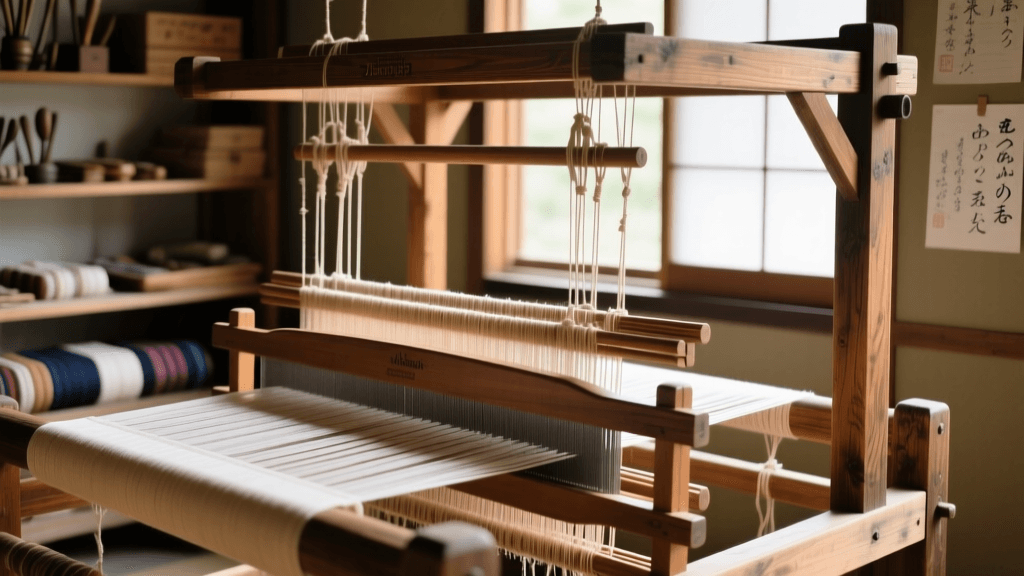
The Jibata is the quintessential handloom used in the Nishijin district of Kyoto for weaving wide fabrics, particularly the luxurious silks used in kimono and obi. Unlike the Jacquard looms that automate complex patterns, the traditional Jibata relies entirely on the weaver’s physical coordination and memory. The loom is typically constructed from Keyaki (Japanese zelkova) or Hinoki (Japanese cypress), woods prized for their density, resonance, and resistance to warping under high tension.
Operating a Jibata in 2026 requires an understanding of its unique harness system. The weaver uses foot treadles to lift specific warp threads, creating a shed through which the hiboko (shuttle) is thrown. The shuttle, often carved from a single piece of dense cherry wood, carries the weft thread and is caught by the weaver's opposite hand. The physical toll of this process is significant; a master weaver might throw the shuttle over 3,000 times a day. To mitigate ergonomic strain, several Kyoto-based artisan guilds have introduced subtle, non-invasive ergonomic modifications to the seating benches and treadle heights in 2026, allowing older master weavers to continue their craft without compromising the historical integrity of the loom.
The tension on a Jibata is maintained by a complex system of weights and ratchets. The warp beam must hold hundreds of silk threads under uniform tension, a feat achieved through the chikara-ito (tension cords). In 2026, while traditional hemp cords are still used by purists, many studios have adopted high-tensile, UV-resistant synthetic cores wrapped in traditional hemp to prevent snapping during the weaving of heavy metallic brocades. The resulting fabric, characterized by its slight irregularities and profound depth of color, is highly sought after by international haute couture houses.
The Takadai (高台): The Architecture of Kumihimo Braiding
While the Jibata is designed for wide, flat textiles, the Takadai is the specialized high-stand loom used for creating complex, multi-layered braids, most notably the obijime (the decorative cord used to tie a kimono obi) and intricate samurai armor lacing. The Takadai elevates the braiding process above the weaver's lap, allowing for the manipulation of dozens of bobbins (koma) simultaneously.
The structural complexity of the Takadai allows for flat, square, and hollow braids that are impossible to achieve on the more common Marudai (round braiding stand). The weaver sits at the base of the Takadai, moving the weighted bobbins in precise, memorized sequences. The weights (omori) hanging below the stand provide the necessary downward tension. In 2026, the art of Kumihimo has seen a massive global revival, with the Victoria and Albert Museum's Asia collections frequently highlighting the mathematical precision and structural integrity of historical Japanese braids, inspiring modern textile artists to invest in Takadai looms.
Modern Takadai construction in 2026 balances traditional joinery with contemporary precision. Master woodworkers in Nara and Kyoto utilize laser-calibrated mortise and tenon joints to ensure the frame remains perfectly plumb, which is critical; even a millimeter of lean can alter the tension of the bobbins and ruin the symmetry of the braid. The bobbins themselves are often turned from bamboo or lightweight brass, weighted with lead or steel cores. Artisans today frequently customize the weight of their bobbins down to the gram, depending on the denier of the silk thread being used, ensuring flawless tension across a 64-bobbin setup.
2026 Sourcing, Pricing, and Studio Setup
Acquiring a traditional Japanese loom in 2026 requires navigating a niche market of antique restorers, custom woodworkers, and specialized textile exporters. The table below outlines the current market conditions, costs, and spatial requirements for setting up a professional studio.
| Loom Type | Primary Use | 2026 Avg. Cost (USD) | Studio Space Required | Lead Time (Custom/Restore) |
|---|---|---|---|---|
| Antique Jibata (Restored) | Wide Silk (Kimono/Obi) | $12,500 - $22,000 | 150 sq ft (High Ceiling) | 4 - 8 months |
| Custom New Jibata | Wide Silk / Experimental | $28,000 - $45,000 | 150 sq ft | 12 - 18 months |
| Traditional Takadai | Kumihimo Braiding (Obijime) | $3,200 - $6,500 | 40 sq ft | 3 - 5 months |
| Modern Hybrid Table Loom | Sample Weaving / Education | $1,800 - $3,500 | 20 sq ft | In Stock / 4 weeks |
When importing an antique Jibata in 2026, buyers must account for specialized crating and climate-controlled shipping, as the aged zelkova wood can crack if exposed to rapid humidity shifts during ocean freight. It is highly recommended to work with Kyoto-based export cooperatives that specialize in cultural properties, as they provide the necessary phytosanitary certificates and custom wooden cradles for the loom's delicate harnesses.
Threading the Loom: Technical Considerations for Artisans
The true mastery of the Jibata and Takadai lies not just in the weaving, but in the preparation. The warping process (seikei) for a Jibata can take weeks. Silk threads, particularly namagaito (raw silk) and shioze (silk crepe), are highly sensitive to ambient humidity. In 2026, professional weaving studios are equipped with advanced HVAC systems that maintain a strict environment of 65% relative humidity and 22°C (71°F). This prevents the silk from becoming brittle and snapping under the high tension of the warp beam.
Before weaving, the warp threads are often treated with a traditional sizing agent (nori), typically made from boiled rice starch or funori (seaweed extract). This sizing reduces friction as the threads pass through the osa (reed) and heddles. Modern artisans in 2026 have refined these recipes, sometimes incorporating microscopic amounts of natural waxes to enhance the glide of metallic threads, which are notoriously prone to catching and fraying. The reed itself, traditionally made from split bamboo, is increasingly being replaced by custom-milled stainless steel reeds for high-volume metallic brocade production, though bamboo remains the standard for pure silk to prevent cutting the delicate fibers.
Preservation and Global Adaptation
The survival of the Jibata and Takadai is a testament to the adaptability of Japanese artisans. While the domestic market for everyday kimono has stabilized, the international appreciation for Japanese textile heritage has exploded. Institutions like the Metropolitan Museum of Art's Asian Art department continue to showcase the unparalleled technical achievements of Nishijin weavers, driving global academic and artistic interest.
In 2026, we see a fascinating cross-pollination: international textile artists traveling to Kyoto for intensive, multi-month residencies to study the Jibata, subsequently adapting these tensioning techniques to local fibers like alpaca, lotus silk, and even recycled copper wire. Conversely, young Japanese weavers are utilizing 3D modeling to design custom Takadai bobbins and Jibata shuttle raceways, optimizing the tools for contemporary art installations rather than just traditional garments. This synthesis of ancient woodcraft and modern material science ensures that the legacy of Japanese hand-weaving remains a living, evolving discipline. For the dedicated artisan, investing in these looms is not merely a purchase of equipment; it is an initiation into a centuries-old dialogue between human hands, natural fibers, and the precise geometry of the loom.