Japanese Jibata Looms & Kasuri Weaving Methods in 2026
The Living Heritage of Japanese Hand-Weaving
As we navigate the textile landscape of 2026, the global appreciation for slow fashion and heritage craftsmanship has reached unprecedented heights. Among the most revered practices in the Asian traditions sphere is Japanese hand-weaving, specifically the use of the Jibata (traditional floor loom) and the intricate Kasuri (ikat) dyeing and weaving method. Unlike mass-produced textiles, garments born from these methods carry the distinct rhythm of the artisan, preserving centuries-old techniques that continue to evolve today.
For textile artists, collectors, and cultural historians, understanding the mechanics of the Jibata and the meticulous preparation required for Kasuri weaving is essential. This guide explores the current state of these traditional methods, how artisans are sourcing materials in 2026, and the technical specifications that define authentic Japanese hand-woven fabrics.
Anatomy of the Jibata: The Traditional Japanese Floor Loom
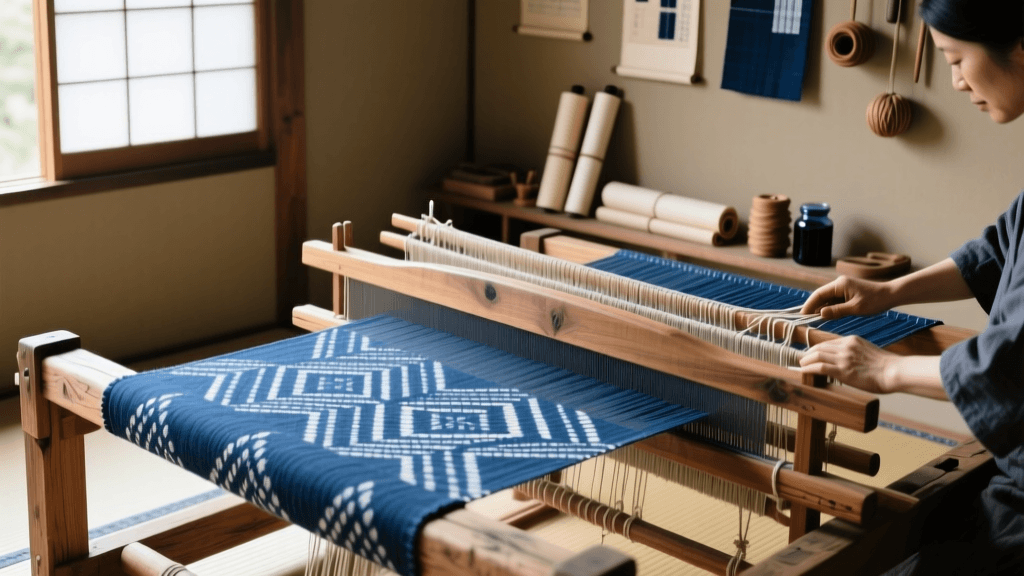
The Jibata (地機), or floor loom, is the backbone of rural Japanese weaving, particularly famous in regions like Ojiya and Yuki. Unlike the rigid, heavy frame looms common in Western weaving, the traditional Jibata is uniquely designed for the weaver's body. The weaver sits on a straw mat or low stool, leaning back to create warp tension, while a strap around the lower back connects to the warp beam.
Key Components and 2026 Sourcing
- Warp Beam (Chikiri): Traditionally made from aged Japanese cypress (Hinoki). In 2026, sustainable forestry initiatives in the Niigata prefecture have made ethically sourced, air-dried Hinoki more accessible to independent loom builders.
- Reed (Osa): Historically crafted from split bamboo. While bamboo reeds are still prized for their flexibility and gentle touch on delicate silk threads, many modern preservationists now use high-grade carbon-fiber reinforced bamboo hybrids to prevent warping in varying humidity levels.
- Heddles (So): Hand-tied cotton or silk loops. Artisans today often use ultra-f 60/3 mercerized cotton for heddle tying to reduce friction during the shedding process.
- Belt (Koshi-ate): The tensioning belt worn by the weaver. Modern weavers often commission custom-woven hemp or heavy linen belts, padded with natural kapok for ergonomic support during long weaving sessions.
The Kasuri Method: Precision in Resist-Dye Weaving
Kasuri is the Japanese iteration of ikat, a resist-dyeing technique where threads are tied and dyed before weaving to create blurred, geometric, or pictorial patterns. According to the Agency for Cultural Affairs in Japan, several regional Kasuri techniques, including Kurume and Ojiya-chijimi, are protected as Important Intangible Cultural Properties.
The 2026 Artisan Workflow
Creating authentic Kasuri in 2026 requires a synthesis of ancestral mathematics and natural material preparation. The process generally follows these stringent steps:
- Design and Calculation: The pattern is drafted on graph paper or specialized CAD software, calculating the exact millimeter of thread that must resist the dye.
- Binding (Kukuri): Warp and/or weft threads are tightly bound with hemp or specialized synthetic resist tape. In 2026, biodegradable plant-based resist tapes have largely replaced petroleum-based plastics in eco-conscious studios.
- Fermentation Indigo Dyeing (Aizome): The bound threads are submerged in Sukumo (fermented Japanese knotweed) vats. Maintaining the alkaline pH and temperature to achieve the desired depth of blue.
- Aligning and Weaving: The most challenging phase. On the Jibata, the weaver must manually adjust each weft thread with a bamboo spatula to ensure the dyed patterns align perfectly across the warp.
Comparing Traditional Japanese Looms
While the Jibata is iconic, it is not the only loom used in Japanese textile traditions. Below is a comparison of the primary traditional looms utilized by artisans and preservation societies today.
| Loom Type | Primary Use | Tension Mechanism | Best Suited For | Estimated 2026 Custom Build Cost (USD) |
|---|---|---|---|---|
| Jibata (Floor Loom) | Wide kimono fabrics, Kasuri | Weaver's body weight via back-strap | Silk, fine ramie, complex ikat alignment | $4,500 - $8,000 |
| Takahata (Treadle Loom) | Everyday cottons, hemp, Obi | Wooden frame and foot treadles | Heavier yarns, faster continuous production | $6,000 - $12,000 |
| Izari (Seated Loom) | Narrow bands, Saori-style weaving | Fixed frame or light body tension | Beginners, small-scale tapestry, wool | $1,200 - $2,500 |
| Takadai (Braiding Loom) | Kumihimo (braided cords for Obijime) | Weighted bobbins (Tama) | Silk braiding, structural cords | $800 - $1,500 |
Sourcing Authentic Materials in 2026
The authenticity of Japanese hand-weaving relies heavily on the provenance of its raw materials. For artisans operating outside of Japan, or those looking to import materials for domestic studios, understanding the 2026 supply chain is crucial.
Natural Fibers: Silk and Ramie
For Kasuri weaving, the thread must be exceptionally smooth to allow for tight binding and crisp resist lines. Joshi (raw silk) from the Gunma prefecture remains the gold standard. In 2026, direct-to-artisan cooperatives have streamlined the export process, allowing international weavers to purchase small-batch, hand-reeled silk directly from sericulture farms via specialized textile import platforms.
Ramie (Choma), essential for summer kimono fabrics like Ojiya-chijimi, requires a specific hand-processing technique called Umi-oshi, where the threads are pressed into the snow or sea to bleach and soften them. Due to climate shifts affecting traditional snow-bleaching windows, artisans have adapted by utilizing controlled, high-humidity cold-storage chambers to replicate the traditional Yuki-sarashi (snow bleaching) effect without compromising the fiber's integrity.
Indigo and Natural Dyes
The traditional dyeing sector has seen a massive resurgence. Sourcing active, healthy Sukumo (indigo compost) from Tokushima remains highly competitive. In 2026, many international weavers are partnering with domestic micro-farmers who have successfully cultivated Japanese indigo (Polygonum tinctorium) and mastered the alkaline reduction vat, ensuring that the deep, living blues of authentic Kasuri can be achieved globally.
Preservation and the Future of Hand-Weaving
The survival of the Jibata and Kasuri methods depends on the transmission of knowledge. In 2026, digital archiving and virtual reality (VR) loom simulations are being used by institutions like the Tokyo National Museum and various prefectural craft centers to teach the complex mathematics of Kasuri tie-dyeing to a new generation of textile students.
However, the tactile reality of weaving—the sound of the wooden batten beating the weft, the physical pull of the warp against the weaver's back, and the smell of the indigo vat—cannot be digitized. For those dedicated to the Asian traditions of garment making, investing the time to master the Jibata is not merely an exercise in historical reenactment; it is a vital act of cultural preservation, ensuring that the profound beauty of Japanese hand-woven textiles continues to drape the human form for centuries to come.