Japanese Jibata Looms & Kasuri Hand-Weaving Guide 2026
The Renaissance of the Jibata Loom in 2026
In the contemporary textile landscape of 2026, the global slow-fashion movement has sparked an unprecedented renaissance in traditional Asian hand-weaving. At the forefront of this revival is the Japanese Jibata (floor loom), an ancient, low-to-the-ground weaving apparatus that demands immense physical dexterity and mathematical precision. For modern artisans, preservationists, and textile enthusiasts, mastering the Jibata and the intricate Kasuri (ikat) technique is not merely a historical exercise; it is a vital practice of cultural preservation and sustainable craftsmanship.
As of 2026, the demand for authentic, hand-woven Japanese textiles has surged, driven by a consumer shift away from mass-produced synthetics toward heritage garments with verifiable provenance. Consequently, the market for restored antique Jibata looms and newly commissioned artisanal models has expanded significantly. This comprehensive guide explores the anatomy of the Jibata, the complex mathematics of Kasuri weaving, and practical steps for setting up your own traditional weaving studio this year.
Understanding Kasuri: The Soul of Japanese Ikat
Before addressing the loom itself, one must understand the textile it is most famous for producing: Kasuri. Originating from the Indonesian word mengikat (to tie), the Japanese Kasuri technique involves resist-dyeing the warp and/or weft threads before they are woven together. The artisan meticulously calculates the pattern, ties off specific sections of the thread bundles with cotton or synthetic resist cords, and dyes them—traditionally in natural indigo vats.
When the dyed threads are finally mounted on the Jibata, the weaver must align the dyed sections of the weft thread perfectly with the corresponding dyed sections of the warp thread. A deviation of even a single millimeter will blur the pattern. In 2026, while some larger studios utilize digital hygrometers and laser-guided tensioning systems to assist with alignment, purists and heritage designers still rely on the traditional tactile feedback of the wooden loom and the weaver's trained eye to achieve the characteristic 'blurred' or 'splashed' aesthetic that defines authentic Kasuri.
Anatomy of the Traditional Jibata
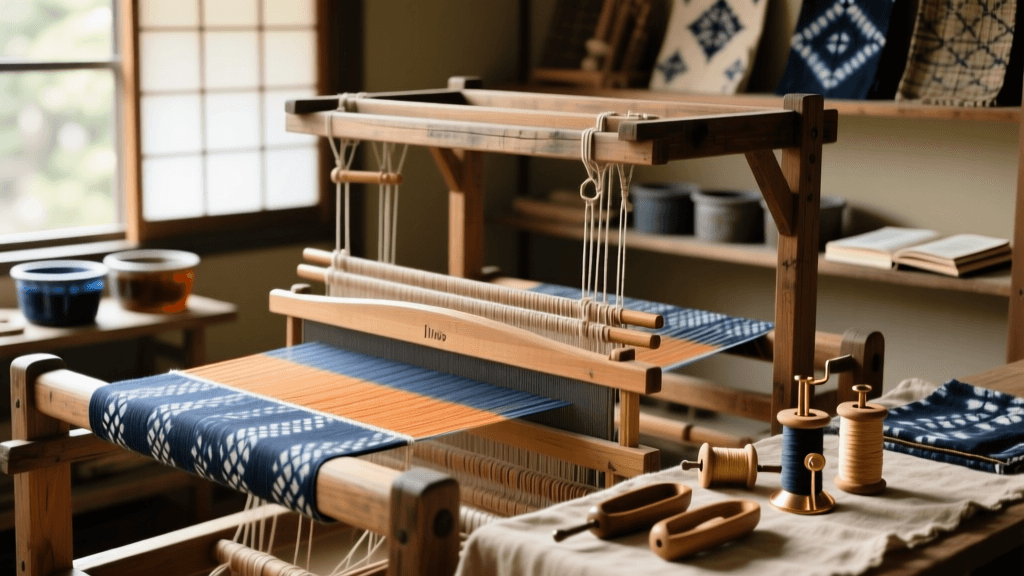
The Jibata differs distinctly from Western counterbalance or jack-style floor looms. It is positioned very close to the floor, requiring the weaver to sit on a low bench or cushion, using their body weight and foot leverage to manage tension. Understanding the terminology and components is essential for any practitioner.
- Osa (Reed): A comb-like structure made of bamboo or metal that spaces the warp threads evenly and beats the weft thread into place.
- Soko (Heddles): Strings or wire loops with an eyelet in the center, used to separate the warp threads and create the 'shed' (the opening through which the shuttle passes).
- Hi (Shuttle): The boat-shaped tool that carries the weft thread (yoko-ito) through the shed. Traditional Kasuri shuttles are often carved from cherry or dogwood to ensure a smooth glide.
- Chikara (Tension Stick): A heavy wooden stick used to apply and maintain extreme tension on the warp beam, crucial for achieving the tight, crisp weave required for high-end silk Kasuri like Oshima Tsumugi.
- Omoi (Weights): Traditional stone or wooden weights hung from the warp ends to maintain consistent tension as the cloth is wound forward.
2026 Loom Market and Specifications
Acquiring a traditional Japanese loom in 2026 requires navigating a specialized market. Due to the shrinking number of master carpenters who build these looms using traditional joinery (without nails), antique restorations are highly prized. Below is a comparison of the primary loom types available to artisans today.
| Loom Type | Traditional Name | Average 2026 Price (USD) | Footprint (L x W) | Primary Use Case |
|---|---|---|---|---|
| Standard Floor Loom | Jibata | $4,500 - $8,000 | 8ft x 4.5ft | Cotton Kasuri, everyday kimono fabrics, hemp |
| Tall Pedal Loom | Takabata | $9,000 - $15,000 | 9ft x 5ft | Complex silk brocades, Nishijin-ori, multi-shaft patterns |
| Backstrap / Sitting Loom | Izari-bata | $1,200 - $2,500 | 5ft x 2.5ft | Narrow sashes (Obijima), rural textiles, Ainu weaving |
Note: Prices in 2026 reflect the premium placed on authenticated, heritage-grade hardwoods (such as Japanese Zelkova or Keyaki) and the inclusion of hand-carved replacement parts.
Step-by-Step Guide to Warping the Jibata (Seikei)
The most daunting task for a novice is Seikei, the process of measuring and winding the warp threads onto the loom. In Kasuri weaving, this step is exponentially more complex because the threads must be aligned according to the pre-dyed pattern.
1. Measuring and Winding
Using a traditional warping wheel (Seiki-guruma), the artisan measures out the exact length of thread required, adding a 15% allowance for loom waste and take-up. In 2026, many studios use humidity-controlled warping rooms set to exactly 65% relative humidity to prevent silk threads from snapping under tension.
2. Threading the Heddles (Soko-tooshi)
Each individual warp thread must be passed through the eye of a heddle in a specific sequence dictated by the weave structure (usually a plain weave or twill for Kasuri). This is often a two-person job, with one artisan handing the threads through the reed and the other catching them with a specialized hook.
3. Tying the Tension (Chikara-musubi)
The warp threads are grouped and tied to the tension stick using a specialized slip knot that allows for micro-adjustments. Achieving uniform tension across a 14-inch wide kimono bolt (tanmono) can take an experienced weaver up to six hours.
The Weaving Process: Rhythm, Breath, and Tension
Once the loom is dressed, the physical act of weaving begins. The weaver depresses the foot pedals (or uses hand-levers on older Jibata models) to raise alternate sets of heddles, opening the shed. The shuttle is thrown swiftly through the opening, caught on the opposite side, and the weaver pulls the Osa (reed) forward with a firm, rhythmic motion to beat the weft into place.
In Kasuri weaving, the weaver must pause every few inches to adjust the weft threads with a small bamboo pick, nudging the dyed sections into perfect alignment with the warp. This meticulous process means a master weaver might produce only 10 to 15 centimeters of high-grade Oshima Tsumugi silk per day. According to heritage preservation data from Kogei Japan, the designation of traditional crafts relies heavily on maintaining these exact, unmechanized production speeds to ensure the structural integrity and cultural authenticity of the textile.
Sourcing Authentic Materials in 2026
A Jibata loom is only as good as the materials it processes. Sourcing authentic, high-quality yarns is critical for traditional weaving.
- Indigo Dyed Cotton: For Kurume-style cotton Kasuri, artisans are increasingly partnering with organic indigo farms in Tokushima and Saitama. In 2026, naturally fermented sukumo indigo costs approximately $120 per kilogram, reflecting the labor-intensive composting process.
- Raw Silk (Ki-ito): For Oshima Tsumugi, the silk must be hand-spun from dupioni cocoons. Artisans source directly from sericulture cooperatives in Kagoshima and Miyazaki, where climate-resilient mulberry cultivation has stabilized yields despite recent environmental shifts.
- Bast Fibers: Ramie (choma) and hemp (asa) remain popular for summer yukata and workwear. These are traditionally sourced from Showa-machi in Oita Prefecture, where water-retting techniques are still practiced.
Preservation and the Future of Hand-Weaving
The survival of the Jibata and Kasuri techniques hinges on the transmission of knowledge to the next generation. In 2026, several prominent textile guilds in Kyoto and Fukuoka have launched hybrid apprenticeship programs. These programs pair young weavers with octogenarian masters, combining traditional oral instruction with modern digital archiving of pattern drafts and tension metrics.
Museums and cultural institutions also play a pivotal role. The extensive archives and ongoing research provided by institutions like the Victoria and Albert Museum's Asian Collections continue to offer invaluable reference points for contemporary weavers attempting to recreate lost historical patterns and dye formulations. By studying these preserved artifacts, modern artisans can reverse-engineer complex multi-layered Kasuri techniques that were nearly lost during the rapid industrialization of the mid-20th century.
Setting Up Your Own Studio: Practical Considerations
If you are planning to install a Jibata in your home or studio in 2026, consider the following environmental and spatial requirements:
- Flooring: Traditional Jibata require tatami mat flooring or specialized wooden slat flooring to allow the weaver to sit comfortably and anchor the loom's base beams. Concrete floors will require a raised wooden platform.
- Lighting: Kasuri alignment requires impeccable lighting. North-facing windows providing diffused, natural daylight are ideal. Supplement with high-CRI (Color Rendering Index > 95) LED studio lights to accurately judge indigo shades and silk luster.
- Climate Control: Wood looms expand and contract. Maintain a stable studio temperature of 20°C (68°F) and a humidity level between 55% and 65% to prevent the wooden joints from loosening and to keep natural fibers pliable.
Conclusion
Mastering the Japanese Jibata loom and the Kasuri hand-weaving method is a profound commitment to the slow, deliberate creation of beauty. In an era dominated by automated textile manufacturing, the rhythmic clatter of the wooden shuttle and the scent of natural indigo serve as powerful reminders of human ingenuity and patience. Whether you are a seasoned textile artist expanding your repertoire or a dedicated preservationist safeguarding Asian traditions, the Jibata offers a direct, tactile connection to centuries of Japanese cultural heritage. By embracing these methods in 2026, we ensure that the intricate, blurred patterns of Kasuri will continue to inspire and endure for generations to come.