Mastering Jibata Handlooms: Nishijin Weaving Methods 2026
The Enduring Legacy of Nishijin-Ori in 2026
In the heart of Kyoto, the rhythmic clatter of wooden shuttles continues to echo through narrow alleyways, defying the relentless pace of modern fast fashion. As of 2026, Nishijin-ori (Nishijin weaving) remains one of Japan’s most prestigious and highly sought-after textile traditions. Originally developed over a millennium ago to clothe the imperial court and samurai elite, this intricate method of producing patterned silk textiles has evolved while fiercely guarding its core methodologies. For contemporary artisans and textile enthusiasts, mastering the traditional Japanese handloom—specifically the Jibata—is not merely an exercise in historical reenactment; it is a vital, living practice that produces fabrics of unparalleled depth, texture, and cultural significance.
The global resurgence of slow fashion and heritage craftsmanship has placed a renewed spotlight on Kyoto’s weaving districts. According to the Ministry of Economy, Trade and Industry (METI), government-backed initiatives in 2026 have successfully stabilized the number of registered traditional craft artisans, reversing a decades-long decline. This stabilization is largely driven by a new generation of weavers who are blending ancestral hand-weaving techniques with contemporary aesthetic sensibilities, ensuring that the Jibata handloom remains a relevant and economically viable tool for creating luxury kimono, obi sashes, and high-end interior textiles.
Understanding the Jibata (Traditional Handloom)
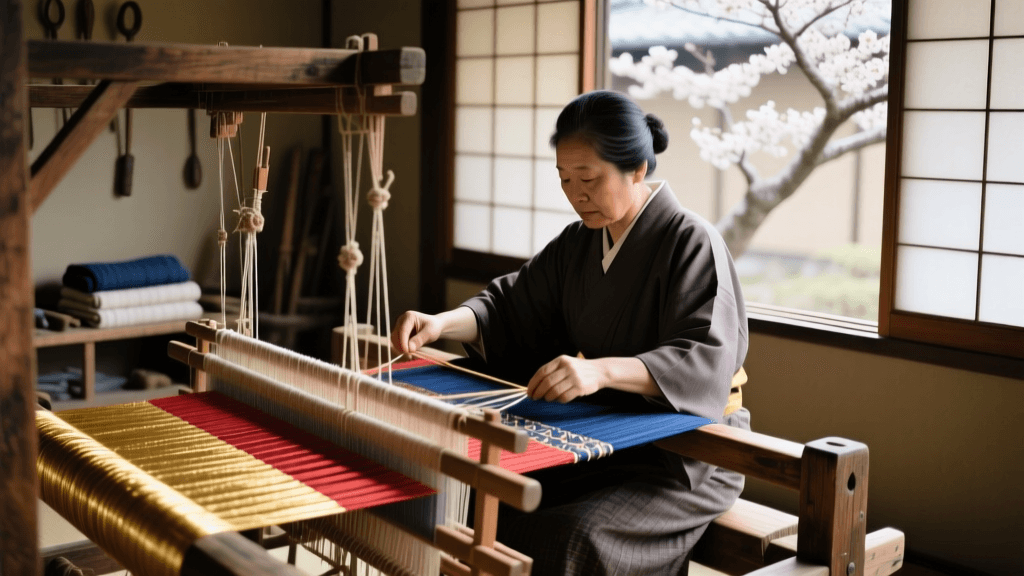
The Jibata is the quintessential traditional Japanese handloom, designed specifically to handle the delicate, high-tension requirements of silk weaving. Unlike Western floor looms that often rely on heavy counterbalances and overhead battens, the Jibata is a low-set, treadle-operated loom that positions the weaver close to the ground. This ergonomic design allows the artisan to use their entire body weight to beat the weft yarn tightly into the fabric, a necessity for creating the dense, stiff brocades characteristic of Nishijin textiles.
Operating a Jibata requires a profound physical and mental connection to the machine. The weaver must synchronize foot movements on the treadles (which raise and lower the warp threads) with the rapid, precise throwing of the hiboko (shuttle) and the forceful pull of the chikara (reed/beater). In 2026, master weavers emphasize that the Jibata is not just a tool, but an extension of the artisan’s body, capable of producing subtle textural variations that fully automated power looms simply cannot replicate.
Anatomy of the Jibata Loom
To understand the weaving method, one must first understand the specialized components of the Jibata:
- Hata (Loom Frame): Constructed from aged, dense hardwoods like Japanese oak or zelkova, the frame must be incredibly rigid to withstand the immense tension of thousands of silk warp threads.
- Soko (Heddles): Made from fine silk or synthetic cords with minute eyelets, the soko separate the warp threads to create the shed. A single complex Nishijin obi may require over 10,000 individual heddle eyes.
- Hiboko (Shuttle): Aerodynamically carved from polished wood, the shuttle carries the weft thread (yokoshi) through the shed. Artisans often customize the weight and balance of their hiboko to suit specific silk deniers.
- Chikara (Beater/Reed): The comb-like structure that packs the weft thread tightly against the fell of the cloth. The spacing of the reed dictates the final density of the fabric.
- Makiki (Cloth Beam): The roller that collects the finished woven fabric, equipped with a ratchet system to maintain constant, unwavering tension.
Jibata vs. Modern Jacquard Looms: A 2026 Comparison
While the pure Jibata handloom remains the gold standard for bespoke, ultra-luxury textiles, the modern Nishijin industry heavily utilizes Jacquard attachments and semi-automated power looms to meet commercial demand. For artisans setting up a studio in 2026, choosing the right equipment is a critical business decision. The Nishijin Textile Industry Association provides extensive resources for new weavers navigating these technological tiers.
| Feature | Traditional Jibata Handloom | Semi-Automated Jacquard Loom | Modern Power Loom (2026 Models) |
|---|---|---|---|
| Operation | 100% Manual (Treadles & Hand Shuttle) | Computerized pattern shedding, manual shuttle throwing | Fully automated shedding, shuttle, and beating |
| Production Speed | 5 - 15 cm per hour (Highly complex) | 30 - 50 cm per hour | 2 - 5 meters per hour |
| Pattern Complexity | Limited by physical heddle count & memory | Unlimited (Digital punch cards/files) | Unlimited (Digital punch cards/files) |
| Textile Quality | Unmatched depth, tension control, and soul | High quality, consistent, slight mechanical uniformity | Commercial grade, lacks micro-textural nuances |
| 2026 Setup Cost | ¥800,000 - ¥2,500,000 (Antique/Custom) | ¥3,500,000 - ¥6,000,000 | ¥10,000,000+ |
| Primary Use | Bespoke Obi, Imperial commissions, Art pieces | High-end commercial Kimono and Obi | Mass-market textiles, accessories, interiors |
Sourcing Authentic Silk and Threads in Kyoto
The finest loom in the world is useless without premium raw materials. In 2026, the supply chain for authentic Nishijin silk has become highly specialized. Artisans rely on a network of specialized thread dyers (itohachi) and gold leaf manufacturers (kinpaku) located primarily in Kyoto and the neighboring Tango peninsula.
For the warp threads (tate-ito), weavers typically source raw silk that has been degummed and twisted to precise tension requirements. A popular choice in 2026 is the ultra-fine 14-denier silk thread, which allows for incredibly detailed pictorial weaves. For the weft, artisans experiment with urushi (lacquer-coated) threads and kinpaku (gold leaf applied to washi paper and cut into micro-strips). The cost of premium 2026 Nishijin gold thread averages ¥45,000 per 100-gram spool, reflecting the intense labor and precious materials involved. Sourcing directly from legacy suppliers like Masunaga or the Tango Crepe cooperatives ensures that the silk possesses the necessary tensile strength to survive the rigorous beating of the Jibata’s chikara.
Step-by-Step: Threading and Weaving on a Jibata
The actual weaving (shokki) is only the final step in a grueling, multi-week process. The preparation of the Jibata requires meticulous mathematical precision and immense patience.
1. Warping (Seikei)
The warp threads are measured out to the exact length and width required for the final textile. For a standard maru-obi (a fully patterned, double-width sash), an artisan may measure out 12,000 individual silk threads, each over 5 meters long. These are wound onto the warp beam (chikiri) with absolute uniformity in tension.
2. Drawing In (Soko-doshi)
Using a specialized hook, the weaver passes every single warp thread through the eye of a heddle (soko) and then through the dent of the reed (chikara). This step, known as soko-doshi, can take a master artisan up to three weeks of continuous, 10-hour days. A single crossed thread will ruin the structural integrity of the pattern.
3. Weaving (Shokki)
Once threaded, the weaving begins. The weaver depresses the wooden treadles with their feet, opening a clean shed between the warp layers. The right hand throws the hiboko carrying the weft thread, while the left hand catches it. Immediately, both hands pull the heavy wooden beater forward with a sharp, resonant bata-bata sound, locking the weft into place. This rhythm is repeated thousands of times a day. The weaver must constantly adjust the humidity in the studio using traditional water basins, as silk becomes brittle and snaps if the ambient moisture drops below 55%.
Preserving the Craft: Education and Workshops
As the demand for authentic, hand-woven heritage garments grows among international collectors and high-fashion houses in 2026, the need for trained Jibata operators has never been higher. The Japanese government, alongside local Kyoto municipalities, has heavily subsidized apprenticeship programs to bridge the generational gap. Institutions such as the Kyoto City University of Arts and specialized Nishijin vocational schools now offer comprehensive 3-year diplomas focused exclusively on traditional hand-weaving mechanics and textile conservation.
For international enthusiasts and independent designers visiting Japan, the Nishijin Textile Center offers immersive, multi-day workshops that allow participants to experience the physical demands and profound satisfaction of operating a Jibata. These programs not only generate vital revenue for the preservation societies but also foster a global appreciation for the staggering amount of human labor woven into every millimeter of traditional Japanese silk. By supporting these educational initiatives and choosing authentic, hand-loomed garments, consumers in 2026 play a direct role in ensuring that the song of the Jibata continues to resonate through the streets of Kyoto for centuries to come.