Mastering Jibata Looms & Kasuri Weaving in 2026: A Complete Guide
The Renaissance of Japanese Hand-Weaving in 2026
As we navigate the global textile landscape in 2026, the slow fashion movement and a profound appreciation for heritage craftsmanship have pushed traditional Japanese weaving techniques into the international spotlight. Among the most revered of these practices is the use of the Jibata (traditional floor loom) to create Kasuri (ikat) textiles. Unlike mass-produced fabrics, hand-woven Japanese textiles carry the distinct signature of the artisan, characterized by meticulous tension control, natural dyeing processes, and geometric precision.
According to the Ministry of Economy, Trade and Industry (METI), the preservation of traditional Japanese crafts has seen a renewed surge in interest from both domestic and international artisans in 2026. This renaissance is not merely about museum preservation; it is about active, living practice. Weavers around the world are importing antique Japanese looms, studying historical pattern drafts, and integrating these ancient methods into contemporary garment creation. This comprehensive guide will explore the mechanics of the Jibata, the intricate art of Kasuri weaving, and how you can engage with these methods today.
Anatomy of the Jibata: Japan’s Traditional Floor Loom
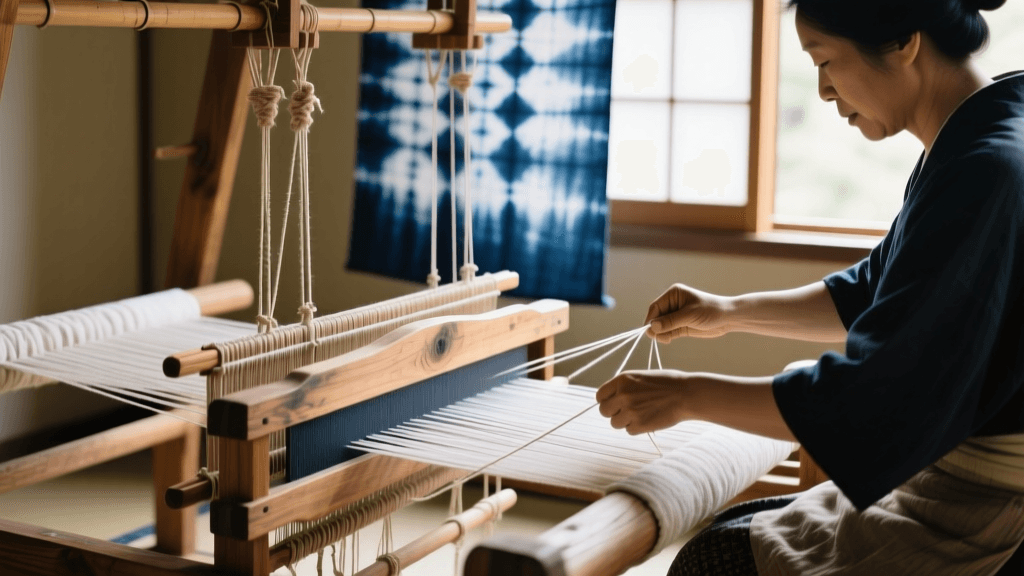
The Jibata (literally 'ground loom') is a low-to-the-ground wooden loom that has been used in Japan for centuries, particularly for weaving cotton and silk in rural and artisan workshops. Unlike the tall, upright Takabata or Western floor looms where the weaver sits on a raised bench, the Jibata requires the weaver to sit on the floor or a low cushion, with legs extended beneath the warp.
Key Components of the Jibata
- Chikiri (Warp Beam): The back beam that holds the warp threads. On a Jibata, the warp is often weighted or tied to the weaver's body in older models, though modern 2026 restorations frequently use a ratcheted wooden beam.
- Soko (Heddles): Made from fine cotton or silk thread loops, the soko lift and lower specific warp threads to create the shed. Japanese heddles are renowned for their delicate construction, allowing for incredibly tight thread spacing.
- Osa (Reed): The comb-like structure used to beat the weft yarn into place. Traditional Japanese reeds were made from split bamboo, though carbon-fiber and stainless-steel reeds are common in 2026 for high-tension silk weaving.
- Hi (Shuttle): The boat-shaped tool that carries the weft yarn. Jibata shuttles are often elongated and polished to a glass-like finish to glide smoothly through the tight shed.
- Ashibumi (Treadles): The foot pedals connected to the heddles. The low profile of the Jibata means the treadle action is subtle, requiring precise ankle movements rather than full leg presses.
The low center of gravity of the Jibata provides the weaver with an intimate, tactile connection to the warp tension. By feeling the threads with their toes and lower body, master weavers can detect microscopic variations in tension, a necessity when weaving delicate Kasuri patterns.
The Intricate Art of Kasuri (Ikat) Weaving
Kasuri is the Japanese term for ikat, a resist-dyeing technique where threads are dyed in specific patterns before they are woven. The hallmark of authentic Japanese Kasuri is the kasuri-aji—the slight, organic 'blur' or 'bleed' at the edges of the pattern, which gives the textile its characteristic warmth and depth.
Types of Kasuri
- Tate-gasuri (Warp Ikat): Only the warp threads are resist-dyed. This is the most common and straightforward method, often used for vertical geometric patterns.
- Yoko-gasuri (Weft Ikat): Only the weft threads are dyed. This requires the weaver to carefully adjust the weft thread with a small pick during weaving to align the pattern perfectly.
- Tate-yoko-gasuri (Double Ikat): Both warp and weft threads are resist-dyed. This is the pinnacle of Kasuri weaving, requiring mathematical precision in both the dye house and at the loom. Regions like Kurume and Okinawa are historically famous for their double ikat techniques.
In 2026, the resist-dyeing process often blends heritage methods with modern precision. While traditional artisans still use hand-tied cotton string to bind the threads before dipping them into natural indigo (aizome) vats, some contemporary studios now use biodegradable, water-soluble resists and IoT-monitored fermentation vats to maintain the exact pH and temperature required for perfect indigo oxidation.
Comparison Chart: Jibata vs. Takabata vs. Western Floor Loom
Choosing the right loom depends on your space, physical ergonomics, and the type of textile you wish to produce. Below is a comparison of the primary loom types available to weavers in 2026.
| Feature | Jibata (Japanese Floor Loom) | Takabata (Japanese Tall Loom) | Western Floor Loom (e.g., Louet, Glimåkra) |
|---|---|---|---|
| Ergonomics | Seated on floor/low cushion; legs extended. | Seated on a raised wooden bench. | Seated on an adjustable, padded bench. |
| Shedding Mechanism | Counterbalance or jack-type; subtle foot treadles. | Drawloom attachments common; complex harnesses. | Jack, counterbalance, or countermarch. |
| Best Use Case | Fine cotton/silk, Kasuri, high-tension weaving. | Complex brocades, Nishijin-ori, Obi sashes. | Wool, heavy cotton, tapestries, general weaving. |
| Footprint | Long and low to the ground. | Tall, requires high ceilings. | Compact to large, standard room height. |
| 2026 Avg. Cost (USD) | $2,500 - $6,000 (Antique/Restored) | $8,000 - $25,000+ (Specialty) | $1,500 - $5,000 (New production) |
Sourcing Your Jibata and Materials in 2026
Acquiring an authentic Jibata outside of Japan requires navigating a niche market. In 2026, most international weavers source antique Jibata looms through specialized Japanese export agents based in Kyoto and Fukui. These agents dismantle, treat the wood for international shipping regulations, and provide digital 3D-assembly guides. Expect to pay between $3,000 and $5,500 for a fully restored, 4-harness Jibata with original bamboo reeds.
For materials, sourcing authentic Japanese yarns is easier than ever. The Japan Kogei Association maintains directories of certified traditional craftspersons and suppliers. For Kasuri weaving, you will need tightly spun, high-quality cotton or silk. Look for Kurume cotton yarns, prized for their durability and exceptional ability to absorb natural indigo dye without fraying during the intense beating process.
Step-by-Step: Dressing the Jibata for Kasuri
Dressing a Jibata for Kasuri weaving is a test of patience and precision. Because the pattern relies on the exact alignment of dyed threads, any error in warping will distort the final image.
1. Warping and Thread Alignment
Begin by measuring your warp on a warping board. For Kasuri, you must follow a strict drafting plan. The dyed sections of the warp must be placed in the exact sequence dictated by your pattern draft. In 2026, many weavers use tablet-based drafting software to generate the tie-up and threading sequences, projecting the pattern onto the wall above the loom for easy reference while threading the soko (heddles).
2. Threading the Soko and Osa
Thread the heddles using a traditional Japanese hook. The density of Japanese weaving is often much higher than Western weaving; it is common to see 30 to 40 ends per inch (EPI) for fine Kasuri cotton. Once threaded, draw the warp through the osa (reed). Ensure that the tension is perfectly even across the entire width. The Jibata's low profile allows you to run your hands along the warp from the front beam to the back beam, feeling for any slack threads.
3. Tensioning and the Waridake
Traditional Jibata setups often utilize a waridake (split bamboo) tensioning system at the back of the loom. This acts as a natural shock absorber. When you beat the weft with the osa, the bamboo flexes slightly, protecting the delicate warp threads from snapping under high tension.
4. Weaving the Kasuri Pattern
As you throw the hi (shuttle), pay close attention to the weft alignment. If you are weaving yoko-gasuri (weft ikat), you must use a small bamboo pick to manually nudge the weft thread left or right after every single pass, ensuring the dyed weft aligns perfectly with the warp to form a crisp geometric motif. This is where the artisan's skill truly shines; the 'blur' should only occur at the micro-level, while the macro-pattern remains sharp and defined.
Preserving Heritage Through Modern Practice
The survival of the Jibata and Kasuri weaving methods relies on continuous practice and education. Institutions like the Kyoto Museum of Traditional Crafts (Fureaikan) play a vital role in exhibiting these textiles, but the true preservation happens in the studios of independent weavers. In 2026, a new generation of textile artists is combining the meditative, physical discipline of the Jibata with contemporary fashion design, creating garments that honor the past while functioning in the modern wardrobe.
Whether you are a seasoned weaver looking to transition from a Western jack loom to a traditional Japanese floor loom, or a fashion historian studying the mathematics of double ikat, the Jibata offers a profound connection to the material world. By understanding the anatomy of the loom, respecting the resist-dyeing process, and mastering the physical rhythm of the shuttle and reed, you become part of a living, breathing tradition that continues to evolve in the 21st century.