Traditional Kimono Tanmono Zero-Waste Construction 2026
The Philosophy of Mottainai and Zero-Waste Design
In the landscape of 2026 sustainable fashion, the global apparel industry is aggressively pivoting toward circular design models to combat the millions of tons of textile waste generated annually. Yet, long before the modern zero-waste movement gained traction, traditional Asian dress traditions had already perfected the art of sustainable garment construction. At the heart of this tradition is the Japanese kimono, specifically its foundational construction technique based on the Tanmono (standardized fabric bolt). Rooted in the philosophy of mottainai—a deep sense of regret concerning waste—the Tanmono system ensures that absolutely no fabric is discarded during the cutting and assembly process. According to the Victoria and Albert Museum, the kimono's linear construction is not merely an aesthetic choice, but a highly engineered approach to textile preservation, allowing garments to be endlessly deconstructed, resized, and repurposed across generations.
The Mathematics of the Standard Kimono Bolt
To understand the brilliance of this zero-waste construction, one must first understand the rigid mathematics of the Tanmono. Unlike Western pattern drafting, which cuts curved shapes from wide fabric and discards the negative space, the Tanmono is woven to a highly specific, standardized dimension. A standard adult kimono bolt is approximately 36 to 38 centimeters (about 14 to 15 inches) wide and 11.5 to 12 meters (about 38 to 39 feet) long. These dimensions are not arbitrary; they are precisely calculated to yield the exact surface area required for a full kimono, including the main body panels, sleeves, front overlaps, and collar, with zero leftover scraps. As noted by Encyclopedia Britannica, this standardization revolutionized the Japanese textile trade, allowing weavers, dyers, and tailors to work in a seamless, decentralized supply chain. In 2026, modern sustainable textile mills are revisiting these narrow-loom weaving techniques to minimize off-cuts at the industrial production level.
Anatomy of the Garment: Rectangular Panel Construction
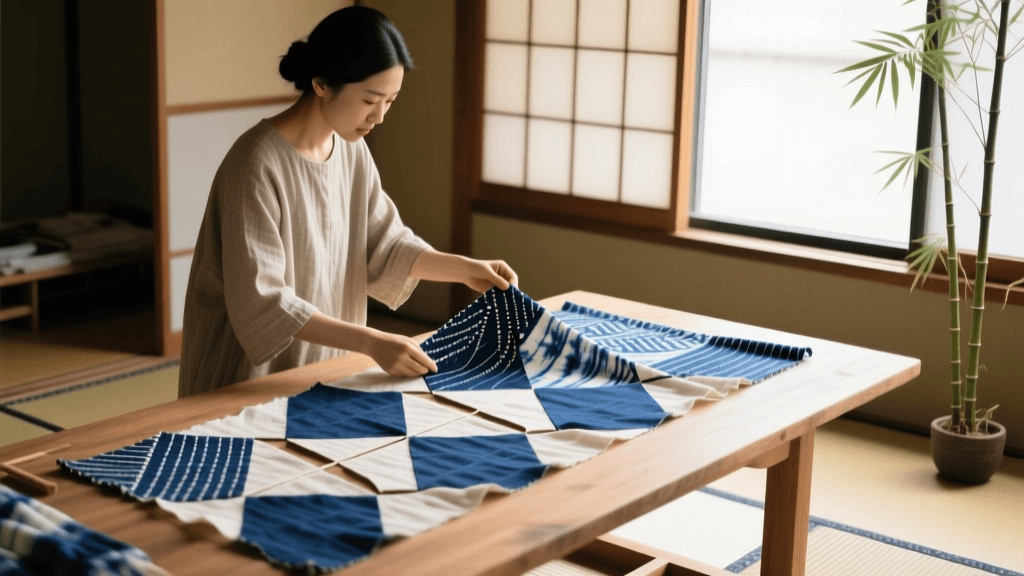
The construction of a kimono from a Tanmono bolt relies entirely on straight lines and rectangular geometry. The garment is composed of eight primary panels, all cut as straight rectangles or squares directly from the bolt without the use of curved armholes or shaped side seams. The Migoro (main body panels) form the front and back of the garment. The Okumi (front panels) are added to the front edges to create the overlapping closure. The Sode (sleeves) are attached as deep, rectangular pouches, and the Eri (collar) is a long, folded strip that wraps around the neck.
Perhaps the most ingenious aspect of this construction technique is the treatment of seam allowances. In Western tailoring, seam allowances are typically trimmed and finished with sergers to prevent fraying. In traditional kimono construction, the seam allowances are left entirely intact and folded inward between the layers of the garment. This means that the fabric width is preserved inside the seams. If the wearer's body shape changes, or if the garment is passed down to a taller or shorter individual, the seams can be unpicked, the fabric shifted, and the garment re-sewn to a new size without requiring additional fabric.
Tanmono vs. Western Tailoring: A 2026 Comparison
As contemporary designers in 2026 seek to reduce their carbon footprint, comparing traditional Asian flat-pattern cutting with Western contoured tailoring highlights the distinct advantages of the Tanmono method.
| Construction Feature | Traditional Tanmono (Kimono) | Standard Western Tailoring | 2026 Sustainability Impact |
|---|---|---|---|
| Fabric Waste | 0% (Zero-waste by design) | 15% - 20% off-cut waste | Tanmono eliminates landfill-bound textile scraps. |
| Seam Geometry | Strictly straight, rectangular lines | Curved armholes, princess seams | Straight seams allow for complete deconstruction. |
| Seam Allowances | Left intact, folded inside | Trimmed, serged, or bound | Intact allowances permit infinite resizing and repair. |
| End-of-Life | Unpicked into flat rectangles for reuse | Difficult to separate mixed-material panels | Tanmono panels can be easily rewoven or repurposed. |
Sourcing and Adapting Tanmono Techniques in 2026
For modern sewists, historical reenactors, and sustainable fashion designers looking to adopt this technique in 2026, sourcing authentic Tanmono can be both a rewarding and costly endeavor. Authentic, hand-woven silk bolts, such as the highly prized Oshima Tsumugi from Amami Oshima, currently command market prices ranging from $2,500 to over $5,000 per bolt due to the intensive, multi-month dyeing and weaving processes. However, for everyday practice and modern adaptations, artisans are increasingly turning to narrow-width linen and hemp blends produced by heritage mills in Kyoto and Fukui, which typically cost between $40 and $85 per yard.
If you are adapting the Tanmono zero-waste method using standard Western fabric widths (such as 110cm or 140cm), you must simulate the narrow bolt. To do this, cut your wide fabric into 38cm strips along the grainline, and then join them using a temporary, straight basting stitch to recreate the 12-meter continuous bolt. Once the 'bolt' is reconstructed, you can lay out your rectangular panels exactly as a traditional shitateya (kimono tailor) would, ensuring that the cross-grain remains perfectly horizontal across the shoulders and hem, preserving the structural integrity and drape of the garment.
The Art of Arai-Hari: Deconstruction and Care
The ultimate testament to the brilliance of the Tanmono construction technique is the traditional cleaning method known as Arai-hari. Because the kimono is constructed entirely of straight seams with untrimmed allowances, it can be completely unpicked into its original eight rectangular panels. According to the Metropolitan Museum of Art, this deconstruction was historically necessary because traditional silk could not withstand the agitation of modern washing methods. Once unpicked, the flat panels are washed, stretched on wooden boards using small pins (shinshi), and allowed to dry. This process removes all wrinkles, resets the fabric's tension, and allows for precise spot-cleaning of stains that might be hidden within the folds of the seam allowances. Once dry, the panels are re-sewn, resulting in a garment that looks and feels entirely brand new.
Conclusion
The traditional Japanese Tanmono system is far more than a historical curiosity; it is a masterclass in sustainable engineering. By constraining the design to the rigid mathematics of a narrow, continuous bolt, Asian dress traditions eliminated textile waste centuries before the concept existed. As the fashion industry navigates the environmental demands of 2026, the zero-waste, fully deconstructible, and infinitely resizable nature of the kimono offers a profound blueprint for the future of garment construction. Whether you are a historian, a sustainable designer, or a dedicated sewist, mastering the rectangular geometry of the Tanmono is an essential step toward truly circular fashion.