Tanmono Zero-Waste Kimono Construction Techniques 2026
The Renaissance of Zero-Waste Fashion in 2026
As the global fashion industry faces stringent sustainability mandates in 2026, designers and makers are increasingly looking to historical garment construction techniques for solutions to the textile waste crisis. At the forefront of this zero-waste renaissance is the traditional Japanese kimono, specifically its foundational construction method based on the tanmono (bolt) system. Unlike Western tailoring, which relies on curved pattern pieces, darts, and significant fabric offcuts, the kimono is an engineering marvel of flat-pattern cutting. According to the Victoria and Albert Museum, the kimono's structural brilliance lies not just in its aesthetic drape, but in its inherently sustainable lifecycle. In 2026, understanding and adapting these Asian dress traditions offers modern sewists and sustainable fashion brands a blueprint for creating garments that produce literally zero cutting waste.
Understanding the Tanmono Bolt System
The foundation of kimono construction is the tanmono, a narrow, tubular bolt of fabric woven specifically to the dimensions required for a single garment. Historically, this was dictated by the width of the traditional Japanese loom. In 2026, while modern digital Jacquard looms can weave any width, the traditional tanmono dimensions remain the gold standard for authentic kimono making and zero-waste pattern drafting. The fabric is woven with finished selvedges, known as waku, which run along both long edges of the bolt. Because the selvedges are intact and tightly woven, they never fray, eliminating the need for hemming or serging along the vertical seams of the garment.
Standard Measurements and 2026 Textile Innovations
A standard women's tanmono bolt measures approximately 36 to 40 centimeters (about 14 to 15.7 inches) in width and 12 to 13 meters (about 39 to 42 feet) in length. A men's bolt is slightly wider, typically around 42 centimeters. In 2026, we are seeing a surge in innovative, eco-friendly fibers woven into these traditional dimensions. Artisans in Kyoto and Kiryu are now producing tanmono bolts using recycled ocean-bound plastics blended with traditional mulberry silk, as well as organic hemp dyed with botanical pigments. The current market price for a high-quality, artisan-woven silk tanmono bolt in 2026 ranges from $450 to over $2,500, depending on the complexity of the weave, such as the highly prized Oshima Tsumugi or Nishijin-ori brocades.
Core Construction Techniques: The Art of Straight Lines
The most striking difference between Asian flat-pattern cutting and Western draping is the complete absence of curves in the kimono's structural seams. Western tailoring shapes fabric to the three-dimensional contours of the human body using curved armholes, princess seams, and darts. This process inevitably leaves behind irregular, curved scraps of fabric that are difficult to repurpose and often end up in landfills. The kimono, conversely, is constructed entirely from straight, rectangular panels. The shaping and drape are achieved not by cutting the fabric to fit the body, but by the way the rectangular panels are folded, wrapped, and secured with an obi (sash). This geometric approach means that 100% of the tanmono bolt is utilized in the final garment, with absolutely zero offcuts.
The Eight-Panel Anatomy
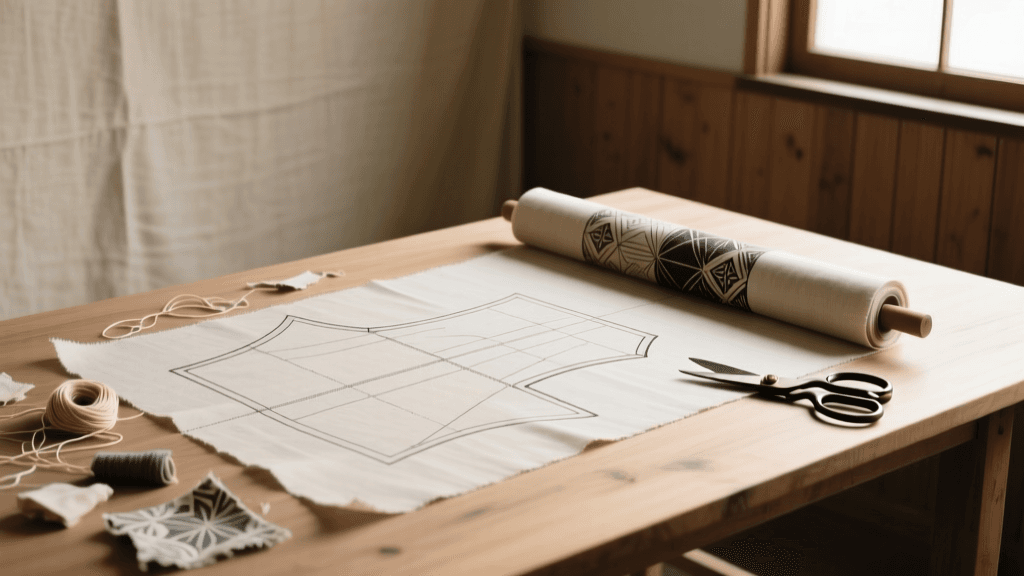
A standard kimono is constructed from eight primary rectangular panels, cut directly across the width of the tanmono bolt. Because the fabric width dictates the panel size, the maker does not need to measure or draw complex pattern pieces. The eight panels consist of:
- Two Mihoro (Body Panels): These form the main front and back of the torso.
- Two Okumi (Front Overlap Panels): These are added to the front edges to create the overlapping closure.
- Two Sode (Sleeves): Cut to specific lengths, featuring the iconic deep, boxy drop that creates the tamomoto (sleeve pouch).
- One Eri (Collar): A long, narrow strip that is folded and attached to the neckline.
- One Tomoeri (Collar Cover): A protective overlay for the back of the neck.
Any remaining fabric from the 12-meter bolt is not discarded; it is folded inward to create deep, hidden seam allowances or used to lengthen the garment for taller wearers, ensuring the entire bolt is encapsulated within the garment's structure.
Traditional Stitches for Modern Makers
While modern 2026 sewing machines equipped with AI-tension sensors can easily handle silk, traditional kimono construction relies heavily on specific hand-sewing techniques that allow the garment to be easily disassembled. The primary stitch is the hon-gushure (running stitch), which is sewn with a slight ease to prevent the silk from puckering. For hems and facings, the shikigui (blind stitch) is used to catch only a single thread of the fabric, rendering the stitch invisible on the right side. Furthermore, seam allowances are not pressed open and trimmed as in Western sewing; they are folded together and enclosed using a technique called kise, which protects the raw edges and adds structural weight to the seams.
Comparative Analysis: Tanmono vs. Western Tailoring
To fully appreciate the engineering of the tanmono system, it is helpful to compare it directly with contemporary Western garment manufacturing standards. The table below highlights the structural and environmental differences as measured by sustainable fashion institutes in 2026.
| Feature | Japanese Tanmono System | Western Curved Pattern Tailoring |
|---|---|---|
| Fabric Waste | 0% (Zero-waste by design) | 15% to 25% offcuts per garment |
| Pattern Geometry | Straight lines and rectangles only | Curves, darts, and complex angles |
| Selvedge Usage | Utilized as finished seam edges | Typically cut away and discarded |
| Seam Allowances | Deep, enclosed, and structural | Narrow, often serged or overlocked |
| End-of-Life Care | Easily unpicked, washed, and resized | Difficult to deconstruct; often downcycled |
| Body Shaping Method | Wrapping, folding, and belting (Obi) | Tailored to 3D body contours via cutting |
The Arai-Hari Method: Sustainable Garment Care
One of the most remarkable aspects of kimono construction is its planned obsolescence—or rather, its planned renewability. Because the garment is sewn using a continuous running stitch rather than permanent, locked machine stitches, it is designed to be completely taken apart at the end of its wearable life or when it requires deep cleaning. This process is known as arai-hari (wash and stretch). According to the Metropolitan Museum of Art's Heilbrunn Timeline of Art History, the meticulous care and preservation of silk garments in Japan have allowed many kimono to survive for centuries. In the arai-hari process, the threads are snipped, and the eight panels are separated, washed, and then stretched on a bamboo frame using natural rice paste to restore the fabric's original tension and dimensions. Once dry, the panels are simply sewn back together. In 2026, this circular lifecycle is being heavily studied by European textile recycling initiatives as a model for modular, zero-waste clothing design.
Sourcing and Sewing Your First Zero-Waste Garment
For modern makers and sustainable fashion students looking to practice tanmono construction in 2026, sourcing the correct materials is the first step. While importing authentic silk bolts from Japan remains the premium choice, many domestic sustainable textile mills now offer 'kimono-width' fabrics woven specifically for zero-waste drafting. When sewing your first garment, such as a casual cotton yukata, follow these actionable steps:
- Calculate Your Dimensions: Measure your hip circumference. Because the kimono wraps, the total width of the two body panels plus the two overlap panels must be at least 1.5 times your hip measurement to ensure proper overlap and modesty.
- Cut Only Across the Grain: Use a rotary cutter and a heavy acrylic quilting ruler to cut your rectangles strictly perpendicular to the selvedge. Never cut along the curve or bias.
- Preserve the Selvedge: When joining the mihoro (body panels) down the center back, align the selvedges. Sew your running stitch exactly 1 centimeter from the edge, leaving the selvedge intact inside the seam allowance.
- Create the Sleeve Pouch: When constructing the sode (sleeves), sew the bottom and outer edges, but leave the inner edge near the body partially open. This creates the tamomoto, a functional pocket historically used to carry small items like tissues or fans.
- Finish with Kise: Fold the seam allowances together toward the back or inside of the garment, and use a blind stitch to secure them, creating a clean, enclosed interior that feels luxurious against the skin.
Conclusion
The tanmono system is far more than a historical artifact; it is a highly sophisticated, mathematically precise approach to garment engineering that perfectly aligns with the ecological imperatives of 2026. By embracing the flat-pattern, zero-waste construction techniques of the traditional Japanese kimono, modern sewists and designers can create garments that are not only deeply respectful of Asian dress traditions but also radically sustainable. Whether you are working with a $2,000 artisan-woven silk bolt or a modern eco-hemp blend, the principles of straight lines, preserved selvedges, and modular construction offer a timeless roadmap for the future of ethical fashion.