Japanese Street Fashion: Styling Vintage Haori Coats
The Rise of Neo-Traditional Japanese Streetwear
In the bustling districts of Harajuku, Daikanyama, and Shimokitazawa, a sartorial revolution is quietly unfolding. Modern Japanese street fashion is increasingly looking to its own rich textile history, blending centuries-old craftsmanship with contemporary urban aesthetics. At the forefront of this neo-traditional movement is the haori, a traditional Japanese hip- or thigh-length jacket originally worn over a kimono. Once reserved for formal ceremonies or specific social classes, the haori has been reclaimed by a new generation of fashion enthusiasts who appreciate its architectural silhouette, exquisite silk linings, and versatile layering potential.
According to the Metropolitan Museum of Art, the haori emerged during the Edo period (1615–1868) as a practical outer layer that eventually became a canvas for hidden luxury. Due to strict sumptuary laws that restricted overt displays of wealth, merchants would line their haori with exquisitely dyed silks, a subtle flex known as iki (understated elegance). Today, this same principle of hidden luxury and structural beauty makes the vintage haori the ultimate statement piece in modern streetwear, offering a striking contrast to mass-produced fast fashion.
Understanding the Haori: Anatomy and Measurements
To successfully integrate a vintage haori into a contemporary wardrobe, one must understand its unique construction. Unlike Western outerwear, which is tailored with darts and curved seams to follow the body's contours, the haori is cut from straight bolts of fabric. This results in a boxy, geometric silhouette with a dramatic drop-shoulder that aligns perfectly with the oversized, gender-neutral proportions favored in modern streetwear.
When shopping for vintage haori to wear as streetwear, standard Western sizing (S, M, L) is largely irrelevant. Instead, you must rely on specific garment measurements to ensure the proper drape and sleeve length. Below is a comparison of how vintage haori measurements translate to modern outerwear equivalents.
| Measurement Feature | Vintage Haori (Typical) | Modern Streetwear Jacket | Streetwear Application |
|---|---|---|---|
| Mitake (Center Back Length) | 80 - 95 cm (31 - 37 in) | 70 - 85 cm (27 - 33 in) | Provides a mid-thigh drape, ideal for layering over longline tees. |
| Yuki (Center Back to Wrist) | 75 - 85 cm (29 - 33 in) | 85 - 95 cm (33 - 37 in) | Creates a cropped, wide sleeve that stacks perfectly over hoodies. |
| Katahaba (Shoulder Width) | 60 - 70 cm (23 - 27 in) | 45 - 55 cm (17 - 21 in) | Extreme drop-shoulder effect; enhances the oversized streetwear silhouette. |
| Sodetake (Sleeve Depth) | 45 - 55 cm (17 - 21 in) | 25 - 35 cm (10 - 13 in) | The deep, kimono-style sleeve allows for bulky inner layering. |
Key Measurements for Streetwear Styling
When sourcing a haori for urban wear, prioritize the Katahaba (shoulder width) and Mitake (length). For a modern, oversized look, aim for a Katahaba of at least 65 cm. This ensures the seam drops far down the arm, mimicking the aesthetic of high-end streetwear brands like Balenciaga or Vetements. The Mitake should ideally hit just above the knee on your specific frame; anything longer risks looking like a bathrobe, while anything shorter loses the dramatic, sweeping motion characteristic of traditional Japanese garments.
Actionable Styling Guide: Haori in Urban Wardrobes
Integrating a delicate, often brightly patterned vintage silk haori into a gritty urban wardrobe requires a careful balance of textures, proportions, and color palettes. Here are three actionable styling formulas to master the neo-traditional aesthetic.
1. The Techwear Fusion
Techwear relies on utilitarian fabrics, waterproof shells, and tactical hardware. The juxtaposition of a fragile, century-old silk haori against modern technical fabrics creates a visually arresting contrast. Start with a base of black, water-resistant nylon cargo pants and a fitted, moisture-wicking turtleneck. Layer a dark-toned, men's wool or heavy silk haori over the top. Instead of traditional haori himo (the woven cords used to tie the jacket), use a matte black tactical carabiner or a modern nylon side-release buckle to secure the front panels. Finish the look with split-toe footwear, such as the Maison Margiela Replica Tabi or the Nike ISPA Flow, bridging the gap between traditional Japanese tabi socks and futuristic streetwear.
2. The Neo-Minimalist
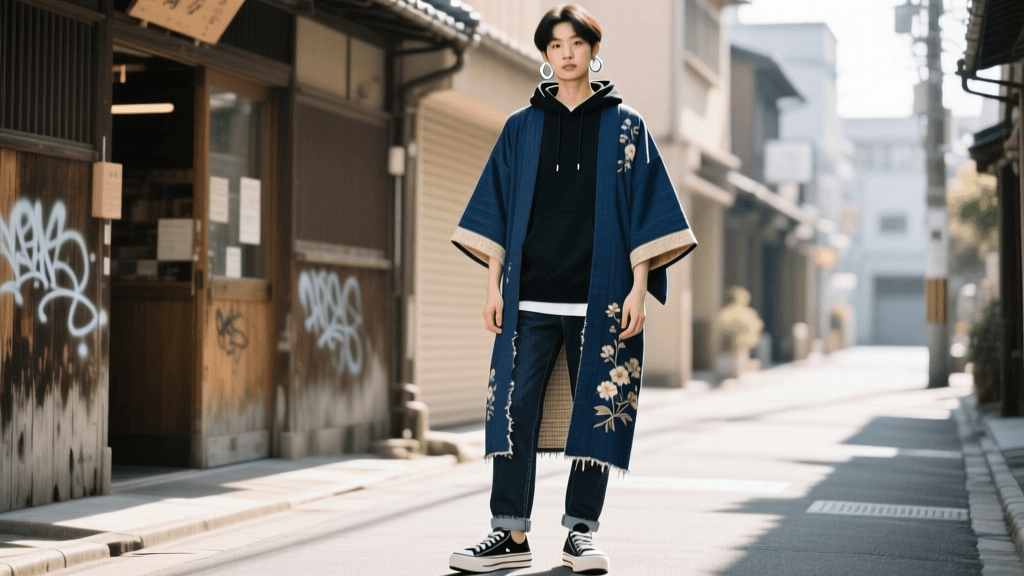
For a cleaner, Daikanyama-inspired aesthetic, focus on high-quality basics and let the haori serve as the sole focal point. Pair a heavyweight, boxy cotton t-shirt (such as those from Uniqlo U or Comme des Garçons) with wide-leg, raw denim trousers. Choose a women's vintage haori featuring a subtle shibori (tie-dye) or kasuri (ikat) pattern in indigo or charcoal. Because the haori lacks buttons or zippers, it naturally creates a long, vertical line that elongates the torso. Roll the sleeves of the haori up to the mid-forearm to reveal the contrasting silk lining (hiyoku), adding a flash of color and movement as you walk.
3. The Hakama Street Hybrid
For those willing to embrace a more avant-garde silhouette, integrate hakama (traditional pleated trousers) into your streetwear rotation. Modern interpretations of hakama, often made from heavy cotton or denim blends, feature the dramatic volume of traditional workwear but with the durability required for city living. Pair a mid-weight cotton haori with wide-pleated hakama pants and chunky, lug-sole boots. Secure the haori with a modern, braided leather belt worn loosely over the front panels, mimicking the placement of a traditional obi sash but with a distinctly contemporary, rugged edge.
Sourcing, Costs, and Timing: Building Your Collection
Acquiring authentic vintage haori requires knowing where to look, when to go, and what to pay. Tokyo remains the global epicenter for sourcing these garments, though online avenues are also viable.
- Shimokitazawa Thrift Stores: Stores like Chicago and New York Joe Exchange are treasure troves for vintage kimono and haori. Timing: Visit on Tuesday or Wednesday mornings when new stock is typically processed and hung. Costs: Expect to pay between 3,000 JPY and 8,000 JPY ($20 - $55 USD) for women's silk haori, and 8,000 JPY to 15,000 JPY ($55 - $100 USD) for men's wool or crepe silk pieces.
- Oedo Antique Market (Tokyo International Forum): This massive outdoor market features over 250 vendors selling antique textiles. Timing: Held on the first and third Sunday of every month. Arrive by 8:00 AM to dig through deadstock bundles before the best patterns are picked over. Costs: Prices are negotiable; you can often find damaged but salvageable silk haori for as low as 1,000 JPY ($7 USD), or pristine, museum-quality pieces for 30,000 JPY ($200 USD).
- Online Sourcing: Platforms like Etsy and specialized Japanese proxy services (e.g., Buyee) allow you to search for specific terms like 'vintage haori jacket' or 'men's haori streetwear'. Always request exact flat-lay measurements in centimeters before purchasing, as return policies for vintage items are notoriously strict.
Caring for Vintage Silk in Modern Environments
Wearing a century-old garment in a modern urban environment exposes it to pollution, UV radiation, and the friction of commuting. Proper care is essential to preserve the structural integrity of the silk and the vibrancy of the natural dyes. The Victoria and Albert Museum recommends strict environmental controls for textile conservation, which can be adapted for personal wardrobes.
Never machine wash or aggressively dry-clean a vintage haori unless it is explicitly marked as modern, washable polyester. For authentic silk, embrace the traditional Japanese practice of mushiboshi (airing out). Twice a year, preferably on dry, breezy days in autumn and spring, hang your haori in a shaded, well-ventilated area for a few hours. This allows trapped moisture to escape and deters fabric-eating insects. Avoid direct sunlight, which will rapidly degrade the silk proteins and fade the intricate yuzen dye work. For localized stains, consult a dry cleaner who specializes in theatrical costumes or antique textiles, as standard chemical solvents can strip the natural sericin coating from the silk fibers.
Cultural Appreciation in the Modern Era
As the Google Arts & Culture initiative highlights, the kimono and its associated garments are not static relics of the past, but living, evolving forms of expression. By integrating the haori into modern streetwear, enthusiasts are not appropriating a costume, but rather participating in a global dialogue about sustainability, craftsmanship, and the enduring relevance of traditional Asian textiles. When you wear a vintage haori on the streets of New York, London, or Tokyo, you are honoring the artisan who wove the silk, the dyer who mapped the pattern, and the generations who preserved it, ensuring that this remarkable garment continues to breathe and move in the modern world.