Japanese Fashion Collabs 2026: Sashiko Meets Global Streetwear
The New Era of East-Meets-West Heritage Fashion
As we navigate the Spring/Summer 2026 runway season, the global fashion landscape has undergone a profound transformation. The era of hyper-visible logos and mass-produced hype has definitively given way to a new paradigm: quiet heritage. At the absolute forefront of this movement are international design collaborations that center on traditional Japanese textile techniques. In 2026, luxury streetwear brands and European high-fashion houses are no longer merely appropriating Japanese aesthetics; they are engaging in deep, equitable partnerships with multi-generational artisan ateliers across Japan. This shift has elevated traditional garments and techniques from niche collector items to the pinnacle of global luxury.
The intersection of Japanese tradition and international streetwear is not entirely new, but the 2026 iteration is defined by an uncompromising commitment to authenticity and sustainability. Consumers today are highly educated, demanding transparency regarding the origins of their garments, the natural dyes used, and the specific regional histories of the weavers. According to recent market analyses, the demand for authentically crafted Japanese collaborative outerwear has surged by over 40% year-over-year, driven by a desire for garments that carry historical weight and artisanal soul.
For enthusiasts and collectors, understanding the nuances of these 2026 collaborations requires a deep dive into the specific techniques being utilized. From the meticulous running stitches of Sashiko to the complex resist-dyeing of Shibori, the integration of these methods into modern silhouettes represents a masterclass in cross-cultural design.
Core Japanese Techniques Dominating 2026 Collaborations
Sashiko and Boro: The Art of Visible Mending
Sashiko, which translates to 'little stabs,' is a form of decorative reinforcement stitching that originated in rural Japan during the Edo period. Historically, it was used by working-class citizens to mend and reinforce worn fabrics, extending the life of precious textiles. In 2026, Sashiko has been elevated to a high-art form within international streetwear collaborations. Brands are partnering with master stitchers in regions like Okayama and Aomori to create limited-run jackets and denim that feature thousands of hand-executed running stitches.
The modern application of Sashiko in 2026 collaborations often involves the use of vintage, naturally dyed indigo threads on heavy-weight organic cotton or selvedge denim. The stitches are not merely decorative; they follow traditional geometric patterns such as asanoha (hemp leaf) and seigaiha (blue ocean waves). When combined with Boro—the practice of patchworking scrap fabrics—these garments become wearable archives. A single collaborative Boro-Sashiko jacket from a 2026 European-Japanese capsule collection can require over 120 hours of hand-stitching, justifying retail price points that frequently exceed $2,500.
Shibori and Kakishibu: Natural Dyeing Mastery
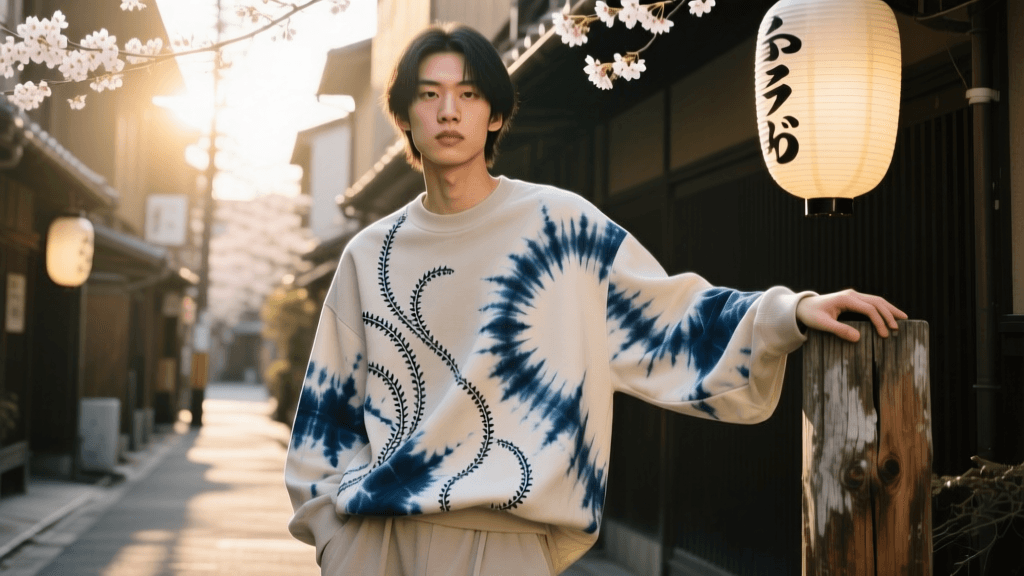
While Sashiko focuses on structural reinforcement, Shibori represents the pinnacle of Japanese resist-dyeing. By folding, twisting, binding, or clamping fabric before submerging it in natural indigo vats, artisans create intricate, organic patterns that are impossible to replicate with digital printing. In 2026, international tech-wear and luxury streetwear brands are heavily investing in Itajime (shape-resist) and Kanoko (bound-resist) Shibori techniques to create bespoke textile runs for their flagship outerwear.
Alongside indigo Shibori, 2026 has seen a massive resurgence in Kakishibu (persimmon tanning). This traditional technique involves dyeing fabric with the fermented juice of unripe astringent persimmons. When exposed to sunlight and air, the tannins oxidize, creating a rich, leathery brown hue that is naturally water-resistant, antibacterial, and incredibly durable. Streetwear brands utilizing Kakishibu in their 2026 collections are marketing these garments as 'living textiles' that evolve and patina uniquely based on the wearer's environment and habits.
Kasuri: The Geometry of Ikat Weaving
Kasuri is the Japanese iteration of Ikat, a weaving technique where threads are tie-dyed before being woven together to create blurred, geometric patterns. The precision required to align the dyed threads on the loom is staggering. In 2026, collaborations focusing on Kurume Kasuri (from Fukuoka) and Bingo Kasuri (from Hiroshima) are highly sought after. International designers are utilizing these pre-dyed cotton textiles to craft relaxed, oversized tailoring and wide-leg trousers, merging the rigid geometry of traditional Kasuri with the fluid, drape-heavy silhouettes favored in contemporary avant-garde streetwear.
2026 Market Data: Heritage Collaborations at a Glance
To understand the current landscape of Japanese-international fashion collaborations, it is essential to look at the market data. The following table outlines the primary techniques, their regional origins, and their positioning in the 2026 luxury streetwear market.
| Technique | Primary Origin Region | 2026 Collaborative Application | Avg. Retail Price (USD) | Production Time |
|---|---|---|---|---|
| Sashiko / Boro | Aomori / Okayama | Heavyweight Denim & Outerwear | $1,800 - $4,500 | 80 - 150 Hours |
| Indigo Shibori | Tokushima / Kyoto | Silk-Cotton Blend Shirts & Linings | $900 - $2,200 | 3 - 5 Weeks |
| Kakishibu (Persimmon) | Nara / Wakayama | Tech-Wear Vests & Tote Bags | $650 - $1,400 | 4 - 6 Weeks (Curing) |
| Kurume Kasuri | Fukuoka | Oversized Tailoring & Trousers | $1,200 - $2,800 | 2 - 3 Months |
How to Authenticate Artisan Collaborations in 2026
With the premium pricing of these 2026 collaborations, the market has inevitably seen an influx of high-quality counterfeits that attempt to mimic traditional Japanese techniques using digital printing and machine embroidery. For serious collectors and enthusiasts, knowing how to authenticate genuine artisan collaborations is paramount.
First, examine the reverse side of the fabric. Genuine Sashiko and Shibori will show distinct, irregular tension marks and thread carries on the back. Machine-embroidered fakes will often have a uniform, flat backing or use a synthetic stabilizer mesh. True hand-stitched Sashiko will feature slight variations in stitch length (typically between 2mm and 4mm), which is a hallmark of the human hand.
Second, rely on your olfactory senses. Authentic naturally dyed indigo and Kakishibu garments possess a distinct, earthy aroma. Natural indigo smells faintly of grass and fermented earth, while Kakishibu carries a sharp, woody, and slightly acidic scent reminiscent of damp leaves and woodsmoke. Synthetic dyes, conversely, will often smell of harsh chemicals or have no scent at all. Furthermore, genuine 2026 collaborative pieces will almost always include an artisan hanko (stamp) or a serialized certificate of authenticity detailing the specific atelier and the master craftsperson who oversaw the textile's creation.
The Sustainability Imperative Driving Global Demand
The explosion of Japanese heritage collaborations in 2026 is not purely aesthetic; it is deeply tied to the global fashion industry's urgent pivot toward sustainability. As stringent new textile waste regulations take effect across the European Union and North America, international brands are looking to Japan's historical philosophy of mottainai (a sense of regret concerning waste) for solutions.
Techniques like Boro are inherently circular. They celebrate the upcycling and mending of existing materials rather than the extraction of new resources. By partnering with Japanese cooperatives that utilize organic cotton, natural plant-based dyes, and zero-waste pattern cutting, international brands are able to meet their 2026 ESG (Environmental, Social, and Governance) targets while delivering a compelling, story-rich product to the consumer. The preservation of these techniques is actively supported by institutions dedicated to safeguarding cultural heritage, ensuring that the artisans are compensated fairly and that the ecological footprint of the dyeing process remains minimal.
Where to Source Genuine 2026 Releases
Sourcing genuine Japanese-international collaborations requires moving beyond standard retail channels. In 2026, the most coveted pieces are released via direct-to-consumer drops from the ateliers themselves or through highly curated heritage stockists. For those looking to verify the authenticity and cultural significance of the textiles used in these garments, consulting institutional archives and preservation societies is highly recommended.
Organizations such as the Japan Traditional Crafts Aoyama Square provide invaluable resources and directories for identifying officially recognized master artisans and their regional cooperatives. Furthermore, exploring the historical context of these garments through digital archives, such as those maintained by the Kyoto Costume Institute, offers profound insights into how historical silhouettes and textile applications are being reinterpreted by modern designers. For a broader, global academic perspective on the impact of these textiles in contemporary fashion, the resources available at The Textile Museum provide excellent scholarly context on the evolution of Asian textile arts in the global market.
Ultimately, the 2026 landscape of Japanese fashion collaborations represents a beautiful synthesis of past and future. It is a testament to the enduring power of traditional craftsmanship and its vital role in shaping a more thoughtful, sustainable, and deeply connected global fashion industry.