Japanese Matsuri Costumes: Styling Happi and Yukata for Bon Odori
The Intersection of Tradition and Movement
When attending a Japanese matsuri (summer festival) or participating in Bon Odori (traditional folk dancing), the clothing you wear is not merely decorative; it is highly functional performance wear. Unlike the formal, restrictive silk kimono worn for tea ceremonies or weddings, festival garments are engineered for heat dissipation, wide ranges of motion, and endurance. According to the Japan National Tourism Organization, summer festivals are deeply rooted in community bonding and ancestral veneration, with dance serving as the physical medium of celebration. To participate authentically and comfortably, one must understand the mechanics of the happi coat and the festival yukata.
The Anatomy of Festival Performance Wear
The two primary garments worn during Matsuri and Bon Odori are the happi coat and the yukata. While both are deeply embedded in Japanese textile history, they serve distinctly different purposes on the dance floor.
Happi Coat: The High-Mobility Layer
The happi is a short, straight-sleeved coat that typically falls to the mid-thigh or hips. Historically worn by firefighters and tradesmen, it has evolved into the quintessential festival uniform. For performance, the happi is ideal for high-energy, acrobatic, or deeply grounded dances like the Awa Odori or the Soran Bushi. It is usually worn open over a bare chest (for men) or a fitted tube top (for women), paired with tobi (baggy trousers) or shorts. The open front allows for maximum airflow, while the short hem prevents tripping during vigorous footwork.
Festival Yukata: The Elegant Unlined Kimono
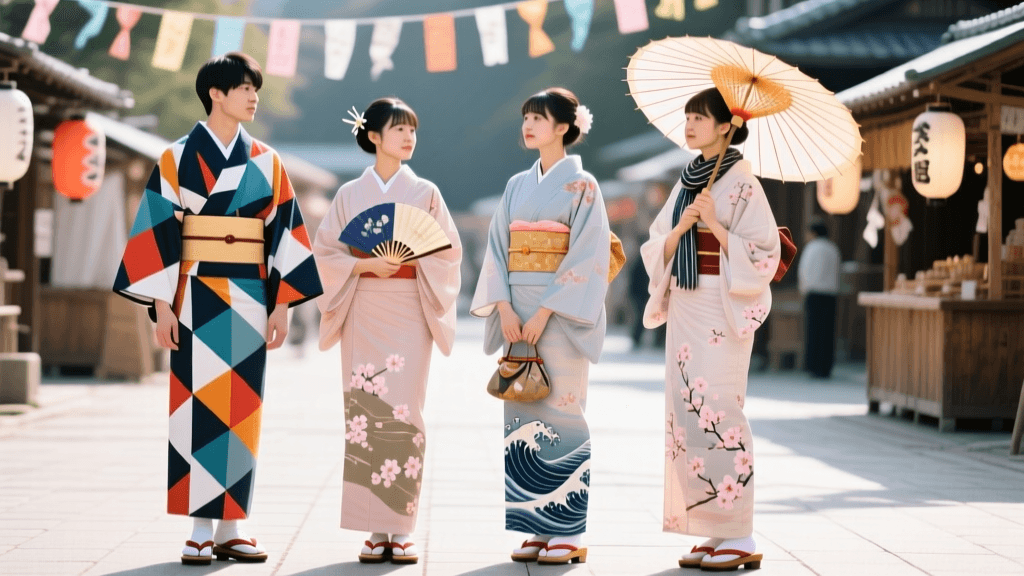
The yukata is an unlined, casual summer kimono. The Metropolitan Museum of Art notes that the yukata originated as a bathrobe for the nobility before becoming the standard summer garment for all classes. For Bon Odori, the yukata is favored for its elegant, flowing silhouette, which accentuates the sweeping arm movements and circular choreography of dances like the Tokyo Ondo or Tanko Bushi. Because it is unlined and typically made of breathable cotton, it wicks sweat effectively during humid August nights.
| Feature | Happi Coat | Festival Yukata |
|---|---|---|
| Primary Use | High-mobility dance, layering, casual wear | Full-body coverage, elegant circular movement |
| Length | Hip to mid-thigh | Ankle-length (with waist fold) |
| Fastening | Left over right, tied with a simple sash | Secured with an Obi (sash) at the waist |
| Mobility | Unrestricted leg movement | Restricted stride; requires gliding steps |
| Ideal Dance Style | Awa Odori, Soran Bushi, Yosakoi | Tokyo Ondo, Tanko Bushi, Gujo Odori |
Practical Guide: Sizing, Measurements, and Fit
Unlike Western clothing, traditional Japanese garments do not use standard S/M/L sizing based on chest or waist circumference. Instead, they rely on height-based measurements to ensure the garment drapes correctly and allows for the necessary performance folds.
How to Measure for a Festival Yukata
The most critical measurement for a yukata is the Mitake (garment length). For a proper fit that allows for the Ohashori (the waist fold that adjusts the hemline and secures the garment during movement), use the following formula:
- Women's Mitake: Calculate 80% to 82% of your total height. For example, a woman who is 165 cm (65 inches) tall should look for a yukata with a Mitake of roughly 132 cm to 135 cm. This extra length is folded at the waist to create the Ohashori, which acts as a shock absorber when dancing, preventing the hem from pulling tight across the legs.
- Men's Mitake: Men do not wear an Ohashori. The yukata should be exactly 90% of the wearer's height, falling just above the ankle bone to prevent stepping on the hem during the sliding steps (suriashi) common in Bon Odori.
- Yuki (Sleeve Span): Measure from the center of the back of your neck, across your shoulder, and down to your wrist bone. A standard women's Yuki is around 64-68 cm, while men's is 70-75 cm. If the sleeves are too long, they will obscure your hand movements, which are vital for expressing the narrative of folk dances.
Securing the Garment: The Performance Obi
The obi (sash) is the anchor of your festival outfit. A poorly tied obi will unravel during a dance, leading to wardrobe malfunctions and restricted movement. The Agency for Cultural Affairs emphasizes the preservation of traditional dressing techniques, but festival contexts allow for practical adaptations.
Obi Choices for Dancing
For women, avoid the stiff, heavily padded Fukuro Obi used for formal kimono. Instead, opt for a Hanhaba Obi (half-width obi) made of soft cotton or polyester. Tie it in a Bunko Musubi (butterfly knot) or a Katahana Musubi (single flower knot). These knots sit flat against the lower back, preventing discomfort when bumping into other dancers in a tight Bon Odori circle.
For men, the Heko Obi is the standard. This is a soft, scarf-like sash that is gathered and tied in a simple, secure knot at the front or slightly to the side. The Heko Obi allows for deep abdominal breathing and torso twisting, which are essential for the grounded, athletic postures of festival dances.
Essential Footwear and Accessories for Dancing
A festival costume is incomplete without its supporting accessories, many of which serve vital functional roles in a performance setting.
The Complete Bon Odori Accessory Kit
- Tabi (Split-Toe Socks): Essential for wearing traditional footwear. For outdoor festivals on asphalt or stone, upgrade to Jika-tabi—split-toe boots with rubber soles that provide grip and arch support during hours of dancing.
- Geta or Zori (Footwear): Wooden clogs (geta) elevate the foot above hot pavement and puddles. Ensure the hanao (thongs) are made of soft, broken-in cotton to prevent blistering between the toes.
- Tenugui (Cotton Towel): A 35cm x 90cm rectangular cotton cloth. In performance, it is often tied around the head as a hachimaki to keep sweat out of the eyes, or tucked into the obi to wipe the face between dances.
- Uchiwa (Rigid Fan): Used both as a prop in dances like the Gujo Odori and as a personal cooling device. Look for fans made of bamboo and washi paper, which are lightweight and durable.
- Koshihimo (Waist Ties): You will need at least two to three thin cotton cords to tie underneath the obi. These hidden ties bear the actual weight and tension of the yukata, ensuring the garment stays perfectly aligned even during vigorous spinning.
Budgeting: Costs and Sourcing Authentic Gear
Building a functional festival wardrobe requires balancing authenticity with budget. While high-end silk yukata exist, cotton and modern synthetic blends are preferred for the rigors of summer dancing.
Estimated Cost Breakdown (USD)
- Festival Yukata (Cotton/Poly Blend): $40 - $80. Look for Shijira-ori (a seersucker-like weave) which prevents the fabric from clinging to sweaty skin.
- Happi Coat: $25 - $60. Mass-produced polyester happi are cheap and vibrant, but hand-dyed cotton happi from regions like Osaka or Kyoto offer superior breathability.
- Hanhaba / Heko Obi: $15 - $35.
- Tabi Socks: $10 - $20. (Add $30-$50 for rubber-soled Jika-tabi).
- Tenugui & Uchiwa: $10 - $25 each. Authentic Edo Komon patterned tenugui make excellent performance accessories and souvenirs.
Pro-Tip on Timing: The best time to purchase festival wear is in May or early June. By July, retail stores in Japan and international online kimono vendors often sell out of popular sizes and traditional patterns, leaving only tourist-grade novelty items.
Conclusion
Participating in a Japanese Matsuri or Bon Odori is a deeply immersive cultural experience. By understanding the functional design of the happi and yukata, taking precise measurements for the Mitake and Yuki, and selecting the appropriate performance obi and footwear, you transition from a passive observer to an active, respectful participant. The right costume not only honors the ancestral traditions of the festival but also grants you the physical freedom to dance comfortably from the first beat of the taiko drum until the final lantern is extinguished.