Mastering Kimono Tanmono Construction: Zero-Waste Cutting in 2026
Introduction to Tanmono: The Foundation of Kimono Construction
When examining the evolution of global fashion, Western garment construction has historically relied on curved seams, darts, and complex pattern drafting that inevitably leads to significant textile waste. In stark contrast, the traditional Japanese kimono is rooted in a profoundly different philosophy of geometry and resource management. At the heart of this zero-waste tradition is the tanmono (反物), a standardized bolt of fabric that dictates the entire architecture of the garment. As the global fashion industry faces intense scrutiny over textile waste in 2026, the ancient construction techniques of the kimono are experiencing a massive renaissance among sustainable designers and traditional artisans alike.
The tanmono system is not merely a method of packaging fabric; it is a strict architectural constraint that informs every cut, fold, and stitch of the kimono. By understanding the tanmono bolt system, modern sewists and fashion historians can unlock a masterclass in zero-waste pattern cutting, modular design, and garment longevity. According to the Metropolitan Museum of Art's Heilbrunn Timeline of Art History, the kimono's linear construction reflects a deep cultural reverence for the textile itself, treating the fabric as a continuous, unbroken canvas rather than a material to be carved away.
The Geometry of Zero-Waste: Straight-Line Cutting
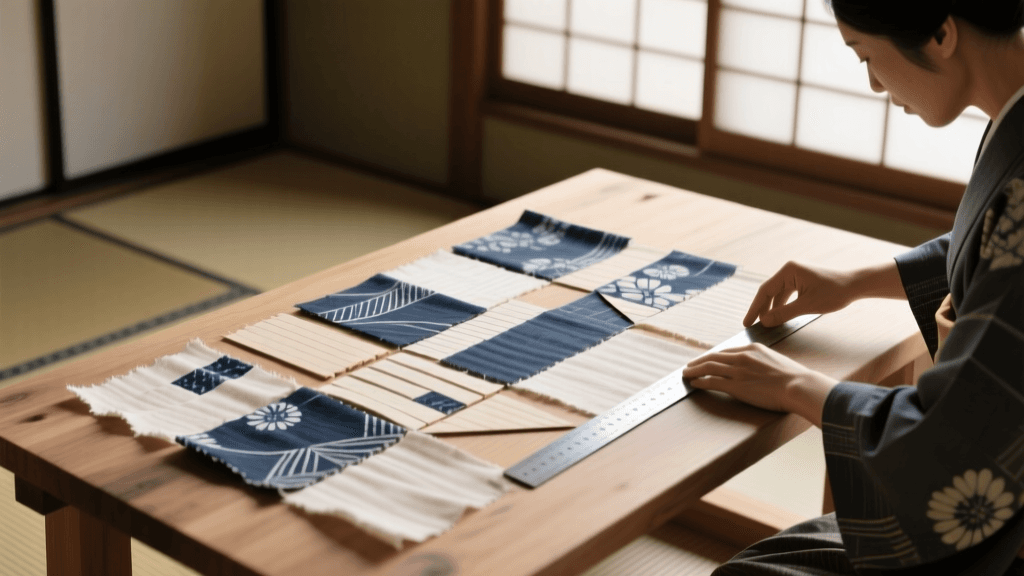
A standard tanmono bolt measures approximately 36 to 40 centimeters in width and 12 to 14 meters in length. This specific width is historically tied to the weaving capabilities of traditional handlooms, but in 2026, it remains the gold standard for zero-waste drafting. Unlike Western patterns that curve around the armhole or waist, the kimono is constructed entirely from straight, rectangular panels. There are no off-cuts, no curved armholes, and no discarded scraps. Every single centimeter of the 12-meter bolt is utilized in the final garment or its structural reinforcements.
The construction relies on a modular system of panels that are sewn together using straight seams. This geometric approach means that the garment's shape is created not through cutting, but through folding, wrapping, and the strategic placement of seams. Below is a breakdown of the primary rectangular panels that make up the standard women's kimono.
| Panel Name (Romaji) | Kanji | Quantity | Function & Placement | Standard Dimensions (Approx.) |
|---|---|---|---|---|
| Mi-goro | 身頃 | 4 | Main body panels (2 front, 2 back) | 38cm x 120cm |
| Sode | 袖 | 2 | Sleeves, attached to the mi-goro | 38cm x 100cm |
| Okumi | 衽 | 2 | Front overlapping lapels | 15cm x 140cm |
| Eri | 衿 | 1 | Main collar band | 12cm x 130cm |
| Kake-eri | 掛衿 | 1 | Decorative overlay collar | 10cm x 110cm |
Essential Sewing Techniques: The Art of the Straight Seam
The brilliance of kimono construction lies not just in the cutting, but in the sewing techniques that allow the garment to be infinitely maintained, resized, and recycled. Because the panels are rectangular, the seams are straight, which facilitates a unique sewing method known as hon-buse. In Western sewing, raw edges are typically serged or zig-zagged to prevent fraying. In kimono construction, the seam allowance is folded inward and enclosed, protecting the raw edge entirely without the need for synthetic threads or overlocking machines.
Furthermore, the kimono utilizes kuke (blind stitching) for hems and kise (a technique where the seam allowance is folded slightly off the seam line to create a soft, rolling edge). These hand-sewing techniques are time-consuming, but they serve a vital structural purpose: they allow the garment to be easily unpicked. According to research from the Japanese Textile Study Group, this unpicking capability is essential for arai-hari, the traditional practice of taking a kimono completely apart, washing the fabric panels as flat rectangles, stretching them on wooden boards to dry, and re-sewing them. This lifecycle management technique ensures that a single kimono can be worn, cleaned, resized for a new owner, and eventually repurposed into futons or children's clothing over multiple generations.
2026 Innovations: Tanmono in Modern Sustainable Fashion
As we navigate the sustainability mandates of 2026, the tanmono constraint is being adopted by avant-garde and eco-conscious designers globally. Modern pattern cutters are using the 38cm width limitation to design modular wrap coats, zero-waste workwear, and adjustable dresses that mimic the kimono's straight-seam architecture. By restricting their digital looms and cutting tables to tanmono widths, designers are mathematically eliminating the 15-20% cutting waste typical in contemporary apparel manufacturing.
'The kimono is not a relic of the past; it is a blueprint for the future of circular fashion. When we force our algorithms and cutting lasers to respect the 38cm bolt width, we eliminate waste at the source rather than trying to recycle it at the end of the garment's life.' — Dr. Arisawa, Sustainable Textile Summit, Tokyo, 2026.
In 2026, we are also seeing the rise of lab-grown silk alternatives and regenerative hemp blends being woven specifically into tanmono widths. These modern textiles are treated with natural botanical dyes and engineered to withstand the rigorous arai-hari washing process, bridging the gap between ancient Japanese tailoring and next-generation material science.
Step-by-Step Guide: Drafting and Assembling the Mi-Goro
For sewists looking to apply these techniques in 2026, mastering the mi-goro (main body) is the best starting point. Here is a practical guide to drafting and assembling the back panels using traditional zero-waste methods:
- Step 1: Measure the Bolt. Confirm your fabric width. If using modern fabric, cut a continuous 12-meter strip at exactly 38cm wide to simulate the tanmono.
- Step 2: Calculate the Length. Measure from the nape of the neck to the desired hemline, then multiply by two. Add 10cm for the waist fold (ohashori). Cut two identical rectangles for the back mi-goro.
- Step 3: The Center Back Seam. Place the two back panels right sides together. Sew a straight seam from the hem up to the nape of the neck using a running stitch or a straight machine stitch (3mm length).
- Step 4: Execute the Hon-buse. Open the panels. Fold one seam allowance over the other, encasing the raw edge. Blind stitch (kuke) the folded edge to the back panel. This creates a clean, enclosed interior with no raw edges.
- Step 5: Mark the Shoulder Line. Fold the assembled back panels in half horizontally to find the exact shoulder point. This fold will eventually connect to the front panels and the sleeves.
Sourcing Authentic Materials and Tools in 2026
Acquiring authentic materials and specialized tools is easier than ever in 2026, thanks to a resurgence in global interest in traditional craftsmanship. For those seeking vintage silk tanmono bolts, online marketplaces and specialized Kyoto-based exporters currently price unworn, mid-century silk bolts between $120 and $180 USD. For modern, sustainable options, regenerative organic hemp and peace-silk tanmono bolts are available from specialized weavers for approximately $250 to $320 USD.
To construct the garment properly, specific tools are required. The hera (a bamboo or agate spatula) is essential for creasing fabric without damaging the fibers, replacing the need for chalk or tracing wheels. The kote (a traditional Japanese iron) is used for pressing seams flat; modern 2026 iterations of the kote feature precise digital temperature controls tailored for delicate silks and lab-grown cellulosic fibers. Investing in these tools not only honors the tradition but fundamentally changes how you interact with the textile, fostering a slower, more intentional approach to garment construction.
By embracing the tanmono system and the straight-line construction of the kimono, modern makers can participate in a centuries-old tradition that perfectly aligns with the urgent ecological needs of 2026. The kimono teaches us that true elegance lies not in what we cut away, but in how we honor the entirety of the material we are given.