Evolution of Chinese Court Fashion: Ming to Qing Dragon Robes
The Zenith of Imperial Dress: Ming vs. Qing Court Fashion
Chinese court fashion is far more than a display of wealth; it is a complex visual language of cosmology, political legitimacy, and strict social hierarchy. For collectors, historians, and traditional garment enthusiasts, understanding the evolution of imperial dress—specifically the transition from the Han-led Ming Dynasty to the Manchu-led Qing Dynasty—reveals profound shifts in textile technology, tailoring, and cultural identity. Today, the resurgence of interest in traditional Chinese garments has created a vibrant market for historically accurate replicas, requiring a deep understanding of period-specific construction and materials.
The Ming Dynasty: Restoring Han Elegance
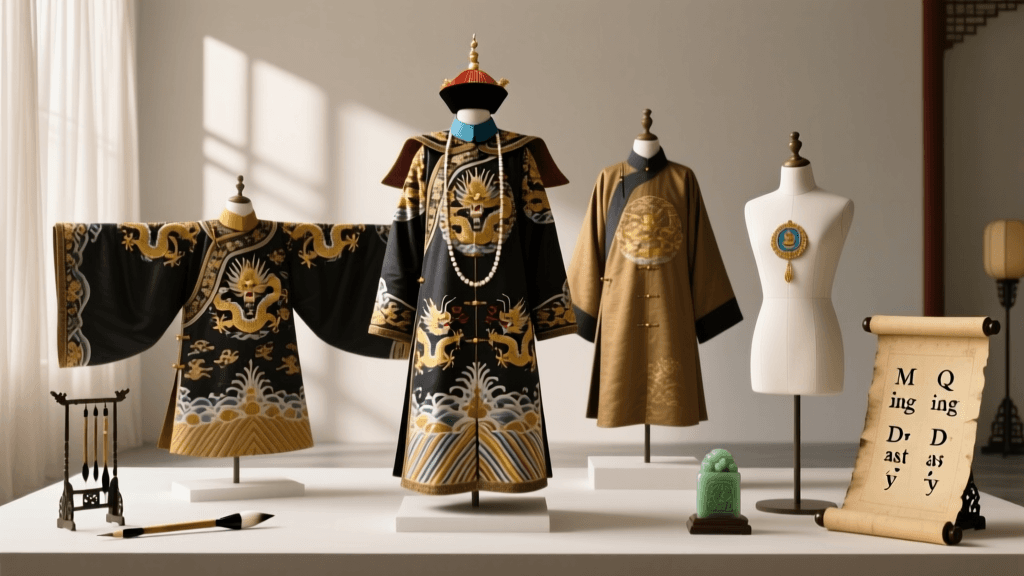
The Ming Dynasty (1368–1644) marked a triumphant return to Han Chinese rule following the Mongol-led Yuan Dynasty. The Hongwu Emperor instituted rigorous sumptuary laws to re-establish traditional Han sartorial codes. The quintessential court garment of this era was the Yuanlingpao (round-collar robe). Characterized by its flowing, A-line silhouette and voluminous sleeves, the Ming court robe emphasized a sense of majestic, unhurried elegance. According to The Met's Heilbrunn Timeline of Art History, Ming textiles reached unprecedented levels of sophistication, particularly in the production of Kesi (cut silk tapestry) and intricate brocades that featured large, centralized roundels depicting five-clawed dragons amidst stylized clouds.
The Qing Dynasty: Manchu Structure and the Jifu
With the establishment of the Qing Dynasty (1644–1911), the Manchu rulers mandated a drastic shift in court dress to assert their political dominance while assimilating Han cosmological symbols. The flowing robes of the Ming were replaced by the Jifu (semi-formal dragon robe) and the Chaofu (formal court robe). As noted by Encyclopedia Britannica, the Qing dragon robe is defined by its structured bodice, flared skirt, and the distinctive matixiu (horse-hoof sleeves), which were designed to cover the hands during cold Manchurian winters and as a gesture of respect when kneeling before the Emperor. The layout of the motifs also evolved; rather than centralized roundels, Qing robes featured directional dragons chasing flaming pearls across the chest and shoulders, anchored by a hem of diagonal stripes and crashing waves known as lishui, symbolizing the emperor's dominion over the universe.
Comparative Analysis: Ming and Qing Silhouettes
Understanding the structural differences between these two eras is critical for anyone looking to commission or authenticate historical garments. The table below outlines the primary distinctions in court robe construction.
| Feature | Ming Dynasty (Yuanlingpao) | Qing Dynasty (Jifu) |
|---|---|---|
| Silhouette | Flowing, A-line, voluminous drop-shoulder | Structured, fitted bodice, flared skirt |
| Sleeves | Wide, sweeping round sleeves | Tapered with curved horse-hoof cuffs (matixiu) |
| Collar | Round, close-fitting to the neck | Distinctive Manchurian curved overlapping collar |
| Fastenings | Hidden inner ties or simple metal buttons | Ornate toggle frogs (pankou) on the right side |
| Motif Layout | Large, centralized chest and back roundels | Directional dragons, ocean wave hem (lishui) |
Decoding the Buzi: The Court Rank Badge System
While the Emperor wore dragons, civil and military officials wore Buzi (rank badges) to denote their exact position within the imperial bureaucracy. Introduced in the Ming Dynasty and refined in the Qing, these square or round embroidered badges were affixed to the outer surcoats. Civil officials were represented by birds (e.g., the Red-Crowned Crane for the first rank, the Silver Pheasant for the second), while military officials were represented by beasts (e.g., the Qilin for the first rank, the Lion for the second). For modern collectors, authenticating a Buzi requires examining the couching techniques of the gold thread and the specific dye palettes used, as synthetic aniline dyes introduced in the late 19th century drastically altered the color profiles of late Qing badges.
Practical Guide: Commissioning a Historically Accurate Court Robe
For museums, theater productions, or serious private collectors, acquiring a historically accurate replica of a Ming or Qing court robe requires navigating a specialized market. Mass-produced 'costumes' found online lack the structural integrity, textile weight, and embroidery techniques of true court fashion. Here is an actionable guide to commissioning a bespoke, museum-quality garment.
Budgeting for Authenticity
Authenticity comes at a premium. A high-quality, machine-embroidered theatrical replica may cost between $300 and $800. However, a bespoke, hand-loomed silk robe featuring traditional gold-couching embroidery (where gold-wrapped threads are laid on the surface and stitched down with fine silk) will range from $3,500 to $15,000+. The price scales heavily with the density of the embroidery and the inclusion of genuine peacock feather filaments or seed pearls, which were historically reserved for the highest nobility.
Selecting the Right Textiles
Do not accept standard polyester brocades or lightweight silks. For a Ming-era robe, commission fabric woven on traditional wooden jacquard looms in Suzhou or Hangzhou. Request 30-momme heavy silk satin or authentic Yunjin (cloud brocade) from Nanjing, which features intricate weft-patterned designs. For Qing-era robes, the ground fabric is often a heavy silk damask or satin, heavily encrusted with embroidery. Ensure the artisan uses natural plant dyes (like indigo, madder, and pagoda tree bud) if strict historical accuracy is required, though high-grade synthetic colorfast threads are acceptable for garments intended for frequent wear.
Taking Traditional Measurements
Traditional Chinese tailoring relies on flat-pattern cutting rather than Western darts and seams. When providing measurements to a master tailor, you must include:
- Center-Back to Wrist: Crucial for the drop-shoulder construction of Ming robes and the tapered sleeves of Qing robes.
- Shoulder Span: Measured from the outer edge of the shoulder, across the back, to the other outer edge.
- Robe Length: Measured from the prominent vertebra at the base of the neck to the floor, minus 2 inches to ensure the hem clears the ground while wearing traditional cloth boots.
- Cuff Circumference: Specifically required for the matixiu (horse-hoof cuffs) on Qing robes to ensure they fold back correctly over the wrist.
Timeline and Artisan Sourcing
Patience is mandatory. According to The Metropolitan Museum of Art, historical Qing dragon robes required hundreds of hours of labor from specialized artisans. Today, commissioning a fully hand-embroidered Jifu from master artisans in Suzhou or Guangdong will take between 8 to 14 months. The process involves drafting the pattern, weaving or sourcing the base silk, tracing the motifs, and executing the embroidery in specialized stages (e.g., one artisan for gold couching, another for silk shading). Always request a 'strike-off' (a small embroidered sample of the dragon's scales or the wave hem) before the artisan commits to the full robe.
Preservation and Care for Silk Brocades
Once acquired, these heavy, metal-threaded garments require specialized care. Never hang a fully embroidered court robe on a standard hanger; the weight of the gold couching and heavy silk will distort the shoulders and tear the fabric over time. Store the garment flat in an acid-free archival box, interleaved with unbleached cotton muslin. Keep the storage environment at a stable 65°F (18°C) with 50% relative humidity, and strictly avoid direct sunlight, which will rapidly degrade both the silk proteins and the historical dye profiles.