Kimono Tanmono Zero-Waste Construction: 2026 Tailoring Guide
Introduction to Tanmono: The Original Zero-Waste Textile
In 2026, the global fashion industry is aggressively pivoting toward circularity, driven by strict environmental mandates and a consumer demand for sustainable practices. Yet, centuries before modern zero-waste design became a trending buzzword, Japanese artisans perfected the ultimate sustainable garment: the kimono. At the heart of this ecological marvel is the tanmono—a standardized, narrow bolt of fabric that dictates the kimono’s unique, waste-free construction techniques. Unlike Western tailoring, which relies on complex curved patterns that leave behind significant fabric scraps, the traditional Japanese approach utilizes every single inch of the textile.
According to historical archives maintained by the Metropolitan Museum of Art, the kimono's structural genius lies in its geometric simplicity and modularity. As contemporary makers and sustainable fashion designers look to the past to solve the textile waste crisis of the 2020s, understanding the intricate, waste-free geometry of traditional Japanese garment construction has never been more relevant. This comprehensive guide explores the anatomy, cutting methods, and sewing techniques of the tanmono, and how contemporary tailors in 2026 are adapting these ancestral methods for modern wardrobes.
The Anatomy of a Tanmono Bolt
To understand kimono construction, one must first understand the canvas. A standard tanmono bolt is woven to specific dimensions: approximately 36 centimeters (14 inches) in width and 11 to 12 meters (36 to 39 feet) in length. This specific width is not arbitrary; it is deeply rooted in the historical constraints of traditional backstrap looms and the proportional geometry of the human body.
Because the fabric is woven as a continuous, narrow tube or flat strip, the weaver can integrate intricate patterns, such as kasuri (ikat) or tsuzure-ori (tapestry weave), directly into the exact measurements required for a single garment. In 2026, modern digital jacquard looms have made it easier to replicate these precise, pre-measured bolts using sustainable bio-silks and recycled cellulosic fibers, but the foundational 36-centimeter width remains the gold standard for traditional wasai (Japanese sewing).
The Straight-Line Cutting Geometry
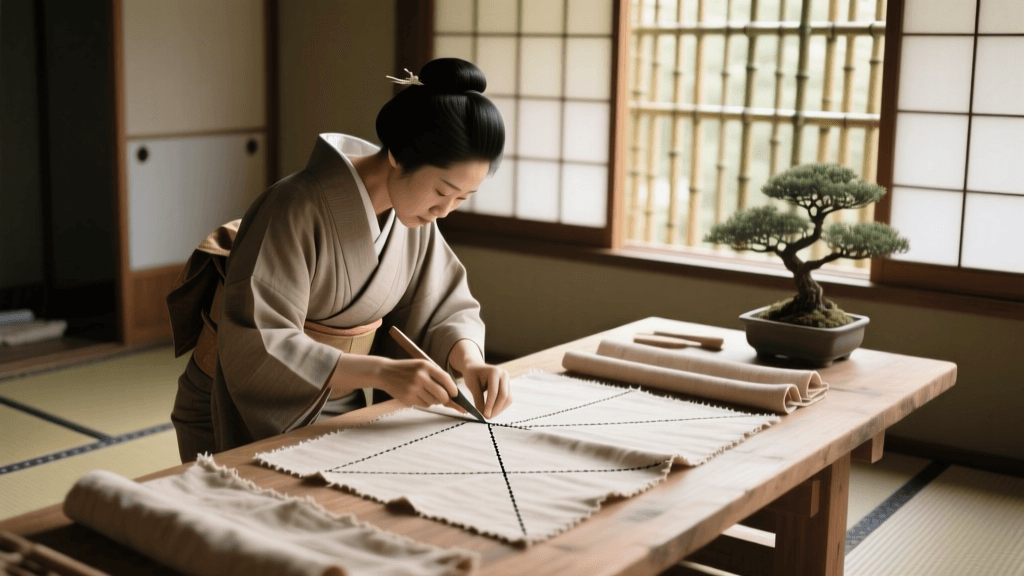
The most striking feature of kimono construction is the complete absence of curved cutting lines. The entire 11-meter bolt is dissected into a series of precise rectangles. There is no negative space, no off-cuts, and absolutely zero fabric waste. The standard kimono is constructed from eight primary rectangular panels, carefully sliced from the bolt using a specialized ruler and a fabric marker or traditional hera (spatula) to crease the cutting lines.
- Migoro (Body Panels): Two large rectangular panels that form the front and back of the torso. They are cut to the wearer's height plus an allowance for the hip fold.
- Sode (Sleeve Panels): Two rectangular panels that attach to the migoro. The depth of the sleeve drop varies depending on the formality of the garment and the age of the wearer.
- Okumi (Front Overlap Panels): Two narrower rectangles attached to the front edges of the migoro to create the overlapping front closure.
- Eri (Collar Panels): Two narrow strips that form the outer collar, folded and stitched to the neckline and down the front overlaps.
- Tomoe (Neckband): A small, hidden rectangular piece used to reinforce the center back of the neck.
Because every component is a rectangle cut along the straight grain of the fabric, the structural integrity of the silk or hemp is maintained, preventing the bias-stretching and warping often seen in Western bias-cut garments.
Essential 2026 Tools for Wasai (Japanese Sewing)
While the fundamental geometry of the kimono has remained unchanged for centuries, the tools used by tailors in 2026 have evolved to combine traditional craftsmanship with modern precision. Below is a comparison of traditional implements and their modern 2026 equivalents used by contemporary wasai artisans.
| Traditional Tool | 2026 Modern Equivalent | Purpose in Construction |
|---|---|---|
| Shaku (Bamboo Ruler) | Laser-guided digital measuring tape | Measuring the 36cm bolt and marking precise panel lengths without stretching the silk. |
| Hera (Bamboo Spatula) | Teflon-coated heated creasing tool | Creasing seam allowances and marking cutting lines without using ink or chalk. |
| Kakehari (Tension Hook) | Magnetic silicone fabric weights and tension boards | Holding the fabric taut while hand-stitching long, straight running seams. |
| Mokinui (Silk Thread) | Recycled bio-silk polymer threads | Providing high-tensile strength for hand-sewn running stitches that match the fabric's drape. |
Core Sewing Techniques: Hishaku and Shiro
The assembly of a kimono relies almost entirely on the hishaku, a specialized, slightly loose running stitch. Unlike the tight, permanent lockstitches of a modern 2026 computerized sewing machine, the hishaku is designed with a specific philosophical and practical purpose: impermanence and adaptability. The stitches are spaced carefully to allow the fabric to breathe and drape naturally, moving with the wearer rather than restricting them.
Perhaps the most crucial construction technique in Japanese dress is the treatment of the shiro, or seam allowance. In Western tailoring, seam allowances are typically trimmed, graded, and serged to prevent fraying, permanently locking the garment into a single size. In kimono construction, the seam allowances are left wide, raw, and entirely uncut inside the garment. These wide, folded allowances are lightly tacked down but never permanently secured to the outer fabric.
The genius of the uncut shiro is twofold: it adds a subtle, structural weight that enhances the downward drape of the silk, and it preserves the original fabric. If the garment needs to be resized, repaired, or passed down to a taller family member, the seams are simply unpicked, the fabric is washed flat as a continuous bolt, and the garment is recut and resewn. This inherent modularity is the pinnacle of circular fashion, a concept heavily championed today by organizations like the Ellen MacArthur Foundation.
The Art of Aramono: Washing and Maintenance
Because the kimono is constructed from straight, unstitched panels, it can be completely disassembled for cleaning—a process known as aramono. When a kimono becomes soiled, a professional artisan carefully removes the hishaku stitches, separating the garment back into its original eight rectangular panels and the continuous tanmono bolt. The flat pieces of fabric are then washed, re-stretched on a bamboo frame (shinshi), and dried. Once dry, the panels are reassembled. This maintenance technique ensures that a single, high-quality silk kimono can easily last for over a century, surviving multiple generations of wearers, making the initial 2026 investment in authentic silk highly cost-effective over its lifecycle.
Adapting Tanmono Construction for Modern 2026 Garments
In 2026, avant-garde designers and sustainable fashion houses are actively adopting the tanmono grid to create contemporary zero-waste clothing. By restricting their design process to a 36-centimeter width and utilizing only straight-line cuts, modern pattern-makers are engineering modular wrap coats, reversible workwear jackets, and adjustable pleated trousers that echo the kimono’s geometry.
For example, modern zero-waste wrap dresses utilize the okumi (overlap panel) concept to create adjustable, size-inclusive garments that require no darts or complex bust shaping. The fabric is simply folded and tied, allowing a single garment to fit a wide spectrum of body types. Furthermore, the use of uncut seam allowances is being integrated into modern children's wear, allowing parents to let out hems and seams as the child grows, drastically reducing the consumption of fast fashion.
Sourcing Authentic Tanmono in 2026
For tailors and hobbyists looking to practice traditional wasai, sourcing an authentic tanmono bolt is the first step. In 2026, the market offers a variety of options ranging from vintage silk to modern sustainable blends.
- Vintage Silk Bolts (Meiji and Taisho eras): Often found in specialized online auctions or Kyoto-based textile exporters. Prices in 2026 range from $150 to $400 USD per bolt, depending on the complexity of the yuzen dye work and the condition of the silk.
- Modern Washable Silk Blends: Produced by contemporary mills in Nishijin, these bolts feature a blend of silk and washable cupro, allowing for home laundering without full disassembly. These typically cost between $250 and $500 USD.
- Sustainable Hemp and Ramie: For summer garments like the yukata or jinbei, organic ramie bolts woven on traditional looms are available for approximately $120 to $200 USD. These fibers offer excellent breathability and possess a crisp, architectural drape that holds the straight-line geometry beautifully.
Whether you are a traditionalist seeking to preserve the ancestral art of wasai or a modern designer looking to eliminate textile waste from your production line, the construction techniques of the Japanese tanmono offer a masterclass in sustainable engineering. By embracing the straight line, the uncut seam, and the modular bolt, the fashion industry can look to ancient Asian traditions to forge a truly circular future.