Mastering Kimono Tanmono Straight-Line Cutting Techniques in 2026
The Renaissance of Zero-Waste: Kimono Construction in 2026
As the global fashion industry in 2026 faces stringent new environmental regulations and a massive consumer pivot toward circularity, designers and tailors are looking to the past for sustainable solutions. At the forefront of this movement is the traditional Japanese kimono and its foundational construction method: the tanmono straight-line cutting technique. Unlike Western tailoring, which relies on curved patterns that inevitably leave behind 15% to 20% in fabric offcuts, the kimono is a masterclass in zero-waste engineering. By utilizing a single, continuous bolt of fabric cut exclusively in straight lines, this centuries-old Asian dress tradition offers a flawless blueprint for modern, sustainable garment construction.
According to the Victoria and Albert Museum's extensive textile archives, the kimono's iconic T-shape is not merely an aesthetic choice but a highly calculated structural design that maximizes fabric utility while allowing for infinite deconstruction and reconstruction. In this comprehensive guide, we will explore the anatomy, tools, and step-by-step construction techniques of the tanmono method, demonstrating how these traditional Asian practices are being adapted for contemporary wardrobes in 2026.
The Philosophy and Dimensions of the Tanmono
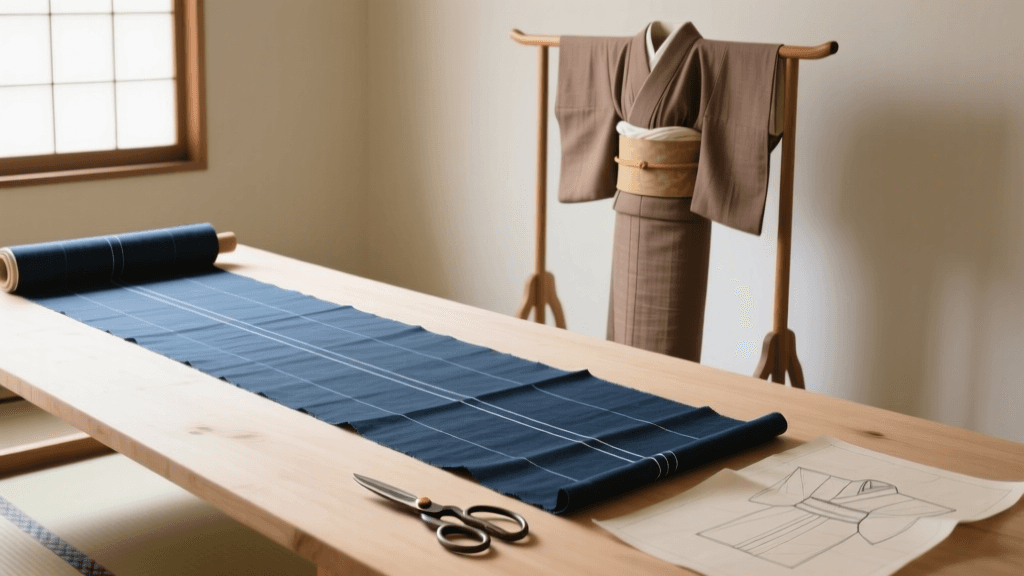
The foundation of kimono construction is the tanmono, a standard bolt of cloth woven specifically for garment making. Historically and continuing into modern 2026 textile production, a standard kimono tanmono measures approximately 36 to 40 centimeters (about 14 to 15.5 inches) in width and 12 meters (about 13 yards) in length. This specific width is dictated by the traditional backstrap loom and the natural reach of the human arm, ensuring that the fabric can be woven without mechanical stretching.
Because the fabric is woven to this exact width, the garment is constructed using only straight vertical and horizontal cuts. There are no curved armholes, no tapered side seams, and no shoulder slopes cut into the fabric. The entire 12-meter bolt is utilized, resulting in absolutely zero fabric waste. Any leftover fabric from the length is simply folded and tucked inside the garment as seam allowances, preserving the textile for future alterations or repairs.
Anatomy of the Kimono: The Eight Essential Panels
To understand the straight-line cutting technique, one must understand the geometric anatomy of the kimono. The garment is composed of eight primary rectangular panels, each cut directly from the tanmono without altering the woven edges (mimi), which prevents fraying and eliminates the need for modern overlocking or serging.
- Migoro (Body Panels): Two long rectangular panels that form the front and back of the main body. They are folded over the shoulders without a shoulder seam.
- Okumi (Front Overlap Panels): Two narrower panels attached to the front edges of the migoro to create the overlapping front closure essential for wrapping the garment left over right.
- Sode (Sleeves): Two rectangular panels that are folded in half and attached to the body, creating the deep, pouch-like sleeves characteristic of traditional Japanese dress.
- Eri (Collar): A long, narrow strip that is folded and attached to the neckline, extending down the front overlaps.
- Tomoeri and Kakeeri (Collar Covers): Additional protective and decorative strips applied to the back of the neck and the inside of the collar to protect the main silk from skin oils and makeup.
Comparative Data: Kimono vs. Western Tailoring
The structural differences between Asian straight-line construction and Western curved tailoring are profound, especially when viewed through the lens of 2026 sustainability metrics. The Ellen MacArthur Foundation's recent reports on circular fashion highlight the urgent need to design out waste, a principle the kimono has embodied for centuries.
| Construction Feature | Kimono (Tanmono Method) | Western Tailored Garment |
|---|---|---|
| Fabric Waste | 0% (True Zero-Waste) | 15% - 25% Average Offcut Waste |
| Pattern Drafting | Straight lines only; relies on fabric width | Curved lines; requires complex grading |
| Seam Allowances | Generous (1.5 - 2 cm), folded and hidden inside | Minimal (0.5 - 1 cm), often finished or serged |
| Shoulder Construction | Continuous fold; no shoulder seam | Structured shoulder pads and set-in seams |
| End-of-Life / Alteration | Fully deconstructable; panels can be resewn | Difficult to alter significantly; often discarded |
Step-by-Step Straight-Line Construction Techniques
Creating a kimono requires a departure from modern sewing habits. The process relies on precise marking, basting, and specific hand-stitching techniques that allow the garment to breathe and move.
1. Measuring and Marking (Shirushi)
Instead of using paper patterns, traditional artisans use a shaku (a traditional Japanese ruler measuring approximately 37.8 cm) and a water-soluble marking brush. In 2026, many contemporary tailors have adopted digital laser-measuring tools calibrated to the shaku system to ensure absolute precision on slippery silk crepes and modern sustainable cupro blends. The fabric is folded in half lengthwise, and the panels are marked simultaneously to guarantee perfect symmetry.
2. The Basting Process (Shitsuke)
Because silk and fine Asian textiles shift easily, machine sewing is rarely used for the main structural seams. The panels are first basted together using long, easily removable running stitches. This allows the maker to check the drape, the alignment of the woven patterns (such as the continuous flow of a dyed landscape across the migoro and okumi), and the overall balance before committing to permanent stitches.
3. Main Seams and Blind Stitching (Honsa and Kuke)
The main seams (honsa) are sewn using a tight, hand-worked running stitch. The seam allowances (nuishiro) are then folded inward and secured using kuke, a nearly invisible blind stitch. This technique ensures that no raw edges are exposed, and no stitches are visible from the outside of the garment. The Metropolitan Museum of Art's textile conservation department notes that this specific method of enclosing raw edges is what allows historical kimonos to survive for centuries without the fabric unraveling.
The Ultimate Sustainability Feature: Arai-Hari
Perhaps the most remarkable aspect of the tanmono construction technique is the arai-hari process. Because the kimono is constructed entirely of straight, un-tapered panels held together by specific tension-based stitches, the garment can be completely unstitched at the end of its wear cycle. The individual rectangular panels are then washed, stretched on bamboo frames (shinshi) to remove wrinkles and restore the fabric's original weave tension, and dried. Once dry, the pristine, flat panels can be resewn into a brand-new kimono, or repurposed into other garments, futons, or household textiles. In 2026, luxury sustainable brands are adopting this exact deconstruction model, offering "take-back" programs where garments are unstitched, professionally cleaned as flat panels, and recut for the next owner.
Essential Tools for Modern Tanmono Construction in 2026
For artisans and fashion students looking to integrate Asian straight-line cutting into their 2026 practice, the following tools bridge the gap between heritage and modern precision:
- Clover 5011 Rotary Cutter (45mm): Essential for achieving perfectly straight cuts along the grainline without the distortion caused by traditional shears.
- Adjustable Digital Shaku Ruler: A modern 2026 innovation that allows tailors to switch between metric, imperial, and traditional Japanese shaku measurements via an e-ink display.
- Silk Weighting Magnets: Used to hold the slippery tanmono fabric in place on the cutting table without piercing or damaging the delicate fibers.
- Water-Soluble Silk Marking Pens: Formulated specifically for high-sheen Asian textiles, ensuring marks disappear completely upon contact with steam during the final pressing.
Conclusion: The Future is Linear
The Japanese kimono's tanmono straight-line cutting technique is far more than a historical artifact; it is a highly advanced, zero-waste engineering marvel. As the fashion industry in 2026 continues to grapple with the ecological灾难 of curved pattern cutting and textile waste, the wisdom embedded in Asian dress traditions offers a clear, actionable path forward. By embracing rectangular geometry, generous enclosed seam allowances, and the philosophy of infinite deconstruction, modern designers can create garments that are not only deeply respectful of their materials but inherently circular by design.