Japanese Kimono Construction: Zero-Waste Cutting in 2026
The Philosophy of Tanmono and Zero-Waste Geometry
In the contemporary fashion landscape of 2026, sustainability is no longer a niche trend but a foundational requirement. As the global apparel industry grapples with textile waste, modern designers are increasingly looking toward historical garment construction techniques for solutions. At the forefront of this zero-waste movement is the traditional Japanese kimono. Unlike Western tailoring, which relies on curved pattern pieces that inevitably leave behind 15% to 20% of fabric as offcuts, the kimono is a masterclass in geometric efficiency. According to the Victoria and Albert Museum, the kimono's structural brilliance lies in its relationship with the tanmono—the standard bolt of cloth from which it is born.
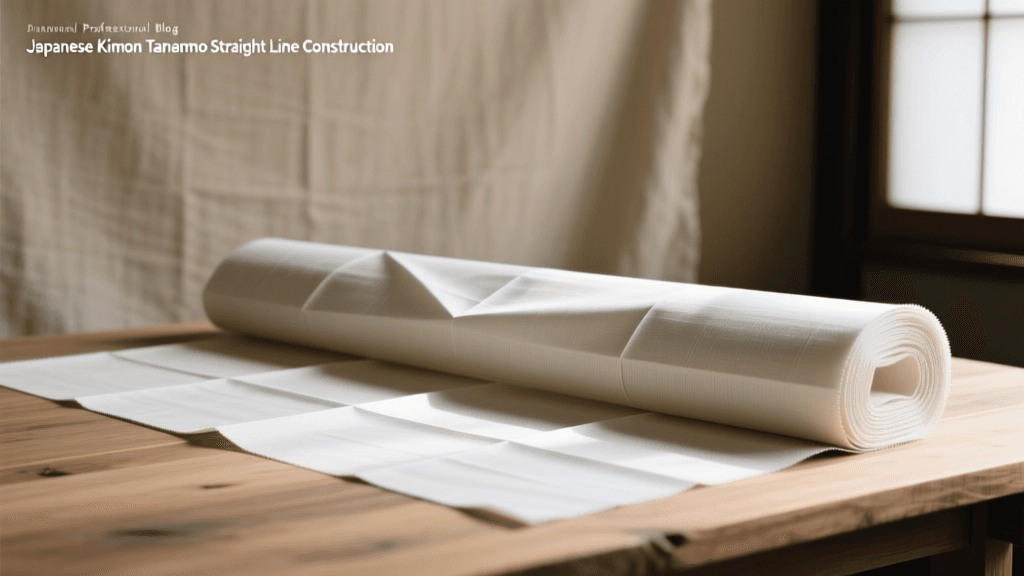
The tanmono is woven to a highly specific, narrow width, traditionally measuring between 36 and 40 centimeters (approximately 14 to 15.7 inches) and spanning 11.5 to 12 meters in length. This narrow width was historically dictated by the limitations of handlooms and the practicalities of washing and storing fabric. However, in 2026, this constraint is celebrated as the ultimate zero-waste framework. Every single centimeter of the tanmono is utilized in the creation of the garment, leaving absolutely no scrap fabric behind.
Deconstructing the Kimono: The Eight Rectangular Panels
To understand the straight-line cutting technique, one must look at the anatomy of the kimono. The garment is constructed from exactly eight primary rectangular panels. Because the fabric is narrow, the body of the kimono cannot be cut from a single wide piece. Instead, it is assembled from multiple vertical strips that are sewn together side-by-side.
- Migoro (Body Panels): Two large rectangular panels that form the front and back of the torso. These are cut to the wearer's height plus extra for the ohashori (the waist fold).
- Sode (Sleeves): Two rectangular panels that are folded in half and attached to the migoro. The bottom of the sleeve fold is often left partially open, creating the iconic furi (swinging sleeve opening).
- Okumi (Overlaps): Two narrower rectangular panels attached to the front edges of the migoro to create the overlapping front closure.
- Eri (Collar): A long, narrow strip of fabric that is folded and sewn around the neckline.
- Kake-eri (Overlay Collar): A protective overlay collar, often made of a different, more easily washable fabric, sewn over the main eri.
Because all pieces are rectangles, the cutting process involves measuring and snipping the threads of the tanmono at precise intervals, then gently pulling the threads to separate the fabric along the grain. This ensures that the edges remain perfectly straight and structurally sound, preventing fraying and eliminating the need for complex serging or edge-finishing typical in Western dressmaking.
Standard Measurements and the 2026 Artisan Market
Constructing a kimono requires a deep understanding of body measurements and how they translate to the rigid grid of the tanmono. In 2026, while custom weaving is still practiced, many artisans and hobbyists also work with pre-woven bolts. The standard length of 11.5 meters is generally sufficient to construct a kimono for a person up to 170 cm tall, assuming a standard sleeve drop.
The pricing for authentic tanmono bolts in 2026 reflects the immense skill required for traditional weaving and dyeing. A high-quality, artisan-woven silk tanmono from the Nishijin district in Kyoto typically ranges from ¥80,000 to ¥250,000 JPY. For everyday wear or practice, cotton yukata bolts are highly accessible, retailing between ¥15,000 and ¥35,000 JPY. When purchasing fabric for straight-line construction, buyers must ensure the fabric width does not exceed 40 cm; if using modern wide-width fabric (typically 110 cm to 150 cm), the fabric must be meticulously folded and cut down to the tanmono width to preserve the zero-waste geometry and correct drape.
Essential Hand-Sewing Techniques for Kimono Construction
The assembly of the kimono relies almost entirely on hand-sewing, utilizing a few specialized stitches that allow the garment to be flexible, durable, and ultimately deconstructable. As noted by The Metropolitan Museum of Art, the temporary nature of kimono seams is a feature, not a bug, allowing the garment to be taken apart for thorough washing and re-sewn.
Hon-Gushinui (The Running Stitch)
The primary seam of the kimono is the hon-gushinui, a precise, evenly spaced running stitch. Unlike the tight, locked stitches of a modern sewing machine, the gushinui is sewn with a slight slackness. This allows the silk threads to breathe and shift, preventing the fabric from tearing under tension. Seam allowances are typically left at 1.5 cm to 2 cm and are folded inward, enclosing the raw edges completely without cutting any fabric away.
Kagari (Overcast Stitch)
Used primarily for the sleeve openings and the bottom hem, the kagari stitch secures the folded edges. It is a loose overcast stitch that catches only a few threads of the main fabric, ensuring the stitch remains nearly invisible on the right side of the garment.
Matsuigake (Blind Catch Stitch)
This stitch is utilized to attach the collar and secure the inner lining. The matsuigake creates a flexible, invisible bond that allows the collar to curve naturally around the neck without puckering.
Comparison: Traditional Kimono vs. Western Tailoring
To fully appreciate the engineering of the kimono, it is helpful to contrast it with standard Western garment construction methods prevalent in 2026.
| Feature | Japanese Kimono (Tanmono) | Western Tailoring (Curved Pattern) |
|---|---|---|
| Fabric Waste | 0% (Zero-Waste) | 15% - 20% (Offcuts and scraps) |
| Cutting Method | Straight-line, along the grain | Curved, bias, and multi-directional |
| Sizing Adjustments | Adjusted via deep seam allowances and waist folds | Adjusted via darts, ease, and recutting |
| Seam Finishes | Folded inward, enclosing raw edges | Serged, zigzagged, or bound |
| End-of-Life / Care | Deconstructed, washed, stretched, and resewn | Machine washed; difficult to fully deconstruct |
Modern Applications: Zero-Waste Pattern Drafting in 2026
The principles of tanmono construction have heavily influenced the sustainable fashion sector in 2026. Modern zero-waste pattern drafting often utilizes the 'jigsaw' method or the 'straight-line' method. By restricting their design process to the narrow width constraints of the tanmono, contemporary designers are creating modular, avant-garde outerwear and wrap dresses that require no fabric waste.
For home sewists and textile artists looking to adopt this technique, the process begins with sourcing narrow-width fabrics, such as traditional Ikat cottons or handwoven linens. If only wide fabric is available, the first step is to cut the fabric into 38 cm strips, selvedge to selvedge. These strips are then sewn together side-by-side to simulate a continuous bolt. From this reconstructed bolt, the rectangular panels for a modern wrap jacket or haori-inspired cardigan can be measured and snipped. The key rule is to never cut a curve; all shaping must be achieved through folding, wrapping, and the strategic placement of ties or belts.
Care, Deconstruction, and the Arai-Hari Tradition
The ultimate proof of the kimono's superior construction lies in its maintenance cycle. The practice of arai-hari (washing and stretching) involves completely unpicking the stitches of the kimono, returning it to its original state as a series of flat, rectangular panels. These panels are then washed, stretched on wooden boards or frames to dry, and re-sewn. This process not only cleans the garment thoroughly but also refreshes the silk, removing creases and restoring the fabric's luster.
In 2026, as consumers seek garments that offer longevity and circularity, the arai-hari philosophy is being adapted for modern wardrobes. Designers are creating modular garments held together by specialized, easily removable threads, allowing consumers to deconstruct their coats and dresses for flat storage, easy repair, or eventual textile recycling. The kimono proves that true sustainability is not just about the materials used, but the fundamental geometry and construction techniques that dictate how a garment lives, breathes, and endures over centuries.
Conclusion
The Japanese kimono remains a towering achievement in textile engineering. Its reliance on the tanmono bolt and straight-line cutting techniques offers a masterclass in zero-waste design. As the fashion industry in 2026 continues to seek viable alternatives to wasteful manufacturing, the ancient geometry of the kimono provides a perfect, time-tested blueprint for the future of sustainable apparel.