Top Japanese Kimono & Shibori Fashion Workshops 2026: Hybrid Guide
The Renaissance of Traditional Japanese Garment Education in 2026
As the global fashion industry pivots toward sustainability, slow fashion, and heritage preservation in 2026, traditional Japanese clothing—known collectively as wafuku—has experienced an unprecedented educational renaissance. International students and seasoned designers alike are flocking to Japan to master the intricate arts of kimono construction, shibori (shaped-resist dyeing), and yuzen (paste-resist painting). However, the way these ancient techniques are taught has evolved dramatically. In 2026, the most sought-after programs are no longer strictly in-person; they are sophisticated hybrid models that blend rigorous online theoretical coursework with intensive, hands-on workshops in Kyoto and Tokyo.
This hybrid approach allows global learners to study the complex history of Japanese textiles, master digital pattern drafting, and understand the chemistry of natural dyes from their home studios. Once the foundational knowledge is secured, students travel to Japan for two-to-four-week immersive residencies to weave, dye, and sew their garments under the watchful eyes of master artisans. According to the Association for the Promotion of Traditional Craft Industries, government-backed initiatives in 2026 have heavily subsidized these hybrid cultural exchange programs to combat the aging demographic of traditional artisans, resulting in a 40% increase in international enrollments this year.
The Hybrid Model: Blending Digital Theory with Artisan Practice
Traditional Japanese tailoring relies on the tanmono system—a standard bolt of fabric measuring approximately 36 centimeters in width and 12 meters in length. Unlike Western clothing (yofuku), which is cut from wide fabric and tailored to curve around the body, wafuku is cut in straight lines from the narrow tanmono, ensuring zero fabric waste. Understanding this geometric logic requires intense study, which is perfectly suited for online 3D modeling modules.
In 2026, top fashion schools utilize advanced digital platforms where students learn to manipulate virtual tanmono bolts using specialized CAD software integrated with traditional measurement systems. After passing their online structural exams, students attend the physical workshops to handle the silk, apply the resist pastes, and execute the meticulous hon-bushi (main seam) stitching techniques that machines simply cannot replicate.
1. Bunka Fashion College: Wafuku Pattern Drafting & Digital Integration
Renowned globally for producing avant-garde designers, Bunka Fashion College in Tokyo has updated its traditional curriculum for the 2026 academic year. Their 'Wafuku Pattern Drafting & Digital Integration' certificate is a premier hybrid program. The online phase spans 12 weeks, focusing on the mathematical precision of the sunpu-jaku (traditional Japanese ruler) system and the structural differences between the kosode (small sleeve) and modern kimono silhouettes.
Students use CLO3D's specialized 2026 Wafuku module to simulate the drape of various silk weights, from heavy chirimen (crepe) to lightweight ro (summer gauze). The program culminates in a mandatory three-week in-person residency at Bunka's Tokyo campus. Here, students transition from screen to studio, learning to cut actual silk with traditional shears and mastering the kake-juya (hanging stitch) used to secure linings without visible external threads. The 2026 tuition for this hybrid certificate is set at ¥245,000, excluding materials and travel.
2. Kyoto Artisan Institute: Shibori & Yuzen Dyeing Masterclass
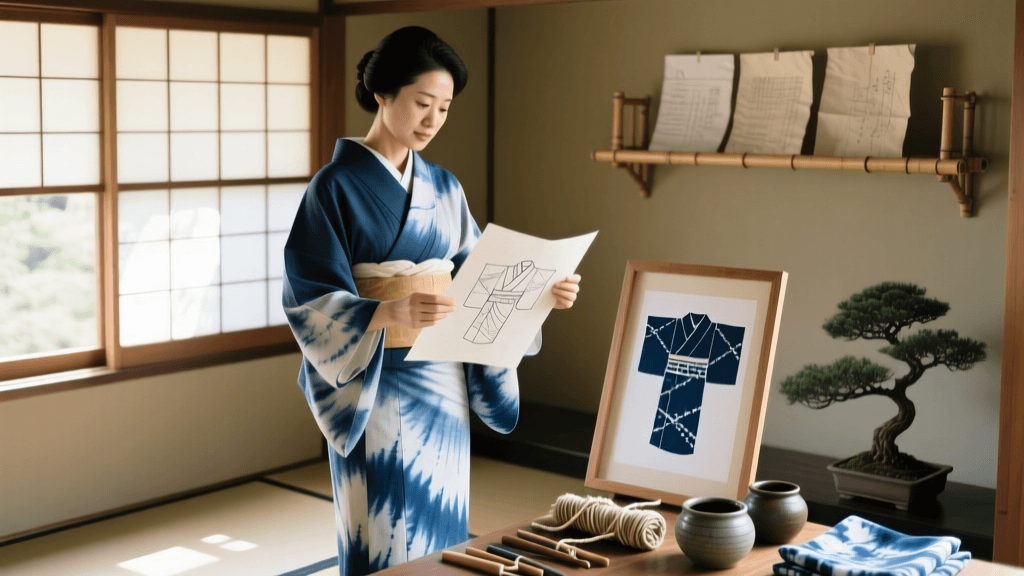
While Tokyo excels in structural drafting, Kyoto remains the undisputed heart of Japanese textile dyeing. The Kyoto Artisan Institute offers a highly specialized hybrid program focusing exclusively on color and surface design. The online curriculum covers the botany and chemistry of natural dyes, with a deep dive into ai-zome (Japanese indigo) fermentation processes and the extraction of murasaki (gromwell root) purple.
The in-person workshop in Kyoto's Nishijin weaving district is a sensory immersion. Students spend two weeks practicing kanoko shibori (fawn-spot binding), where thousands of micro-knots are tied into silk before dyeing to create intricate geometric patterns. They also learn itome nori, the precise application of rice-paste resist lines used in yuzen dyeing to create the pictorial landscapes seen on formal furisode kimono. Because natural dye vats require daily feeding and temperature monitoring, the online modules teach students how to maintain a micro-vat at home, ensuring they can continue their practice after returning from Japan.
Comparison Chart: 2026 Workshop Pricing & Formats
| Institution | Program Name | Format (2026) | Tuition (JPY) | Key Technique Focus |
|---|---|---|---|---|
| Bunka Fashion College | Wafuku Drafting & Digital | 12 Wks Online + 3 Wks Tokyo | ¥245,000 | Straight-line cutting, 3D drape simulation |
| Kyoto Artisan Institute | Shibori & Yuzen Masterclass | 8 Wks Online + 2 Wks Kyoto | ¥198,000 | Indigo fermentation, rice-paste resist |
| Tokyo Mode Gakuen | Sustainable Washi Weaving | 6 Wks Online + 1 Wk Nagano | ¥120,000 | Paper-thread spinning, backstrap loom |
| Osaka Kimono Academy | Modern Yukata Styling & Sew | 4 Wks Online + 1 Wk Osaka | ¥85,000 | Cotton printing, casual summer tailoring |
Essential Tools for Your 2026 Online Learning Setup
To succeed in the online phases of these hybrid programs and prepare for your in-person workshops, you must equip your home studio with specific tools that bridge the gap between Western and Japanese tailoring. Standard sewing kits will not suffice for wafuku.
- Sunpu-jaku (Traditional Ruler): Unlike the metric system, the traditional Japanese ruler divides length into shaku, sun, and bu. One sun is approximately 3.79 cm. In 2026, most schools require students to purchase a specialized acrylic sunpu-jaku with dual metric/traditional markings to translate historical patterns accurately.
- Juki TL-2010Q or Similar Straight-Stitch Machine: While kimono are traditionally hand-sewn, modern workshops often use high-speed, single-needle straight-stitch machines for practice garments and linings. The Juki TL-2010Q remains the industry standard for home studios due to its powerful motor and ability to handle thick silk layers without puckering.
- Bamboo Hera (Spatula): Used for creasing fabric and applying resist pastes. A set of varying widths is essential for manipulating the narrow 36cm tanmono fabric without stretching the bias.
- Kote (Traditional Iron): Modern hybrid programs emphasize the use of the kote—a specialized, narrow iron designed to press open the thick, multi-layered seams of a kimono without flattening the textured surface of chirimen silk.
How to Apply and Prepare for 2026 Intakes
Admissions for the 2026 hybrid cohorts are highly competitive, particularly for the Kyoto-based dyeing workshops where studio space and natural dye vats are strictly limited. Most institutions open their Spring intake applications in October of the previous year, with Fall intake applications closing by May.
Applicants are generally required to submit a portfolio demonstrating basic sewing proficiency and a statement of intent detailing how they plan to integrate traditional Japanese techniques into their contemporary design practice. Fluency in Japanese is rarely required for the international hybrid tracks, as real-time AI translation earpieces and bilingual teaching assistants are standard in 2026 classrooms.
For the in-person residency phase, international students must secure the appropriate cultural activity visas. The Japan National Tourism Organization provides updated 2026 guidelines on visa exemptions and short-term cultural study permits, which typically allow stays of up to 90 days for workshop participants. Students are advised to book accommodations in Kyoto's Higashiyama or Tokyo's Shinjuku districts at least six months in advance, as the 2026 surge in cultural tourism has driven up short-term rental prices significantly.
By embracing the hybrid model, the next generation of fashion designers is ensuring that the meticulous, zero-waste, and deeply symbolic traditions of Japanese garment making are not just preserved in museums, but actively worn, adapted, and celebrated on the global stage.