Japanese Fashion Schools & Kimono Apprenticeships 2026
The Renaissance of Wafuku Education in 2026
The landscape of traditional Japanese garment education has undergone a significant transformation by 2026. With the artisan population in historic textile hubs like Kyoto, Kanazawa, and Niigata aging rapidly, the preservation of intangible cultural properties has become a national priority. The Japanese government, alongside private guilds, has injected unprecedented funding into succession programs. For international and domestic students alike, mastering the arts of kimono tailoring (wasai), Yuzen dyeing, and Nishijin weaving is no longer just a historical pursuit; it is a highly subsidized, forward-looking career path that now integrates 3D digital archiving with centuries-old hand techniques. Whether you are drawn to the meticulous brushwork of silk dyeing or the rhythmic clatter of the jacquard loom, understanding the educational pathways available in 2026 is essential for any aspiring artisan.
The Modern Deshi System: Traditional Apprenticeships
The deshi (apprenticeship) system remains the most authentic and rigorous route to mastering traditional Japanese textiles. In 2026, the rigid, hierarchical structures of the past have softened to accommodate international applicants and modern labor laws, though the dedication required remains immense. The relationship between master (shishou) and apprentice is built on mutual respect, observation, and repetitive physical practice.
Uchi-Deshi vs. Kayoi-Deshi
There are two primary models of apprenticeship in Japan today. Uchi-deshi (live-in apprentices) reside in the master artisan's workshop or affiliated dormitories. This immersive model is common in rural weaving villages like Ojiya, famous for its snow-bleached Ojiya-chijimi linen. Apprentices handle workshop maintenance, prepare natural dyes, and gradually earn the right to touch the looms after months of observation. Kayoi-deshi (commuting apprentices) are more prevalent in urban centers like Kyoto and Tokyo. They work set hours, typically from 8:00 AM to 6:00 PM, and focus strictly on technical skill acquisition, such as the meticulous brushwork required for Kyo-Yuzen silk dyeing.
2026 Stipends and Living Conditions
Historically, apprentices worked merely for room and board. However, to combat the declining birthrate and attract young talent, the 2026 standard for government-recognized deshi includes a monthly stipend ranging from ¥140,000 to ¥180,000 ($950 to $1,200 USD). Masters affiliated with the Association for the Promotion of Traditional Craft Industries often provide additional bonuses upon the completion of specific milestones, such as mastering the suri-bake (brush dyeing) technique or successfully warping a loom without breaking the delicate silk threads.
Essential Tools and Workshop Etiquette
Entering a traditional Japanese workshop in 2026 requires an understanding of both the physical tools and the spiritual etiquette of the space. Before you ever touch a bolt of silk, you must master the maintenance of your tools. Apprentices spend their first months learning to sharpen the hera (bamboo spatulas used for applying resist paste) and maintaining the shinshi (bamboo needle stretchers used to keep fabric taut during dyeing). Etiquette is equally paramount. Sweeping the workshop floor every morning is not just about cleanliness; it is a meditative practice that grounds the apprentice and ensures no dust settles on the pristine silk. Bowing to the loom or the dye vats before beginning work is a common practice that honors the spirits of the materials and the ancestors who perfected the craft.
Top Vocational Schools for Traditional Garments
For those seeking a structured academic environment before entering a workshop, Japan's vocational schools and universities offer unparalleled resources, blending heritage techniques with modern design theory.
Bunka Fashion College (Tokyo)
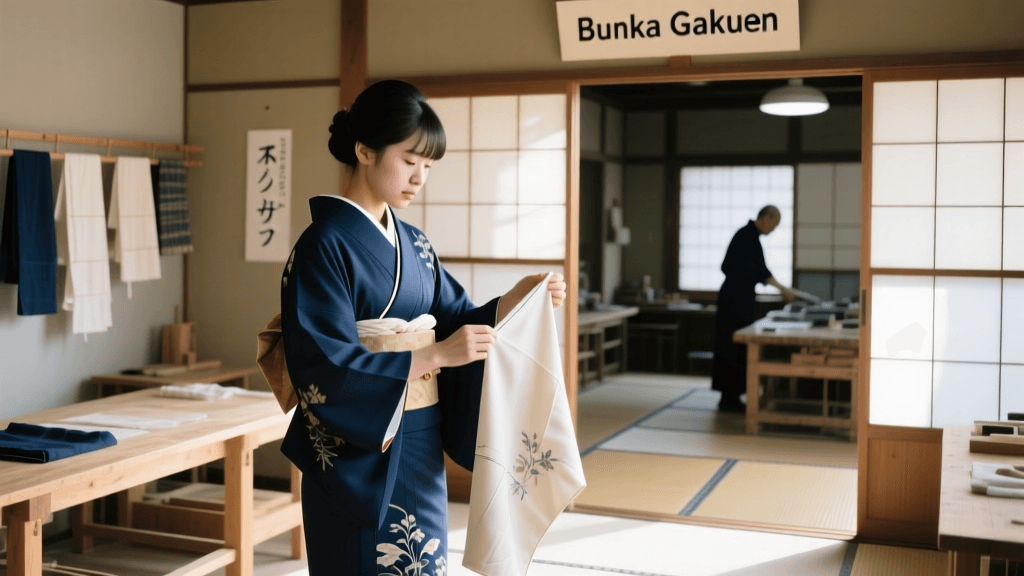
While globally renowned for avant-garde contemporary fashion, Bunka Fashion College maintains a rigorous Traditional Arts and Textiles department. In 2026, their curriculum emphasizes the intersection of heritage and modern sustainability. Students spend their first year mastering the flat-pattern cutting unique to kimono, where fabric is woven to specific bolt widths (tan-mono, typically 36cm wide) and sewn using long, flexible running stitches that allow the garment to be entirely disassembled, washed, and resewn. The college's new 2026 digital loom lab allows students to scan and replicate the tension metrics of master weavers, creating a bridge between analog mastery and digital preservation.
Kyoto University of the Arts
Located in the heart of Japan's cultural capital, this institution offers a dedicated Textile Arts course. Students have direct access to Nishijin weaving cooperatives and centuries-old dye houses. The 2026 syllabus includes mandatory fieldwork in indigo fermentation vats (sukumo) in Tokushima, ensuring students understand the chemical and biological processes of natural dyeing. They learn to feed the indigo 'living' bacteria with sake and wood ash, a sensory and scientific experience that cannot be replicated in a standard classroom.
Tokyo Kimono Academy
Focusing on the commercial and practical sides of the garment trade, this academy specializes in kitsuke (the art of dressing) and wasai (tailoring). Graduates are highly sought after by luxury ryokans, international theater companies, and high-end bridal salons that require authentic Edo-period styling. The academy's 2026 curriculum includes a module on dressing clients for various international climates, adapting traditional silk layering for modern, temperature-controlled environments without sacrificing historical accuracy.
Comparison: Apprenticeship vs. Vocational School (2026)
| Feature | Traditional Deshi (Apprenticeship) | Vocational School / University |
|---|---|---|
| Duration | 3 to 7 years | 2 to 4 years |
| Average Annual Cost | Free (Earns ¥1.6M - ¥2.1M stipend) | ¥1,200,000 - ¥1,800,000 tuition |
| Primary Focus | Mastery of a single, specific craft (e.g., Yuzen dyeing) | Broad textile knowledge, design theory, and business |
| Language Requirement | JLPT N1 (Fluent technical Japanese) | JLPT N2 (Intermediate Japanese) |
| Career Outcome | Independent Artisan, Guild Master | Textile Designer, Brand Founder, Kitsuke Instructor |
| 2026 Tech Integration | Low (Focus on analog, hand-made perfection) | High (3D scanning, digital Jacquard drafting) |
Step-by-Step Guide to Applying in 2026
1. Language Proficiency and Technical Vocabulary
Traditional masters rarely speak English, and the nuances of textile manipulation are deeply embedded in the Japanese language. A minimum of JLPT N2 is required for most vocational schools, while N1 is strongly recommended for direct apprenticeships. Beyond standard fluency, you must memorize technical terminology. Knowing the difference between tate-ito (warp threads) and yoko-ito (weft threads), or understanding the precise meaning of shibori (tie-dye) resist patterns, is critical for surviving your first month in a workshop.
2. Portfolio Preparation
Your portfolio should not just feature finished, glamorous garments. Masters and admissions boards want to see patience, precision, and a respect for materials. Include high-resolution macro photography of your hand-stitching, samples of natural dyeing experiments, and evidence of repetitive practice. A page showcasing perfectly aligned sashiko quilting or a series of 50 identical hand-drawn arabesque (karakusa) patterns will impress a Nishijin master far more than a conceptual, avant-garde dress.
3. Navigating Visas and Bureaucracy
International applicants must secure the correct visa status. Enrolling in a recognized school like Bunka Fashion College qualifies you for a standard Student Visa. However, entering a direct, rural apprenticeship requires a Cultural Activities Visa or, in some cases, a Designated Activities Visa if the apprenticeship is part of a government-sponsored cultural exchange program outlined by the Ministry of Foreign Affairs. Begin your visa paperwork at least six months before the April or October academic intake periods.
Financial Aid and 2026 Government Subsidies
The Japanese Agency for Cultural Affairs has expanded its 'Successor Training Subsidy' for 2026, recognizing the critical threat of losing intangible cultural assets. International students who commit to a three-year apprenticeship in a designated rural craft village can apply for housing grants covering up to 60% of their rent. Furthermore, the newly launched 'Wafuku Global Ambassador' grant provides up to ¥2,000,000 for graduates who launch international businesses promoting traditional Japanese textiles. This grant is specifically designed to cover initial material costs, such as purchasing premium Oshima Tsumugi silk or importing natural indigo, allowing young artisans to establish their independent studios without crippling debt.
The Future of Japanese Textile Education
As we navigate 2026, the line between preservation and innovation continues to blur in the most exciting ways. The new generation of kimono artisans is not merely copying the past; they are utilizing AI-driven pattern generation to create mathematically perfect Yuzen drafts, which are then executed entirely by hand using natural pigments. Whether you choose the immersive, silent discipline of a Kyoto weaving workshop or the bustling, tech-forward studios of Tokyo's top fashion colleges, the path of the Japanese garment artisan remains one of the most profound educational journeys in the world. It demands patience, reverence for raw materials, and an unwavering commitment to beauty that transcends generations.