Miao Silver Jewelry and Indigo Batik: A Buyer's Guide
The Wearable Archives of the Miao People
The Miao people, one of China's largest and most culturally diverse ethnic minorities, possess a rich sartorial heritage that functions as a wearable historical record. Historically lacking a formalized written language, the Miao encoded their myths, migration routes, and clan identities into the intricate motifs of their textiles and the elaborate forms of their silver jewelry. Today, the provinces of Guizhou, Hunan, and Yunnan remain the heartlands of these traditions, where villages like Xijiang and Shidong continue to produce some of the most breathtaking handicrafts in Asia. For collectors, cultural enthusiasts, and conscious travelers, understanding the nuances of Miao indigo batik and silversmithing is essential to acquiring authentic, ethically sourced pieces while supporting local artisan communities.
The Art of Miao Indigo Batik (Laran)
Miao batik, known locally as laran, is a resist-dyeing technique that has been perfected over centuries. The process is deeply tied to the agricultural calendar and the natural environment of the mountainous regions of southern China. According to the UNESCO Intangible Cultural Heritage registry, the traditional knowledge of natural dyeing and textile weaving among Chinese ethnic minorities represents a vital link to sustainable, pre-industrial craftsmanship.
The Dyeing Process and Timing
Authentic Miao batik begins with the cultivation of the indigo plant (Polygonum tinctorium). The leaves are harvested in late summer, steeped in water, and fermented with wood ash and rice wine to create a living dye vat. The artisan uses a specialized copper pen called a ladao, which is heated and filled with melted beeswax. With remarkable precision, the artisan draws complex geometric and floral patterns onto plain white cotton. The wax acts as a resist. When the fabric is submerged in the indigo vat, the unwaxed areas absorb the deep blue dye. The fabric is then boiled to melt away the wax, revealing the striking white patterns against the indigo background. The natural cracking of the wax during the dyeing process creates a delicate, web-like "ice-crack" pattern that is the hallmark of genuine hand-drawn batik.
Practical Guide to Buying Authentic Batik
When sourcing Miao batik, timing and location are critical. The best time to purchase newly dyed fabrics is in late autumn, following the harvest festivals, when the indigo vats are at their most potent and the weather is dry enough for proper sun-curing.
- Cost Expectations: Authentic, hand-drawn batik using natural indigo typically costs between $50 and $150 USD per meter, depending on the complexity of the motif and the reputation of the artisan.
- Identifying Fakes: Mass-produced tourist souvenirs often use synthetic indigo (chemical dyes) and silk-screen printing to mimic the wax-resist look. Synthetic pieces will lack the subtle "ice-crack" veining and will have a uniform, unnatural sheen. Natural indigo has a slightly matte finish and a distinct, earthy scent.
- Measurements: Traditional batik is usually woven on narrow backstrap or frame looms, resulting in fabric widths of roughly 40 to 50 centimeters. If you are offered a piece that is 1.5 meters wide, it is likely commercially milled cotton.
Miao Silver Jewelry: More Than Adornment
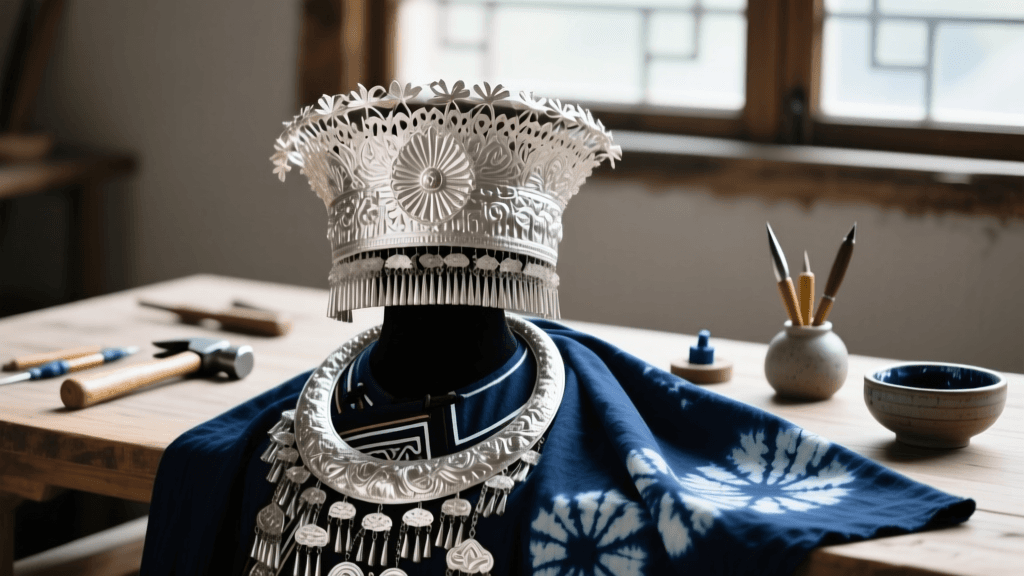
While textiles record history, silver represents wealth, spiritual protection, and social status. In traditional Miao society, a woman's silver dowry could weigh anywhere from 5 to 10 kilograms, comprising elaborate horned headdresses, heavy neck rings, chest locks, and hairpins. The ethnographic records of the Hmong/Miao people highlight how silver is believed to ward off evil spirits and ensure a safe passage in the afterlife.
Types of Silver Ornaments
The most iconic piece is the silver horn headdress, which mimics the shape of water buffalo horns—a symbol of agricultural prosperity. These headdresses are constructed using a combination of repoussé (hammering from the reverse side) and intricate filigree work. Master silversmiths in Shidong village are renowned for their filigree, twisting fine silver wires into the shapes of butterflies, dragons, and birds, which are then soldered onto the main structural base.
How to Verify Authenticity and Understand Pricing
Buying ethnic silver requires a keen eye, as the market is flooded with "Tibetan silver" or "Miao silver" alloys that contain little to no actual silver, often consisting of copper, nickel, and lead.
- Pricing Structure: Authentic Miao silver is priced by weight plus a craftsmanship fee. As of recent market rates, expect to pay the raw silver market price plus an artisan fee of roughly $1.50 to $3.50 USD per gram. A genuine 200-gram silver neck ring will cost a minimum of $300 to $400 USD.
- The Magnet Test: Pure silver is non-magnetic. If a piece is attracted to a strong neodymium magnet, it contains iron or steel and is a fake.
- Hallmarks and Sound: Look for the Chinese characters for pure silver (Zu Yin) or numerical stamps like 990 or 999. Furthermore, when gently tapped, high-purity silver emits a soft, high-pitched, lingering ring, whereas base metals produce a dull thud.
- Weight Verification: Traditional pieces are heavy. A tourist-shop "silver" butterfly hairpin that feels surprisingly light is likely made of aluminum or white metal alloys.
Comparison Chart: Authentic vs. Commercial Pieces
To assist buyers in making informed decisions, the following table contrasts genuine artisan pieces with mass-produced alternatives commonly found in commercial tourist hubs.
| Feature | Authentic Artisan Piece | Mass-Produced Tourist Souvenir |
|---|---|---|
| Batik Dye | Natural fermented indigo (earthy scent, matte) | Synthetic chemical dye (sharp scent, shiny) |
| Batik Pattern | Hand-drawn with beeswax; features "ice-crack" veining | Silk-screened or stamped; perfectly uniform lines |
| Silver Purity | 990 or 999 pure silver; heavy and non-magnetic | Copper/nickel alloy ("Tibetan Silver"); lightweight |
| Silver Technique | Hand-soldered filigree and repoussé; slight asymmetries | Cast in molds; perfectly symmetrical, lacks depth |
| Estimated Cost | $50+ per meter (textile); $300+ (heavy jewelry) | $5 - $15 (textile); $10 - $30 (jewelry) |
Care and Maintenance of Miao Garments and Silver
Owning authentic Miao textiles and silver requires specific care protocols to preserve their integrity and historical value. The natural materials used in their creation react poorly to modern, harsh cleaning methods.
Preserving Indigo Batik
Natural indigo is not entirely colorfast and will bleed, especially during the first few washes. Never wash Miao batik in hot water or use alkaline detergents, which will strip the blue pigment and leave the fabric looking gray and washed out. Instead, hand-wash the garment in cold water with a mild, pH-neutral soap. Adding a half-cup of white vinegar to the final rinse helps set the dye and restores the fabric's pH balance. Always dry the textile flat in the shade; direct ultraviolet sunlight will rapidly degrade natural indigo.
Cleaning Traditional Silver
Miao silver jewelry is often intentionally oxidized in the recesses of the filigree to provide contrast and highlight the intricate details. Commercial silver dips and abrasive polishing cloths will strip this oxidation, leaving the piece flat and blindingly white, which diminishes its aesthetic and cultural value. To clean the high points of the silver without ruining the dark patina in the crevices, use a simple electrochemical bath: line a glass bowl with aluminum foil, add hot water, a tablespoon of baking soda, and a pinch of salt. Submerge the silver for no more than 60 seconds, then rinse with distilled water and pat dry with a microfiber cloth. This method removes sulfur tarnish from the surface without abrasive scrubbing.
"The textiles of the Miao are not merely decorative; they are a complex visual language. Every stitch, every dyed motif, and every silver ornament serves as a testament to a people who carried their history on their backs across mountains and centuries." — Curatorial notes from the Metropolitan Museum of Art's Asian Textile archives.
Conclusion: Investing in Cultural Continuity
Purchasing authentic Miao silver and indigo batik is more than a transaction; it is an investment in the survival of an endangered intangible cultural heritage. By understanding the labor-intensive processes behind natural indigo fermentation and hand-drawn filigree, buyers can confidently bypass mass-produced imitations. Seeking out direct relationships with artisan cooperatives in Guizhou ensures that your acquisition is ethically sourced, fairly compensated, and serves as a genuine piece of Asian wearable history. Whether you are adding a subtle indigo scarf to your wardrobe or acquiring a museum-quality silver hairpin, respecting the craft guarantees that the Miao's wearable archives will endure for generations to come.