Guide to Japanese Fashion Schools & Kimono Apprenticeships 2026
The 2026 Landscape of Japanese Traditional Fashion Education
As we navigate the cultural renaissance of 2026, the intersection of heritage craftsmanship and contemporary design has never been more vibrant. For international students and domestic enthusiasts alike, mastering the art of traditional Japanese garments—such as the kimono, yukata, and hakama—requires navigating two distinct but complementary educational pathways: formal fashion institutions and the ancient artisan apprenticeship system, known as the deshi system. In 2026, the Japanese Ministry of Economy, Trade and Industry (METI) has heavily subsidized traditional craft preservation, leading to a surge in hybrid programs that teach centuries-old techniques like Nishijin-ori weaving and Kyo-Yuzen resist dyeing alongside modern sustainable fashion technologies.
Whether your goal is to launch a heritage-inspired global fashion label or to dedicate your life to becoming a certified shokunin (master artisan), understanding the nuances of Japan's educational landscape is critical. This comprehensive guide breaks down the top institutions, the realities of traditional apprenticeships, and actionable steps for securing your place in the 2026 academic and artisan cohorts.
Premier Fashion Schools for Heritage Garment Studies
Formal education offers a structured environment, access to cutting-edge textile machinery, and internationally recognized degrees. In 2026, several institutions stand out for their dedication to traditional Japanese garments.
Bunka Fashion College (Tokyo)
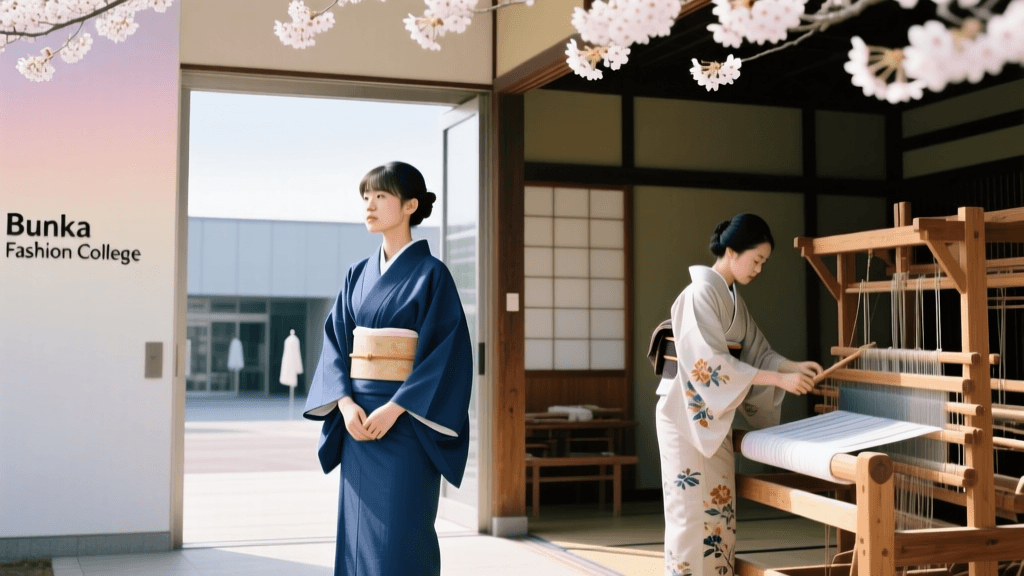
Widely regarded as Asia's premier fashion institution, Bunka Fashion College has expanded its traditional textile curriculum for the 2026 academic year. While globally famous for avant-garde contemporary design, Bunka's Department of Traditional Textiles and Innovation offers a rigorous two-year diploma focusing on the structural engineering of the kimono. Students learn the precise mathematics of the tanmono (traditional bolt of fabric), mastering how straight-line cutting minimizes waste. The 2026 tuition is approximately 1,450,000 JPY per year, which includes access to Bunka's newly renovated digital archiving labs where students study Edo-period garment construction using 3D modeling before cutting physical silk.
Kyoto University of the Arts
Located in the cultural heart of Japan, the Kyoto University of the Arts offers a four-year Bachelor of Arts in Textile Arts. This program is ideal for students who view the kimono not just as a garment, but as a canvas for fine art. The curriculum dives deep into regional dyeing techniques, including the intricate stencil-cutting of Ise-Katagami and the botanical fermentation processes of traditional indigo (aizome). Because Kyoto is the epicenter of the kimono industry, the university leverages strong partnerships with local weaving cooperatives, guaranteeing third-year students a mandatory one-month immersion in a working Nishijin weaving studio.
Kyoto Seika University
Though famous for manga, Kyoto Seika University's Faculty of Fashion and Textiles offers a unique 2026 track focusing on the sociology and pop-culture evolution of traditional garments. Students explore how the kimono has been adapted for modern mobility and global streetwear, making it an excellent choice for those looking to commercialize traditional aesthetics for international markets.
The Traditional Artisan Apprenticeship (Deshi) System
For those who seek absolute mastery over a single, highly specialized craft, the deshi (apprentice) system remains the gold standard. Unlike Western internships, a Japanese apprenticeship is a profound life commitment, often requiring the apprentice to live with or in close proximity to the master (shisho).
Nishijin-ori (Brocade Weaving) Apprenticeships
Nishijin weaving is the pinnacle of Japanese textile production, characterized by its complex, pre-dyed yarn patterns and heavy, luxurious brocades. The Nishijin Textile Center in Kyoto acts as a primary liaison for placing dedicated individuals into multi-year apprenticeships. In 2026, becoming a fully licensed Nishijin weaver requires a minimum five-year commitment. Apprentices spend the first two years solely on loom maintenance, thread preparation, and the meticulous winding of bobbins (itokuri). Only in the third year do they begin to operate the jacquard looms under direct supervision. Financially, apprentices do not pay tuition; instead, they receive a modest monthly living stipend (ranging from 120,000 to 150,000 JPY in 2026), which is enough for basic shared living in Kyoto but requires a frugal lifestyle.
Kyo-Yuzen (Resist Dyeing) Workshops
Kyo-Yuzen involves painting elaborate, multi-colored designs directly onto silk using a rice-paste resist to prevent colors from bleeding. Apprenticeships in Yuzen studios are highly competitive and rely heavily on personal introductions and networking. A master dyer will typically accept only one or two apprentices per decade. The training focuses on the chemistry of natural dyes, the precise application of itome-nori (thread-like paste resist), and the painstaking brushwork required for shading (bokashi). This path is less about garment construction and entirely focused on surface design and textile artistry.
Formal Education vs. Artisan Apprenticeship: A 2026 Comparison
Choosing between a university/fashion school and a traditional workshop depends entirely on your career objectives, financial situation, and visa status. Below is a detailed comparison of the two pathways as they stand in 2026.
| Feature | Fashion School (e.g., Bunka) | Traditional Apprenticeship (Deshi) |
|---|---|---|
| Primary Focus | Garment construction, design theory, industry networking | Mastery of a single, highly specialized craft technique |
| Duration | 2 to 4 Years | 5 to 10 Years for full mastery |
| Financial Cost (2026) | 1,200,000 to 1,600,000 JPY per year (Tuition) | No tuition; receives 120k-150k JPY monthly stipend |
| Visa Accessibility | High (Student Visa easily sponsored by the institution) | Low (Requires Cultural Activities or Designated Activities visa) |
| Language Requirement | JLPT N2 (Some programs offer English support) | JLPT N1 (Fluency and understanding of dialects required) |
| Career Outcome | Fashion designer, brand director, textile consultant | Certified Shokunin, independent artisan, workshop heir |
Financial Aid, Scholarships, and 2026 Visa Pathways
Funding and legal residency are the primary hurdles for international students. In 2026, the Japanese government has expanded the MEXT (Ministry of Education, Culture, Sports, Science and Technology) scholarship to specifically include students pursuing graduate-level research in traditional craft preservation. This highly coveted scholarship covers full tuition and provides a monthly stipend of approximately 145,000 JPY.
For those pursuing the deshi route, securing a visa is more complex. The standard Student Visa does not apply to private, unaccredited workshops. Instead, international apprentices must apply for the 'Cultural Activities' visa, which requires a detailed portfolio, a letter of guarantee from a recognized Living National Treasure (Ningen Kokuho) or a registered cooperative, and proof of sufficient savings to supplement the modest workshop stipend. In 2026, immigration authorities have streamlined the 'Designated Activities' visa for foreign artisans who can prove they are learning a craft designated as an Important Intangible Cultural Property, making the apprenticeship route more accessible than in previous decades.
Actionable Steps for International Applicants
If you are determined to study traditional Japanese garments in 2026, follow this strategic roadmap:
- Achieve JLPT N2 or N1: While some fashion schools offer translation support, the vocabulary of traditional textiles is highly archaic and specialized. Terms like karakusa (arabesque patterns) or shibori (tie-dye) require deep linguistic comprehension. Aim for JLPT N1 if pursuing an apprenticeship.
- Build a Heritage-Focused Portfolio: Admissions committees and master artisans want to see patience and precision. Include hand-sewn samples, detailed sketches of historical garments, and any experience with natural dyeing or hand-weaving in your portfolio.
- Attend the 2026 Tokyo and Kyoto Craft Fairs: Networking is essential for the deshi system. Attend events like the Japan Traditional Crafts Exhibition to meet master artisans in person. A face-to-face introduction, accompanied by a traditional gift and a formal letter of request (nyumon-jou), is often the only way to secure an apprenticeship.
- Research Regional Specialties: Do not limit yourself to Kyoto. Explore apprenticeships in Kanazawa for Kaga-Yuzen dyeing, or Niigata for Ojiya-chijimi linen weaving. Regional cooperatives are often more open to international applicants than the highly insular Kyoto workshops.
Conclusion
The preservation and evolution of Japanese traditional garments in 2026 rely on a new generation of dedicated practitioners. Whether you choose the structured, innovative environment of Bunka Fashion College or the rigorous, silent discipline of a Nishijin weaving studio, the path requires immense dedication. By understanding the distinct educational frameworks, preparing your linguistic skills, and navigating the 2026 visa landscapes, you can successfully immerse yourself in one of the world's most profound sartorial traditions.