Kimono Life Stages Guide 2026: Dressing For Japanese Milestones
The Evolution of the Kimono: A Lifelong Journey
The traditional Japanese kimono is far more than a beautiful garment; it is a wearable calendar, a marker of social status, and a profound reflection of a person’s journey through life. In 2026, while Western clothing dominates daily life in Japan, the kimono remains the undisputed sovereign of major life milestones. The rules governing kimono wearing—often summarized by the acronym TPO (Time, Place, Occasion)—are deeply intertwined with the wearer's age, marital status, and the specific milestone being celebrated.
As we navigate the cultural landscape of 2026, the kimono industry has beautifully balanced centuries-old sartorial rules with modern sensibilities. From eco-conscious rental markets to augmented reality (AR) fitting rooms in Kyoto and Tokyo, the way Japanese people interact with their national dress is evolving. Yet, the core philosophy remains untouched: the length of a sleeve, the placement of a family crest (kamon), and the vibrancy of the dye all communicate exactly where the wearer stands on the timeline of life. This comprehensive guide explores the specific kimono styles designated for every major life stage, offering actionable insights, 2026 market pricing, and cultural context for enthusiasts and travelers alike.
Childhood Milestones: Shichi-Go-San (Ages 3, 5, and 7)
One of the most endearing sights in Japan during November is the Shichi-Go-San (Seven-Five-Three) festival, a traditional rite of passage for children aged three, five, and seven. According to cultural historians and resources like Japan Experience, these ages were historically considered critical developmental thresholds where children were presented to local deities to pray for health and longevity.
Age 3: The Hifu and First Obi
At age three, both boys and girls traditionally wear kimono, though modern 2026 celebrations see girls participating much more frequently. Three-year-old girls wear a standard silk kimono paired with a hifu—a padded, sleeveless vest that covers the obi (sash). The hifu is designed for comfort, ensuring the toddler is not restricted by tight tying. In 2026, rental boutiques report a massive surge in demand for vintage, upcycled hifu sets, reflecting a broader eco-conscious parenting trend in Japan.
Age 5: The First Hakama
Five-year-old boys celebrate by wearing their first hakama (pleated trousers) over a kimono, often adorned with a haori (jacket) featuring the family crest. The ensemble symbolizes the boy's first step into the male societal sphere. Modern parents in 2026 often opt for lightweight, wrinkle-resistant silk blends for active five-year-olds, with rental packages averaging ¥25,000 to ¥40,000 ($170 to $275 USD).
Age 7: The Transition to the Adult Obi
For seven-year-old girls, the milestone marks the transition from the simple, tied cords of childhood to the structured obi worn by adult women. They wear a full-length kimono with an obi-shime (decorative cord) and often carry a shigoki (a decorative silk sash tied below the obi). The motifs are heavily auspicious, featuring pine, bamboo, and plum blossoms to signify resilience and growth.
Coming of Age: Seijin-no-Hi and the Furisode
The transition into adulthood is marked by Seijin-no-Hi (Coming of Age Day). The landscape of this holiday has shifted significantly following Japan's 2022 legal revision that lowered the age of adulthood from 20 to 18. By 2026, a dual-track system has firmly taken root. While 18-year-olds are legally adults, most municipalities still host the grand civic ceremonies for 20-year-olds (now often rebranded as Hatachi no Tsudoi or "Twenty-Year-Old Gatherings") to avoid clashing with high school and university entrance exams.
As detailed in traditional culture guides, the undisputed garment for unmarried young women at these ceremonies is the furisode. The furisode is characterized by its dramatically long, swinging sleeves, which historically served to ward off evil spirits and signal availability for marriage.
Furisode Classifications in 2026
- Oh-Furisode (Large Furisode): Sleeves measuring over 114 cm. This is the most formal and dramatic style, heavily favored for the main 20-year-old civic ceremonies and high-end photography shoots.
- Chu-Furisode (Medium Furisode): Sleeves measuring between 90 cm and 105 cm. This is the most common rental choice in 2026, offering a balance of elegance and physical manageability for all-day wear.
- Ko-Furisode (Small Furisode): Sleeves measuring around 75 cm. Often chosen for 18-year-old localized celebrations or graduation ceremonies (sotsugyoshiki), paired with a hakama.
In 2026, the furisode market has embraced bold, non-traditional color palettes. While classic red and black remain popular, deep jewel tones like emerald green and sapphire blue, often featuring retro-modern Taisho-era geometric patterns, are dominating Tokyo and Kyoto rental catalogs. A comprehensive 2026 furisode rental package—including the garment, professional dressing, hair styling, and studio photography—typically ranges from ¥80,000 to ¥150,000 ($550 to $1,050 USD).
Marriage and Matrimony: Shiromuku and Kurotomesode
Marriage represents the most dramatic sartorial shift in a Japanese woman's life, specifically regarding the kimono's sleeve length and crest placement. The traditional Japanese wedding involves multiple outfit changes, each steeped in Shinto symbolism.
The Bride: Shiromuku and Iro-Uchikake
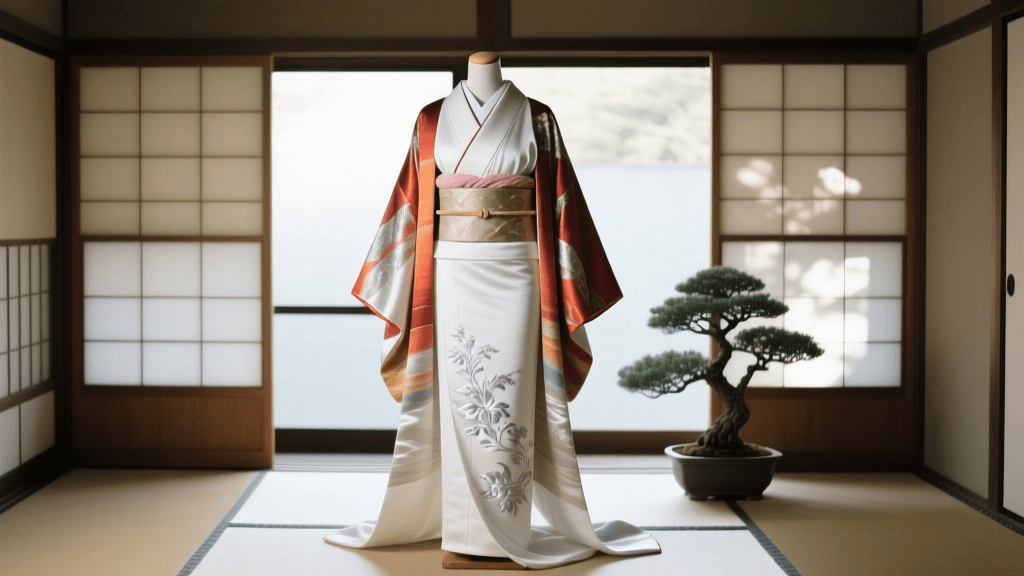
The ceremony begins with the Shiromuku, an entirely pure white ensemble symbolizing the bride's willingness to be "dyed" in the colors of her new family. The white hood (wataboshi) acts as a veil to hide "horns of jealousy" from the gods. Following the vows, the bride changes into an Iro-Uchikake, a heavily padded, brightly colored outer robe worn open over a base kimono. In 2026, while crimson and gold remain standard, boutique designers are seeing high demand for navy and silver uchikake featuring intricate metallic thread embroidery of cranes and peonies.
The Married Guest: Kurotomesode
Once a woman is married, she transitions away from the long-sleeved furisode. If attending a formal wedding as a close relative (such as the mother of the bride or groom), she wears a Kurotomesode. This is a black silk kimono featuring five family crests and a continuous, elaborate pattern (e-ba) that flows across the lower half of the skirt. The sleeves are shortened to the tomesode (cut sleeve) length, signaling her married status and mature elegance.
Middle Age and Elder Elegance: Subdued Sophistication
As Japanese men and women enter their middle and elder years, the kimono aesthetic shifts from vibrant displays of youth to the quiet, refined sophistication known as shibui. The focus moves to the exquisite quality of the textile, the subtlety of the dyeing technique, and the comfort of the weave.
According to the Ministry of Economy, Trade and Industry (METI), the preservation of traditional regional weaving techniques is heavily supported by elder demographics who value heirloom-quality garments. Two styles dominate this life stage:
- Edo Komon: A micro-pattern dyeing technique originating from samurai kamishimo. From a distance, the kimono appears to be a solid, muted color, but up close, it reveals thousands of tiny, intricate dots forming auspicious shapes. It is the pinnacle of understated luxury for formal tea ceremonies and civic events.
- Tsumugi (Pongee): Woven from slubbed silk threads, Tsumugi has a nubby, textured feel that is incredibly comfortable and breathable. While historically considered casual wear, high-end Oshima Tsumugi from Amami Oshima is now a highly coveted, expensive luxury item for elder connoisseurs in 2026, often costing upwards of ¥500,000 ($3,500 USD) for a vintage, authenticated piece.
2026 Kimono Market Data: Milestones and Costs
Understanding the financial and practical aspects of acquiring kimono for these milestones is essential for both locals and international collectors. The table below outlines the standard garments, 2026 market costs, and defining features for each major life stage.
| Life Milestone | Typical Age | Primary Garment | 2026 Avg. Rental/Purchase Cost (USD) | Defining Feature |
|---|---|---|---|---|
| Shichi-Go-San | 3, 5, 7 | Hifu / Hakama | $170 - $400 (Rental) | Padded vests, first pleated trousers |
| Coming of Age | 18 or 20 | Furisode | $550 - $1,050 (Rental Package) | Long swinging sleeves, vibrant motifs |
| Wedding (Bride) | 20s - 30s | Shiromuku / Iro-Uchikake | $2,000 - $5,000+ (Purchase/Rental) | Pure white silk, heavy embroidery |
| Wedding (Relative) | 40s - 60s | Kurotomesode | $300 - $600 (Rental) | Black silk, 5 crests, lower-hem pattern |
| Elder/Tea Ceremony | 60+ | Edo Komon / Tsumugi | $800 - $3,500+ (Purchase) | Micro-patterns, slubbed silk texture |
Modern Preservation and AR Try-Ons in 2026
The kimono industry in 2026 is not merely relying on nostalgia; it is leveraging cutting-edge technology to ensure these traditions survive. One of the most significant hurdles to kimono adoption is the physical difficulty of trying on multiple layers. Today, flagship boutiques in Kyoto's Gion district and Tokyo's Ginza utilize advanced Augmented Reality (AR) mirrors. These systems allow customers to virtually "try on" dozens of furisode and tomesode combinations, adjusting obi colors and crest placements in real-time before committing to a physical fitting. This technology has increased rental conversion rates by over 40% among younger demographics.
Furthermore, the preservation of heirloom silk has become a high-tech endeavor. Climate-controlled, nitrogen-flushed storage vaults are now offered by specialized logistics companies in Japan, protecting vintage Shichi-Go-San and wedding kimono from humidity, mold, and the dreaded "yellowing" of aged silk. For the global enthusiast, understanding these life stages provides a profound lens through which to view Japanese culture. The kimono is not a static costume frozen in the Edo period; it is a living, breathing companion that grows, adapts, and matures alongside the person wearing it.