Japanese Festival Costumes: The Awa Odori Dance Guide
The Art of Movement: Understanding Matsuri Performance Wear
Japanese traditional clothing is globally revered for its elegance, structure, and deep cultural symbolism. However, when the summer heat rises and the rhythmic beats of the shamisen and taiko drums echo through the streets, the rigid formality of the silk kimono gives way to the dynamic, breathable, and vibrant world of matsuri (festival) performance wear. Unlike formal garments designed for quiet tea ceremonies or shrine visits, festival costumes are engineered for extreme physical exertion, high kicks, and hours of continuous dancing.
Among the myriad of Japanese summer festivals, the Awa Odori in Tokushima Prefecture stands as the pinnacle of festival dance. Attracting over a million spectators and tens of thousands of dancers, the Awa Odori requires specialized costuming that balances historical authenticity with athletic functionality. According to the Awa Odori Kaikan, the festival's official cultural center, the garments worn by the ren (dance troupes) are meticulously chosen to enhance the visual spectacle while accommodating the dance's vigorous choreography.
Women's Awa Odori Costumes: Yukata, Obi, and Amigasa
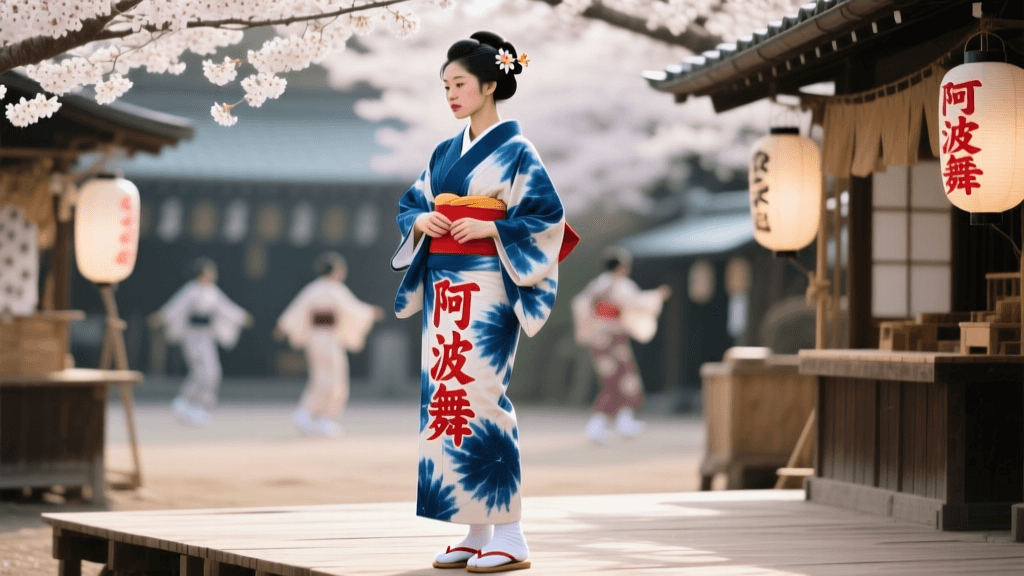
The female Awa Odori costume is a masterclass in adapting the traditional yukata (summer cotton kimono) for high-energy performance. While a standard yukata is worn with the hem resting gracefully at the ankles, the dance yukata is worn significantly shorter, often hemmed or tucked at the mid-calf. This alteration serves two purposes: it prevents the dancer from tripping during the intricate footwork, and it highlights the striking wooden geta clogs and the dancer's precise leg movements.
Fabric and Dyeing Techniques
Performance yukata are almost exclusively crafted from 100% cotton or advanced cotton-polyester blends. Traditional troupes favor aizome (natural indigo dye). Historically, indigo was prized not just for its beautiful deep blue hue, but for its practical properties: it naturally repels insects and masks the scent of perspiration. Modern performance troupes often use chugata (medium-sized patterns) or bold geometric designs that create a mesmerizing, blurred visual effect when the dancers spin and leap.
The Obi and Tying Techniques
Securing a yukata for dance requires specialized knotting. The standard taiko musubi (drum knot) used in formal wear is far too bulky and restrictive. Instead, female dancers use a hanhaba obi (half-width sash) or a specialized thin sash tied in a karamage or a compact bow. The tying process involves an exaggerated ohashori (the fold at the waist), which acts as a shock absorber and allows the dancer to adjust the hem length dynamically. The Japan National Tourism Organization (JNTO) notes that the vibrant colors of the obi and the accompanying koshihimo (tying cords) are often coordinated to represent the specific ren (troupe) colors.
Headwear and Accessories
The iconic amigasa (woven straw or rattan hat) is a staple of the female Awa Odori costume. Worn tilted low over the eyes, it adds an air of mystery and elegance, hiding the dancer's exertion while framing the face. Dancers also carry uchiwa (rigid fans) or suzu (bells), using them as extensions of their arms to create sweeping, synchronized visual lines across the dance troupe.
Men's Awa Odori Costumes: Happi, Tobis, and Tenugui
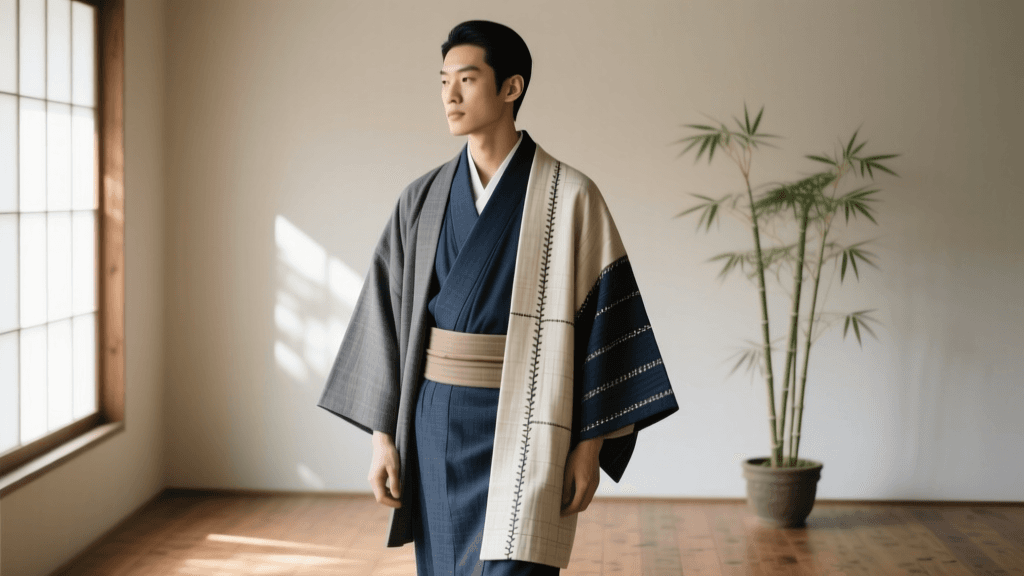
While women traditionally dance in yukata, the male Awa Odori costume is characterized by its rugged, athletic, and uninhibited style. Men typically wear a happi coat or a short, informal yukata paired with specialized trousers or shorts, prioritizing maximum range of motion for the dance's deep squats and high leaps.
The Happi Coat and Tobi Trousers
The happi is a lightweight, straight-sleeved coat bearing the crest or kanji of the dancer's troupe on the back. For Awa Odori, the happi is often worn open or loosely tied, exposing the chest and allowing for maximum ventilation. Beneath the happi, men wear tobi trousers—baggy pants that taper tightly at the calves—or simple cotton shorts. This silhouette emphasizes the low-to-the-ground, grounded stomping that characterizes the male dance style.
The Tenugui: More Than Just a Towel
No male festival costume is complete without the tenugui, a versatile rectangular cotton cloth. In daily life, it is a hand towel, but in performance, it is intricately wrapped around the head in styles like the hachimaki (headband) or zukin (hood). The tenugui absorbs sweat, keeps hair out of the eyes, and serves as a canvas for troupe branding. The wrapping technique must be secure enough to withstand violent head-shaking movements without unraveling.
Footwear for Performance: Geta vs. Jikatabi
Footwear is arguably the most critical component of any Japanese festival costume, directly impacting the dancer's stamina, balance, and acoustic contribution to the performance.
- Geta (Wooden Clogs): Worn primarily by women in Awa Odori, geta feature elevated wooden teeth and cotton hanao (thongs). The clacking sound of hundreds of geta striking the pavement in unison is the auditory heartbeat of the festival. Dancers must train for months to build the calf strength required to dance in geta without blistering.
- Jikatabi (Split-Toe Boots): Men, and increasingly women in modern or fusion troupes, wear jikatabi. These rubber-soled, split-toe boots provide excellent grip on asphalt and concrete. The separation of the big toe enhances balance and allows the dancer to grip the ground during deep lunges. As noted by Japan's Agency for Cultural Affairs, the evolution of traditional footwear like the jikatabi perfectly illustrates how functional workwear became integrated into festival and performance traditions.
Practical Guide: Sizing, Fitting, and Budgeting
For international enthusiasts, theater groups, or cultural festival participants looking to source authentic Japanese performance wear, understanding measurements and budgeting is essential. Unlike Western clothing sized by S/M/L, traditional garments are measured in centimeters.
Key Measurements for Dance Yukata
- Mitake (Back Length): Measure from the base of the neck (the prominent vertebra) down to the desired hemline. For dance, subtract 10-15 cm from your standard ankle-length measurement to achieve the mid-calf look.
- Yuki (Sleeve Length): Measure from the center of the back of the neck, across the shoulder, and down to the wrist. Festival yukata often feature slightly shorter yuki (around 65-70 cm) to prevent the sleeves from catching on accessories or other dancers during wide arm sweeps.
- Katahaba (Shoulder Width): Crucial for happi coats to ensure the mon (crest) sits perfectly centered on the back.
Costume Comparison and Budgeting Table
| Garment / Accessory | Primary Wearer | Material | Estimated Cost (USD) | Performance Function |
|---|---|---|---|---|
| Dance Yukata | Women | Cotton / Poly-blend | $45 - $150 | Breathability, visual flow |
| Happi Coat | Men / Unisex | Cotton Sashiko / Twill | $35 - $90 | Troupe identification, ventilation |
| Jikatabi (Boots) | Men / Unisex | Cotton upper, Rubber sole | $40 - $85 | Grip, balance, foot protection |
| Geta (Clogs) | Women | Paulownia wood, Cotton | $30 - $120 | Acoustic rhythm, posture |
| Amigasa (Hat) | Women | Woven Rattan / Straw | $25 - $60 | Sun protection, aesthetic framing |
| Tenugui (Towel) | Men / Unisex | Woven Cotton | $10 - $25 | Sweat absorption, head securing |
Caring for Your Festival Garments
Performance garments endure immense stress, heavy perspiration, and friction. Proper care ensures their longevity. Cotton yukata and happi coats should be hand-washed or machine-washed on a gentle cycle using cold water and a neutral pH detergent to preserve indigo and vibrant synthetic dyes. Never use bleach. Roll the garment in a dry towel to press out excess water, then hang it in the shade; direct sunlight will rapidly fade traditional dyes.
For geta, wipe the wooden base with a slightly damp cloth and allow it to air dry away from heat sources, which can crack the wood. The cotton hanao thongs can be detached and hand-washed. Jikatabi should be aired out immediately after use; many modern versions feature antimicrobial linings, but inserting cedar shoe trees helps maintain their shape and absorb lingering moisture.
Conclusion
Japanese festival costumes are not merely static museum pieces; they are living, breathing tools of performance. From the meticulously tucked hems of the Awa Odori yukata to the rhythmic clacking of wooden geta, every element of matsuri wear is designed to elevate the human body in motion. Whether you are preparing to join a local Bon Odori circle, staging a theatrical performance, or simply seeking to understand the functional brilliance of Asian traditional garments, mastering the nuances of festival wear opens a vibrant window into Japan's dynamic cultural heritage.