Eco-Friendly Japanese Natural Dye Plants: Aizome Guide 2026
The 2026 Resurgence of Kusaki-Zome (Plant Dyeing)
As the global fashion industry faces mounting pressure to abandon toxic synthetic chemicals and petroleum-based dyes, the ancient Japanese art of kusaki-zome (plant dyeing) has experienced a massive renaissance in 2026. No longer relegated to niche artisan studios, traditional Japanese natural dye plants are now at the forefront of the sustainable textile movement. Modern designers and eco-conscious consumers are increasingly turning to heritage techniques that prioritize soil health, water conservation, and biodegradable inputs. This guide explores the most prominent eco-friendly Japanese natural dye plants—specifically Aizome (indigo) and Kakishibu (persimmon tannin)—and details the cutting-edge, closed-loop methods defining the craft in 2026.
Aizome: Persicaria Tinctoria and the Sukumo Revolution
At the heart of Japan's natural dyeing tradition is Aizome, the iconic deep blue dye derived from the leaves of Persicaria tinctoria (Japanese indigo). Unlike synthetic indigo, which is derived from petrochemicals and requires harsh reducing agents like sodium hydrosulfite to become water-soluble, traditional Japanese indigo relies on a meticulous biological fermentation process. The cornerstone of this process is sukumo, the composted, fermented indigo leaves.
In 2026, the cultivation and processing of sukumo have become a model for regenerative agriculture. Heritage farms in Tokushima and Saitama prefectures are utilizing crop rotation, organic composting, and natural pest management to grow Persicaria tinctoria without synthetic fertilizers. Farms like Buaisou have pioneered a 'seed-to-garment' philosophy, proving that indigo farming can actually restore soil microbiome health. The fermentation process itself is a masterclass in zero-waste biology: the harvested leaves are dried, shredded, and then composted in specialized stone beds. Over 120 days, artisans carefully water and turn the piles, allowing naturally occurring bacteria to break down the plant matter and concentrate the indican (the precursor to indigo pigment). The resulting sukumo is a living, breathing dye material that nourishes the skin and possesses natural antibacterial properties.
As of 2026, premium organic sukumo retails for approximately $55 to $75 per 100 grams, reflecting the intensive labor and agricultural expertise required. However, its yield and colorfastness make it a highly cost-effective investment for sustainable fashion labels looking to achieve the coveted 'Japan Blue' without environmental degradation.
Kakishibu: Upcycling Persimmon Waste for Textile Strength
While indigo provides color, Kakishibu provides structural integrity. Kakishibu is a dark, tannin-rich liquid extracted from unripe, astringent persimmons (Diospyros kaki). Historically used to waterproof paper, treat wood, and strengthen fishing nets, Kakishibu has found a vital role in 2026's eco-friendly textile landscape.
The extraction process is a brilliant example of agricultural upcycling. Unripe persimmons that are unsuitable for the culinary market are crushed, pressed, and fermented in large cedar vats for two to three years. The resulting tannin acts as a natural bio-resin. When applied to cellulose fibers like cotton, hemp, or linen, Kakishibu binds to the molecular structure of the plant, dramatically increasing the fabric's tensile strength, water resistance, and UV protection. Furthermore, when fabrics dyed with Kakishibu are exposed to sunlight, the tannins oxidize and polymerize, shifting the color from a pale yellowish-brown to a rich, deep mahogany. This solar-curing process requires zero additional thermal energy, making it an incredibly low-carbon finishing method for sustainable garments.
Comparison: Traditional vs. 2026 Eco-Friendly Dyeing Inputs
The transition from mid-20th-century industrial dyeing to the 2026 sustainable standard is best understood by comparing the chemical inputs and waste management strategies. Below is a breakdown of how modern eco-studios have optimized traditional Japanese methods.
| Category | Conventional / Industrial Dyeing | 2026 Sustainable Kusaki-Zome |
|---|---|---|
| Indigo Reduction | Sodium Hydrosulfite (toxic, depletes oxygen in waterways) | Organic Fructose, Henna, or Sukumo Fermentation (100% biodegradable) |
| Alkali Source | Sodium Hydroxide (Lye - highly caustic) | Calcium Hydroxide (Slaked Lime) or Wood Ash Lye (gentler, mineral-rich) |
| Mordants | Heavy metals (Chrome, Tin, Copper) | Bio-mordants (Symplocos, Pomegranate, Soy Milk, Potassium Alum) |
| Water Management | Single-pass discharge into municipal sewage | Closed-loop biochar filtration and reed-bed settling systems |
| Textile Finishing | Fluorocarbon DWR (forever chemicals) | Kakishibu (Persimmon Tannin) and natural plant waxes |
Closed-Loop Water Systems and Bio-Mordants
Water consumption and heavy metal pollution have historically been the Achilles heel of textile dyeing. In 2026, sustainable Japanese dye studios utilize closed-loop water systems to ensure that not a single drop of contaminated water leaves the premises. After an indigo vat reaches the end of its life cycle, the alkaline, nutrient-rich liquid is not discarded. Instead, it is routed through biochar filtration beds and neutralized with organic acids (like fermented rice water or citrus extracts) before being used to irrigate non-edible botanical gardens or reed beds that naturally filter out residual organic compounds.
Similarly, the use of heavy metal mordants—which fix dyes to fibers but cause severe neurological and environmental toxicity—has been entirely phased out by eco-conscious artisans. According to natural dye educators at Botanical Colors, the modern standard relies on bio-mordants. Symplocos, a plant whose leaves naturally accumulate alum from the soil, is boiled to create a highly effective, completely non-toxic mordant bath. Soy milk is also widely used to protein-coat cellulose fibers, allowing them to bond permanently with plant dyes without the need for metallic salts.
Step-by-Step: Building a Sustainable Fructose Indigo Vat
For artisans, designers, and hobbyists looking to adopt these eco-friendly methods at home or in small studios, creating an organic indigo vat is highly accessible in 2026. The '1-2-3 Fructose Vat' is the gold standard for non-toxic, chemical-free indigo reduction. Here is how to prepare a 5-gallon (approx. 19-liter) sustainable vat:
- Ingredients: 50g of high-quality natural indigo pigment (or 200g of wet sukumo extract), 100g of calcium hydroxide (slaked lime), and 150g of organic fruit fructose powder.
- Step 1: The Paste. In a small stainless steel pot, combine the indigo pigment with a small amount of warm water and rubbing alcohol (or high-proof vodka) to break the surface tension. Muddle it into a smooth, lump-free paste.
- Step 2: The Alkali. Fill your 5-gallon dye pot with warm water (120°F / 50°C). Sprinkle the calcium hydroxide over the surface and stir gently. The water will become cloudy and highly alkaline (pH 11-12).
- Step 3: The Reduction. Stir in the organic fructose. The fructose acts as the reducing agent, consuming the dissolved oxygen in the water and converting the insoluble blue indigo into soluble leuco-indigo (which is yellow-green).
- Step 4: The Rest. Add your indigo paste, stir gently to avoid introducing new oxygen, cover the pot tightly, and wrap it in thermal blankets. Let it rest for 24 to 48 hours.
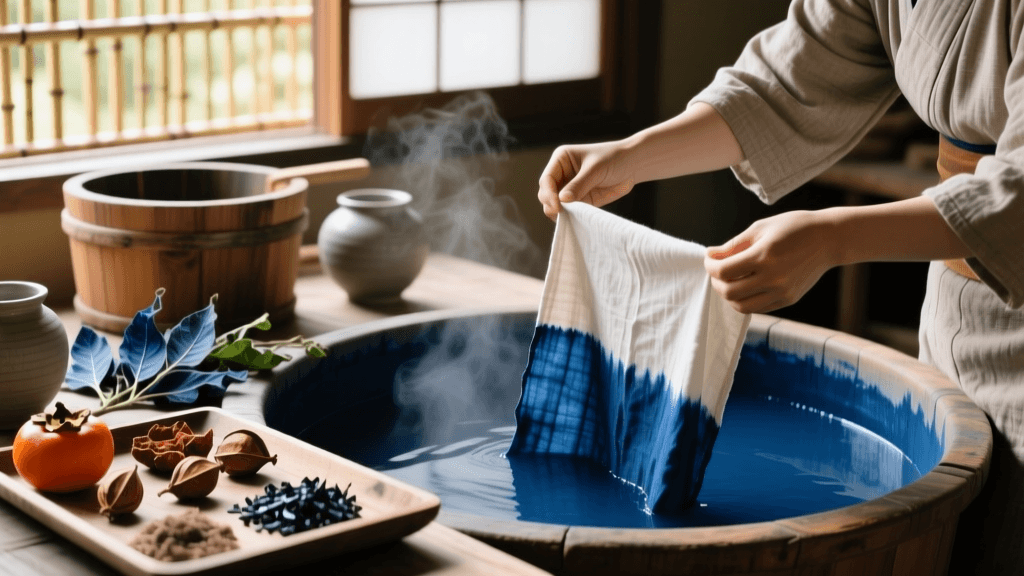
- Step 5: Dyeing. Once the liquid is a clear amber-yellow with a dark, coppery 'flower' (foam) on top, it is ready. Submerge pre-scoured, wet fabric slowly, massage it under the surface for 5 minutes, and remove. As the fabric meets the oxygen in the air, it will magically oxidize from yellow to green, and finally to a deep, permanent blue.
The Future of Japanese Textile Sustainability
The integration of ancient Japanese botanical knowledge with modern ecological science represents a vital pathway forward for the fashion industry. Aligning with the circular economy frameworks championed by the Ellen MacArthur Foundation, the 2026 approach to kusaki-zome proves that luxury, durability, and environmental stewardship are not mutually exclusive. By supporting regenerative indigo farms, utilizing zero-waste persimmon tannins, and strictly adhering to closed-loop water management, today's artisans are ensuring that the vibrant legacy of Japanese natural dyeing will endure for centuries to come, without costing the earth.