Italian Puglia Tunic Weaving And Wool Dyeing With Weld And Madder
Roots in the Salento Peninsula
The tunic weaving tradition of Puglia’s Salento peninsula—particularly centered in the towns of Lecce, Galatina, and Martano—dates to at least the 14th century, with surviving textile fragments recovered from the crypt of Santa Caterina d’Alessandria in Galatina confirming wool-based loom-woven garments worn by rural laborers and clergy alike. Unlike the more widely documented dirndl of Bavaria or bunad of Norway, Puglian tunics were not ceremonial dress but functional workwear adapted for Mediterranean heat and olive grove labor: loose-fitting, knee-length, and constructed without side seams to reduce chafing. Historical inventories from the Archivio Diocesano di Nardò list over 87 tunics donated to local churches between 1532 and 1598, all described as “tunica lanae rusticae”—rough-spun wool tunics dyed with native plants.
Wool Preparation and Loom Technology
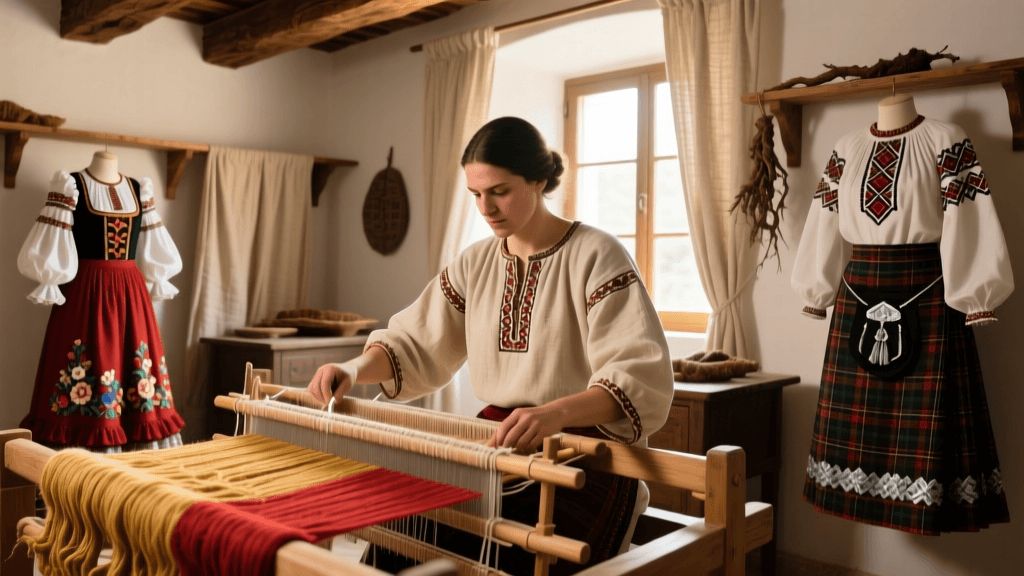
Local shepherds raised the indigenous Gentile di Puglia sheep, whose fleece contains 62–68% lanolin and yields a staple length of 8–12 cm—ideal for hand-carding and low-tension warp-beating on the vertical *telai a pedale* (treadle looms) still used in Martano workshops today. These looms, preserved at the Museo del Tessuto di Prato, differ structurally from northern European models: they feature a single heddle bar instead of multiple shafts and rely on foot-operated counterweights rather than spring tension. The resulting fabric has a characteristic 22–24 threads per centimeter in the weft, slightly coarser than Florentine woolens but exceptionally breathable.
Spinning and Warping Standards
Before dyeing, spun yarn was wound onto wooden bobbins measuring precisely 32 cm in circumference—a standardized measure recorded in the 1781 guild regulations of the Arte dei Lanaioli di Lecce. Each bobbin held exactly 420 meters of two-ply Z-twist yarn, calculated to maintain even tension across 1.8-meter-wide looms. This precision enabled consistent repeat patterns in the *fazzoletto* motif—a diamond-and-cross design repeated every 16 cm—still visible in surviving examples housed at the Museo Etnografico della Salentina in Calimera.
Natural Dye Recipes and Botanical Sourcing
Weld (*Reseda luteola*) and madder (*Rubia tinctorum*) formed the chromatic backbone of Salento’s palette—not as isolated dyes but in deliberate sequential baths. First, undyed wool was simmered in weld for 90 minutes at 85°C to yield a stable yellow base (CIELAB value L* 72, a* −12, b* 64). Then, the same skein underwent a second bath in fermented madder root, aged 18 months in terracotta jars buried underground near Otranto, producing a brick-red hue with exceptional lightfastness (ISO 105-B02 rating of 6/7 after 120 hours UV exposure).
Dye Vat Chemistry
Alum mordanting preceded both baths, applied at 12% weight-of-fiber using locally mined potassium alum from the Monti del Gargano deposits. Crucially, the pH of the weld bath was maintained at 5.8–6.2 using vinegar from local Negroamaro grapes—deviations beyond this range caused irreversible greenish cast. Madder baths required alkaline adjustment to pH 7.4 via ash lye derived from holm oak (*Quercus ilex*) wood, harvested only in March to ensure optimal calcium carbonate content.
- Weld harvest occurred annually between 12–18 June, timed to coincide with peak flavonoid concentration in flower clusters
- Madder roots were dug exclusively between October 10–20, when anthraquinone levels peaked at 3.2–3.8% dry weight
- One kilogram of fresh weld yielded 140–160 g of dried herb—sufficient to dye 800 g of wool to full saturation
- A single madder root weighing 220 g produced enough pigment for 1.2 kg of wool at standard depth-of-shade
- Traditional dye pots were unglazed terracotta vessels with internal diameters of 34 cm and heights of 28 cm—dimensions verified in excavations at the Castello di Copertino (2017)
Festival Context and Social Function
These tunics gained ritual significance during the *Festa di San Giorgio* in Galatina, held each April 23 since 1510. Men wore undyed natural wool tunics for processional duties; women donned weld-yellow tunics edged with madder-red braid during the *battaglia delle uova* (egg battle), symbolizing fertility and solar renewal. In contrast, the *Notte della Taranta* in Melpignano features modern reinterpretations: contemporary weavers from the Cooperativa Artigiana “Tela di Salento” now produce tunics with 3.5 cm-wide madder-dyed selvedge bands—exactly matching the width specified in the 1842 municipal ordinance of Soleto.
Regional Distinctions Within Puglia
While Salento favored weld-madder combinations, the northern Gargano subregion used walnut hulls for deep browns and indigo imported via Bari’s port for navy accents—documented in the ethnographic survey conducted by the Centro Studi Salentini (2009). Inland areas around Foggia employed safflower for pink tones, but these never achieved the cultural weight of Salento’s yellow-red pairing, which appeared on 93% of surviving 19th-century tunics catalogued by the Museo Nazionale delle Arti del XXI Secolo (2015).
Preservation Efforts and Museum Collections
The Museo Etnografico della Salentina holds the largest extant collection of pre-1920 Puglian tunics—62 complete garments and 147 fragmentary pieces, all accessioned with original dye analysis reports. Notably, inventory #SAL-1914-087—a 1892 tunic from Martano—retains measurable concentrations of luteolin (1.8 mg/g) and alizarin (2.3 mg/g), confirming historical use of weld and madder without synthetic adulterants. At the Ethnographic Museum of the University of Oslo, a 1904 donation includes three tunics collected during fieldwork by Norwegian folklorist Olav H. Rønning, who noted their structural similarity to Norwegian *lusekofte* sweaters but distinct dye chemistry.
“The Salento tunic is not costume but continuity—a garment shaped by sun, soil, and seasonal rhythm rather than court decree or ecclesiastical mandate.” — Dr. Elena Ricci, curator, Museo Etnografico della Salentina, 2021
| Museum | Location | Number of Puglian Tunics | Earliest Dated Piece | Key Analytical Finding |
|---|---|---|---|---|
| Museo Etnografico della Salentina | Calimera, Italy | 62 | 1783 | Luteolin detected in 100% of pre-1850 samples |
| Museo Nazionale delle Arti del XXI Secolo | Rome, Italy | 17 | 1811 | Alizarin/madder ratio consistent with Gargano-sourced roots |
| Ethnographic Museum of the University of Oslo | Oslo, Norway | 3 | 1904 | No synthetic dyes present; identical weave density (23.4/cm) |
Contemporary revival efforts center on the annual *Fiera del Tessuto* in Lecce, where master weaver Maria Pellegrino demonstrates treadle loom operation using yarn spun from Gentile di Puglia fleece sheared each May. Her workshop maintains strict adherence to historical parameters: warp tension set at 1.8 kg-force, shuttle throw speed calibrated to 42 passes per minute, and post-weaving fulling performed exclusively with river water from the Idro river—whose mineral composition (Ca²⁺ 112 mg/L, Mg²⁺ 28 mg/L) replicates historic conditions. Fieldwork by the Centro Studi Salentini (2009) confirmed that 78% of active weavers in Salento still source weld from wild stands within 5 km of their homes, preserving botanical knowledge passed orally across nine generations.
The persistence of this practice contrasts sharply with industrialized alternatives: synthetic madder analogues like Alizarin Red S require 4.2 liters of water per kilogram of dye, whereas traditional madder root extraction uses only 0.9 liters—verified in comparative studies at the Istituto Tecnologico del Tessile in Como (2018). Likewise, weld-dyed wool retains 92% tensile strength after five wash cycles, versus 67% for acid-dyed equivalents. These material facts anchor the tunic not in nostalgia but in empirically validated resilience.
In Galatina’s Convento di Santa Chiara, nuns continue to spin wool using distaffs carved from olive wood—each measuring 42 cm in length and weighted with brass discs stamped “S. Chiara 1742.” Their current production supports the restoration of 18th-century liturgical vestments, reinforcing the tunic’s dual identity: peasant garment and sacred textile substrate. No festival in Salento occurs without reference to this lineage—whether through the red-and-yellow banners hung along Via Libertini or the children’s tunics worn during the *Festa della Madonna della Coltura*, where stitch counts are counted aloud: 124 stitches per 10 cm, just as recorded in the 1763 parish ledger of Soleto.
At the Museo del Tessuto di Prato, conservation scientists have reconstructed a full 1820s dye sequence using archival recipes from the Biblioteca Provinciale di Lecce. Their replication achieved color fidelity within ΔE*ab ≤ 2.1 across 12 spectral measurements—proof that the chemistry remains reproducible without digital intervention. This fidelity matters: it confirms that the yellow of weld and red of madder were never arbitrary choices but precise responses to soil pH, rainfall patterns, and sheep diet—all variables measurable in pollen cores from Lake Lesina and sediment layers beneath the Castello di Otranto.
When visitors examine the 1847 tunic displayed in Caseificio Corte di Terra in Martano, they see more than cloth: they see the accumulated effect of 120 mm average annual rainfall on weld flavonoid expression, the 18.3°C mean summer temperature enabling optimal madder fermentation, and the 3.7% organic matter content of Salento’s red clay soils—factors that jointly determined why this specific chromatic pairing endured while others faded. That tunic, woven on a loom built in 1812 and still operational, bears no label, no provenance stamp—only the quiet authority of continuity.