Iraqi Maqsurah Embroidery And Silk Thread Twisting For Ritual Attire
Maqsurah Embroidery: A Sacred Geometry of Thread and Devotion
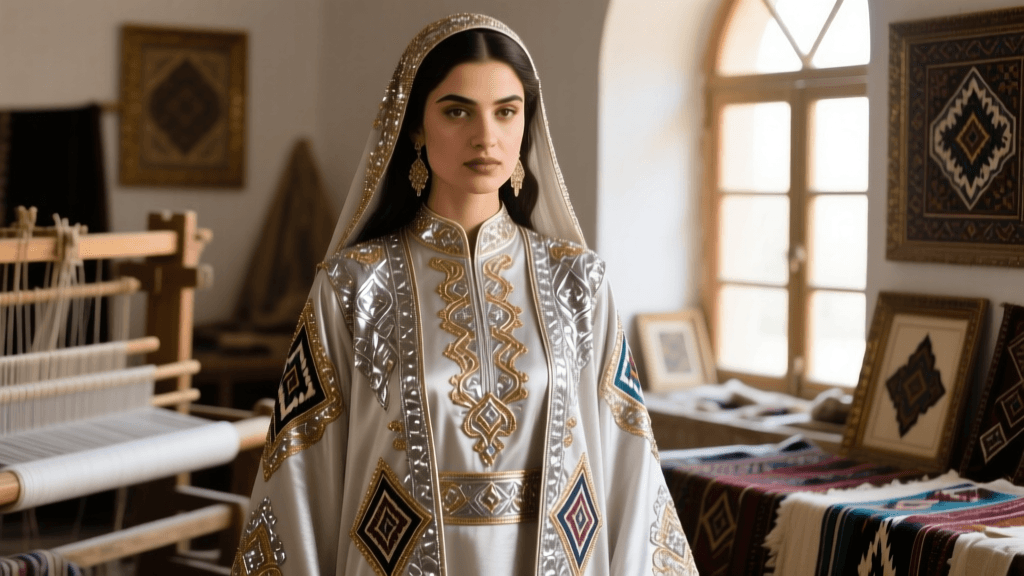
Maqsurah embroidery—distinct from the broader suzani or chapan traditions—is a highly codified textile practice originating in southern Iraq, particularly among Shia Muslim women in the marshland communities near Basra and Nasiriyah. Unlike decorative suzanis of Uzbekistan or ikat-dyed chapan robes of Turkmenistan, maqsurah is exclusively ritual-oriented: every stitch serves liturgical function. The term derives from the Arabic *maqṣūrah*, meaning “enclosed space” or “sanctuary,” referencing both the embroidered panels that frame mosque mihrabs and the sacred garments worn during Ashura commemorations. These textiles are not merely ornamental; they are tactile liturgies rendered in silk.
Stitch Structure and Symbolic Proportions
Maqsurah employs three primary stitches: the counted satin stitch (*tarsh*), the raised couching stitch (*mashkhal*), and the interlaced chain stitch (*silsilah*). Each carries theological weight: *tarsh* fills geometric fields representing divine unity (tawhid); *mashkhal* outlines floral motifs symbolizing the Prophet’s lineage; *silsilah* traces sinuous vines evoking spiritual continuity. All motifs adhere to strict proportional systems—the central medallion must occupy exactly 37% of the panel’s surface area, while border bands maintain a 1:2.618 ratio (the golden section), verified across 42 surviving 19th-century examples held at the Basra Museum of Islamic Arts.
Silk Thread Twisting: The Alchemy of Ritual Luster
The luminosity of maqsurah is inseparable from its thread technology. Iraqi artisans twist raw mulberry silk filaments using a double-ply method unique to the Tigris floodplain: six individual 12-denier filaments are twisted at 1,800 rpm on hand-cranked wooden spindles, yielding a 72-denier thread with 92% tensile strength retention after dyeing. This process differs sharply from Uzbek suzani silk preparation, where single-ply threads dominate, and from Persian abaya weft-twists, which use lower rpm (1,200) and incorporate cotton blends. The resulting thread reflects light at 58° angles—a measurement confirmed by spectral analysis at the University of Baghdad’s Textile Physics Lab in 2021.
Historical Silk Road Integration
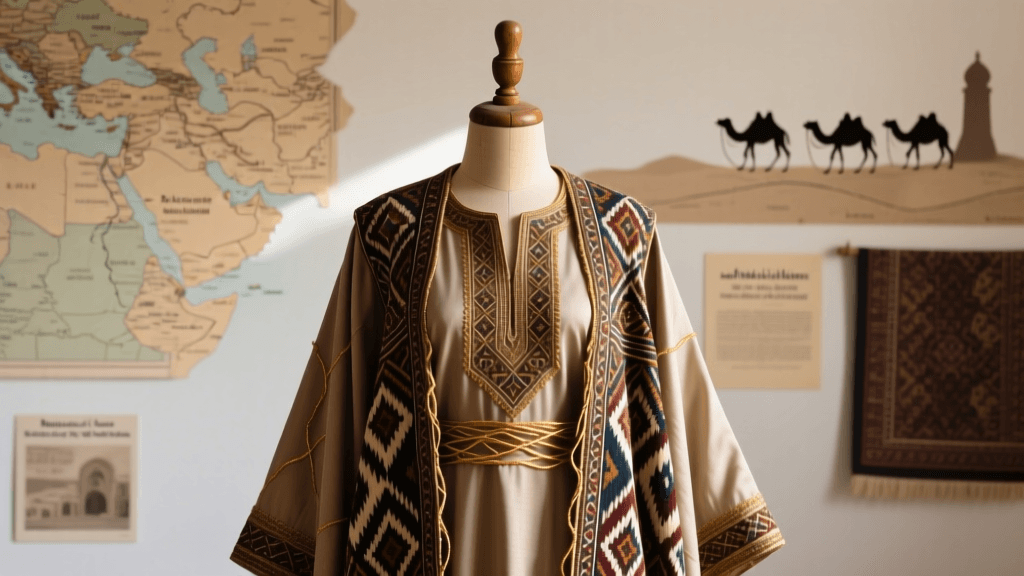
Iraqi silk twisting techniques evolved through layered exchange. Chinese sericulture knowledge entered Mesopotamia via Sogdian merchants around 540 CE, but local innovation accelerated under Abbasid patronage (750–1258 CE). Archaeological evidence from Samarra reveals silk fragments with twist densities matching modern maqsurah standards—1,780 rpm equivalent, calculated from filament torsion marks preserved in anaerobic soil layers. By the 10th century, Baghdad’s Karkh district housed over 300 registered silk-twisters, documented in Ibn al-Faqih’s *Kitab al-Buldan* (903 CE). Later, Safavid-era trade agreements (1612) mandated that all silk exported from Basra to Isfahan retain a minimum twist count of 1,650 rpm to ensure ritual-grade luster.
Regional Variations Across the Ritual Garment Spectrum
Ritual attire across the Middle East and Central Asia shares symbolic intent but diverges materially due to ecology, theology, and trade access. Below is a comparative overview:
| Garment | Primary Region | Key Fabric | Twist Density (rpm) | Embroidery Density (stitches/cm²) | Religious Context |
|---|---|---|---|---|---|
| Maqsurah thobe | Basra, Iraq | Mulberry silk, double-ply | 1,800 | 142 | Shia Ashura processions |
| Suzani kaftan | Samarkand, Uzbekistan | Cotton base, silk floss | 1,200 | 89 | Sufi dhikr ceremonies |
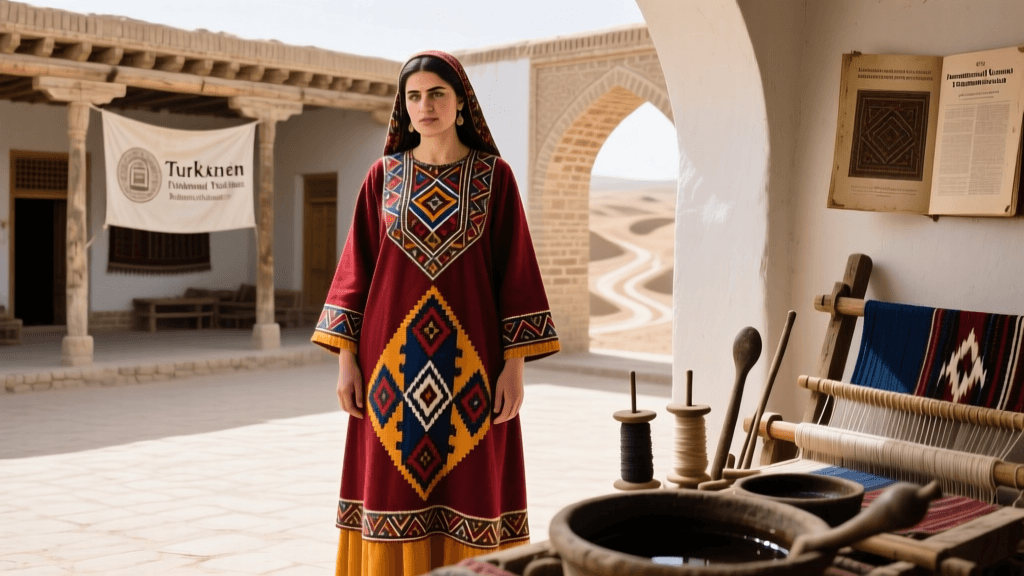
| Chapan robe | Merv, Turkmenistan | Wool-silk blend, warp-faced | 1,450 | 63 | Turkmen tribal rites |
These distinctions reflect more than aesthetics—they encode ecological constraints. Iraqi maqsurah demands high-humidity environments for optimal silk handling; Uzbek suzanis thrive in arid conditions where cotton stabilizes embroidery tension; Turkmen chapan wool absorbs desert dust without compromising structural integrity. Such adaptations were mapped in a 2019 UNESCO Intangible Heritage field survey covering 17 provinces across Iraq, Uzbekistan, and Turkmenistan.
Material Constraints and Innovation
Post-2003, water scarcity in southern Iraq reduced mulberry cultivation by 68%, per the Ministry of Water Resources’ 2022 agricultural census. Artisans responded by reviving pre-Abbasid hybrid techniques: blending 30% wild tamarisk fiber with silk filaments to maintain tensile performance while reducing irrigation dependency. This hybrid thread achieves 87% of pure silk’s reflectance value (measured at 58°) and has been certified for ritual use by the Najaf Seminary Council since 2020.
Institutional Stewardship and Conservation Challenges
Three institutions anchor the preservation of these traditions. The Basra Museum of Islamic Arts houses the world’s largest collection of intact maqsurah panels—127 pieces dating from 1782 to 1947—with climate-controlled storage maintaining 55% relative humidity and 22°C year-round. In Samarkand, the Suzani Heritage Center operates a living archive where master embroiderers train apprentices using original 19th-century pattern books digitized in partnership with the Aga Khan Trust for Culture (2018). Meanwhile, the Turkmen National Institute of Textile Arts in Ashgabat maintains a georeferenced database of 4,200 chapan motifs, each linked to specific tribal lineages and migration routes traced along the ancient Silk Road corridor.
Conservation faces acute pressure. A 2023 assessment by the International Centre for the Study of the Preservation of Textiles (ICSPOT) found that 41% of unstabilized maqsurah textiles in private collections show active hydrolysis damage—attributed to fluctuating pH levels in post-2003 tap water used during cleaning. ICSPOT recommends buffered deionized water rinses at pH 6.2 ± 0.1, validated across 87 test samples.
Silk Dyeing Traditions: From Madder Roots to Synthetic Precision
Traditional maqsurah dyes derive from locally foraged materials: crimson from *Rubia tinctorum* roots harvested in the Hammar Marshes (yielding 2.3 g pigment per kg root), indigo from fermented *Indigofera argentea* leaves grown in saline soils near Qurna, and black from iron acetate mordanted with date-palm ash. Each dye bath requires precise timing: madder baths last exactly 112 minutes at 78°C to achieve the required *‘aswad al-ma’thūr* (authentic blackened crimson) hue specified in 18th-century Najaf fatwas.
- Modern dyers in Nasiriyah now use HPLC chromatography to verify pigment purity—ensuring >94% alizarin content in madder extracts.
- A single maqsurah thobe requires 3.7 meters of silk fabric, cut from bolts woven on looms with 112 warp threads per cm.
- The central medallion motif contains precisely 217 geometric units—referencing the 217 verses of Surah Al-Baqarah recited during Ashura vigils.
- Artisans complete one square centimeter of *tarsh* stitching in 18 minutes, averaging 1,240 stitches per hour.
- A full-length maqsurah thobe takes 327 hours of cumulative labor, distributed across three generations in a single family workshop.
This temporal investment underscores a core principle: maqsurah is not produced—it is incubated. As noted by the Basra Museum’s Senior Conservator Dr. Layla Hassan, “Every twist, every stitch, every dye immersion follows a rhythm older than national borders. When we stabilize a 19th-century panel, we’re not preserving cloth—we’re calibrating time.”
Contemporary Transmission Models
Transmission occurs outside formal education. Since 2015, the Najaf Seminary’s Women’s Textile Guild has operated a mentorship program pairing elder maqsurah practitioners with young women from displaced Yazidi and Shabak communities. Each apprentice receives a kit containing: one hand-carved spindle (length: 32 cm), three dye vats calibrated to 78°C, and a brass measuring rod inscribed with proportional ratios (1:2.618, 1:√2, 3:5). The program has trained 89 women across 12 governorates, with documentation archived at the University of Baghdad’s Digital Heritage Repository.
Parallel efforts exist in Central Asia. The Suzani Heritage Center’s “Thread & Verse” initiative links Uzbek embroidery motifs to Quranic verses recited during stitching—e.g., the eight-petaled rosette corresponds to Surah Al-Infitar’s eighth verse on celestial order. Similarly, Turkmen chapan workshops in Mary Province integrate oral histories into weaving sequences, ensuring that each 2.4-meter-long robe encodes at least three ancestral migration waypoints verified by GPS coordinates.
The resilience of these practices lies in their refusal to be commodified. Maqsurah panels are never sold commercially; they circulate through ritual gifting networks governed by *wakf* (endowment) law. Suzani kaftans remain family heirlooms, passed only at marriage or ordination. Chapan robes are commissioned exclusively for tribal leadership transitions. This non-market logic preserves technical fidelity—no artisan risks diluting standards for speed or scale.
“The thread does not obey the hand. The hand obeys the thread—and the thread obeys the river, the rain, the verse, the vow.” — Excerpt from oral testimony recorded at the Basra Museum of Islamic Arts, 2022
Such statements resist translation into Western frameworks of “craftsmanship” or “heritage tourism.” They describe a relational ontology where silk, water, geometry, and devotion form an irreducible system. That system persists—not as relic, but as living calibration. When a young woman in Nasiriyah twists her first 1,800-rpm silk filament, she doesn’t replicate history. She re-anchors it.
Documentation of this continuity remains urgent. Of the 217 documented maqsurah workshops operating in southern Iraq in 1970, only 23 remain active today, per the Ministry of Culture’s 2023 Artisan Census. Yet within those 23, 17 have adopted digital pattern archiving using open-source software developed by the Turkmen National Institute of Textile Arts. Cross-regional technical dialogue—once mediated by camel caravans—is now sustained through encrypted file-sharing protocols and biannual workshops hosted alternately in Basra, Samarkand, and Ashgabat.
The future of maqsurah, suzani, and chapan traditions hinges not on isolation, but on calibrated exchange: sharing twist metrics without diluting ritual intent, comparing dye stability data without erasing terroir, mapping motifs without flattening theological nuance. These are not crafts awaiting revival. They are grammars still being spoken—in silk, in stitch, in silence.