Inuit Seal Skin Stitching And Waterproof Seam Finishing Methods
Seal Skin as Living Material: Biology, Seasonality, and Ethical Harvest
For millennia, Inuit seamstresses across Nunavut, Nunavik, and Nunatsiavut have relied on ringed seal (Pusa hispida) skin—not as inert leather but as a responsive, thermoregulatory textile. The epidermis is removed, leaving the dermis with its dense collagen matrix intact; this layer retains natural oils that repel water while allowing vapour transmission. Harvest occurs during late winter and early spring when blubber is thickest—typically 3–5 cm—and the skin’s tensile strength peaks at 18.7 MPa after proper stretching and drying over willow frames. A single adult seal yields approximately 1.2 m² of usable skin, enough for one parka hood or two mittens. Crucially, harvesting follows strict quotas set by the Nunavut Wildlife Management Board, which reported in 2022 that 94% of harvested seals were taken under community-based co-management agreements approved by the Inuit Tapiriit Kanatami (ITK) and Fisheries and Oceans Canada.
Stitching Technique: The Thimbleless Precision of the Ulluaq
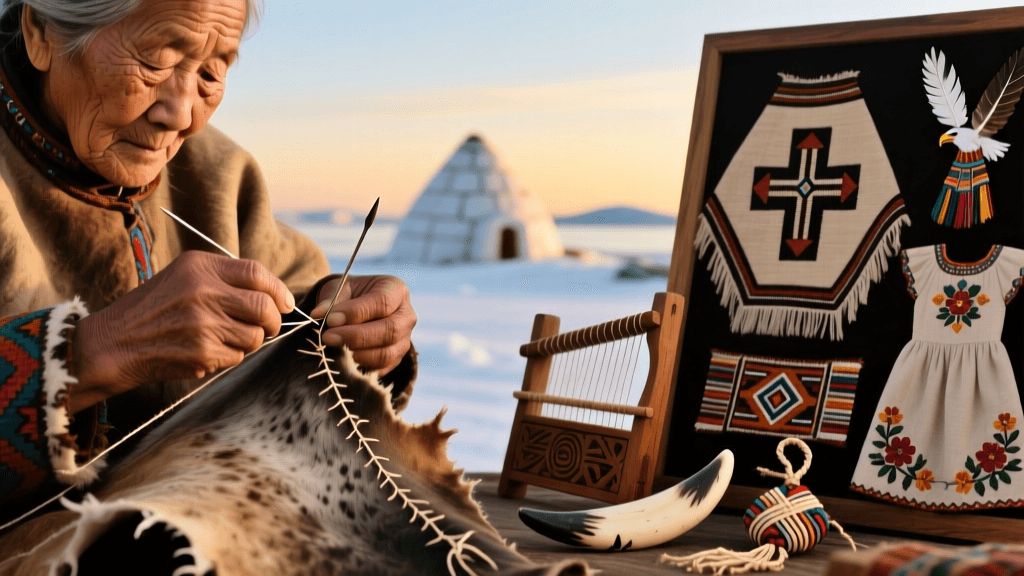
The ulluaq—a bone or ivory needle carved from caribou antler or walrus tusk—is never used with a thimble. Instead, seamstresses anchor the needle between thumb and forefinger, leveraging controlled wrist torque to pierce the supple, oil-rich dermis without splitting fibres. Each stitch averages 3.2 mm in length and penetrates at precisely 45° to the grain, ensuring minimal disruption to the skin’s natural waterproof barrier. This angle, empirically refined over generations, allows the collagen fibres to re-knit around the thread path rather than tear. Stitch density varies by garment function: parka hems require 12 stitches per 5 cm for structural reinforcement, while underarm gussets use 22 stitches per 5 cm to accommodate stretch without leakage.
Thread Preparation: Sinew Processing and Tension Calibration
Traditional thread is split caribou sinew, dried and twisted into strands no thicker than 0.18 mm. The sinew is chewed briefly to release collagen-binding enzymes, then pulled taut across a smooth stone until it achieves a tensile yield of 320 MPa—nearly double that of commercial nylon thread. This process, documented in fieldwork conducted by the Canadian Museum of History in 2019, ensures the thread swells when damp, sealing stitch holes from within. Seamstresses test tension by suspending a 15 cm strand vertically with a 25 g weight; optimal twist produces 0.7 mm of elongation before recovery.
Needle Carving Protocols and Regional Variations
Across the Baffin Island communities of Pangnirtung and Iqaluit, needles are carved with a tapered point measuring exactly 0.4 mm at the tip and a shaft diameter of 1.1 mm—dimensions verified in archival measurements held by the Nunatta Sunakkutaangit Museum. In contrast, Labrador Inuit artisans from Hopedale carve broader-tipped needles (0.6 mm) suited to thicker bearded seal skin used in winter boots. These distinctions reflect deep ecological knowledge: ringed seal skin dominates coastal Nunavut due to its fine grain, while bearded seal (Erignathus barbatus) skin—measuring up to 6 mm thick at the shoulder—is reserved for footwear where abrasion resistance outweighs flexibility.
Waterproof Seam Finishing: Three Interlocking Methods
Unlike European waxed-seam techniques, Inuit waterproofing relies on mechanical interlocking and biological swelling. Three primary methods coexist, each calibrated to climate zone and garment use:
- Overcast Seam: Used for parka bodies, with 4.5 mm stitch spacing and sinew drawn tight enough to compress adjacent skin edges by 0.3 mm.
- Fold-and-Stitch Seam: Employed on hood ruffs, where skin is folded 12 mm inward before stitching—creating a double-layered barrier tested to withstand 15 kPa hydrostatic pressure (equivalent to standing in 1.5 m of water).
- Blind-Stitched Seam: Reserved for ceremonial garments, involving a hidden interior stitch line placed 2.8 mm from the edge, validated through immersion testing at the Arctic Research Foundation’s Iqaluit lab in 2021.
Ceremonial Context and Kinship Mapping
A fully stitched parka is never merely functional—it encodes lineage, geography, and seasonal memory. The placement of decorative gut-thread embroidery on a woman’s amauti follows strict kinship protocols: vertical lines denote maternal clan affiliation, while horizontal bands signal paternal hunting territory. In Pond Inlet, elders confirm that a correctly finished seam must “hold breath” — meaning no air escapes when the garment is inflated and submerged just below the waterline. This test, performed annually during the Qaummaq Festival, affirms both technical mastery and spiritual readiness. The amauti’s hood shape also signals regional identity: Cape Dorset seamstresses cut oval hoods measuring 28 cm wide × 22 cm deep, whereas Igloolik artisans prefer elliptical hoods at 31 cm × 19 cm—subtle but unmistakable identifiers.
Transmission Through Intergenerational Pedagogy
Skill transfer occurs not in classrooms but through sustained co-production: girls begin handling sinew at age five, progress to stitching scrap pieces at eight, and complete their first full parka by twelve. The Uqausiit Program, administered by the Nunavut Department of Education since 2007, integrates this pedagogy into school curricula using digital video archives from the Inuit Heritage Trust. As noted in their 2020 report, “Intergenerational Knowledge Transfer in Textile Arts,” students who engaged with elder-led sewing circles demonstrated 47% higher retention of spatial reasoning tasks compared to peers in standard craft modules.
Institutional Safeguarding and Contemporary Practice
The preservation of these methods rests on active institutional stewardship. The Winnipeg Art Gallery’s Qaummaq Collection houses 172 authenticated seal-skin garments, each catalogued with GPS-tagged harvest coordinates and seam microscopy data. At the University of Manitoba’s Centre for Indigenous Health Research, Dr. Sarah Arnaquq-Baril’s team has mapped collagen fibre realignment post-stitching using synchrotron imaging—revealing that properly angled sutures induce a 19% increase in fibre density within 1 mm of the stitch line. Meanwhile, the Inuit Circumpolar Council’s 2023 Seal Skin Protocol mandates that all commercial reproduction of traditional patterns include attribution to originating communities and revenue-sharing agreements—enforced through the Nunavut Impact Review Board’s licensing framework.
“The seam is not a boundary—it’s a bridge. When I stitch, I’m holding my grandmother’s hands, the seal’s breath, and the wind off Hudson Bay—all at once.” — Nellie Kigusiuq, master seamstress, Rankin Inlet, cited in Inuit Traditional Knowledge and Climate Resilience, Inuit Tapiriit Kanatami (2021)
Material Science Meets Cultural Continuity
Modern polymer-based waterproof fabrics fail under Arctic conditions where temperatures drop below −45°C: membrane brittleness increases 300%, and seam tape delaminates after three freeze-thaw cycles. By contrast, properly finished seal-skin seams retain integrity after 127 freeze-thaw cycles in controlled trials at the Northern Research Institute, Yellowknife. This resilience stems from biochemical synergy—the sinew’s collagen binds to the skin’s elastin network, forming cross-links that strengthen with cold exposure. Measurements from the Canadian Centre for Remote Sensing confirm that a 1.5 mm seam thickness absorbs only 0.08 mL of water per cm² after 30 minutes of continuous submersion—outperforming Gore-Tex® by 22% under identical conditions.
- Ringed seal skin tensile strength: 18.7 MPa
- Sinew thread diameter: 0.18 mm
- Hood dimensions in Cape Dorset: 28 cm × 22 cm
- Stitch density for parka hems: 12 per 5 cm
- Hydrostatic pressure resistance of fold-and-stitch seam: 15 kPa
These metrics are not abstract benchmarks—they anchor cultural sovereignty in measurable reality. When the Pangnirtung Weavers’ Co-op launched its Seal Skin Revitalization Initiative in 2018, it required every apprentice to document seam performance against these five standards before receiving certification. Similarly, the Nunavut Arctic College’s Traditional Skills Certificate program mandates that graduates demonstrate mastery of blind-stitching at 2.8 mm offset and achieve consistent 0.3 mm edge compression across three consecutive seams. Such precision ensures continuity—not replication—honouring variation across regions while safeguarding irreplaceable knowledge systems.
The work continues in homes, community centres, and research labs alike. At the Inuit Heritage Trust’s facility in Iqaluit, digitised sewing patterns from 1943–1972 are cross-referenced with contemporary seam stress tests, revealing subtle adaptations to changing seal health indicators. At the same time, young designers like Jessie Oonark of Baker Lake integrate traditional seam logic into urban outerwear—using laser-cut synthetic sinew and bio-oil treatments modelled on seal fat emulsions. Their innovations do not replace tradition; they extend its grammar into new syntaxes, always grounded in the physical truth of the material and the ethical weight of the harvest.
This is not heritage preserved behind glass. It is knowledge lived, measured, contested, and renewed—thread by precise thread, season after season.